 |
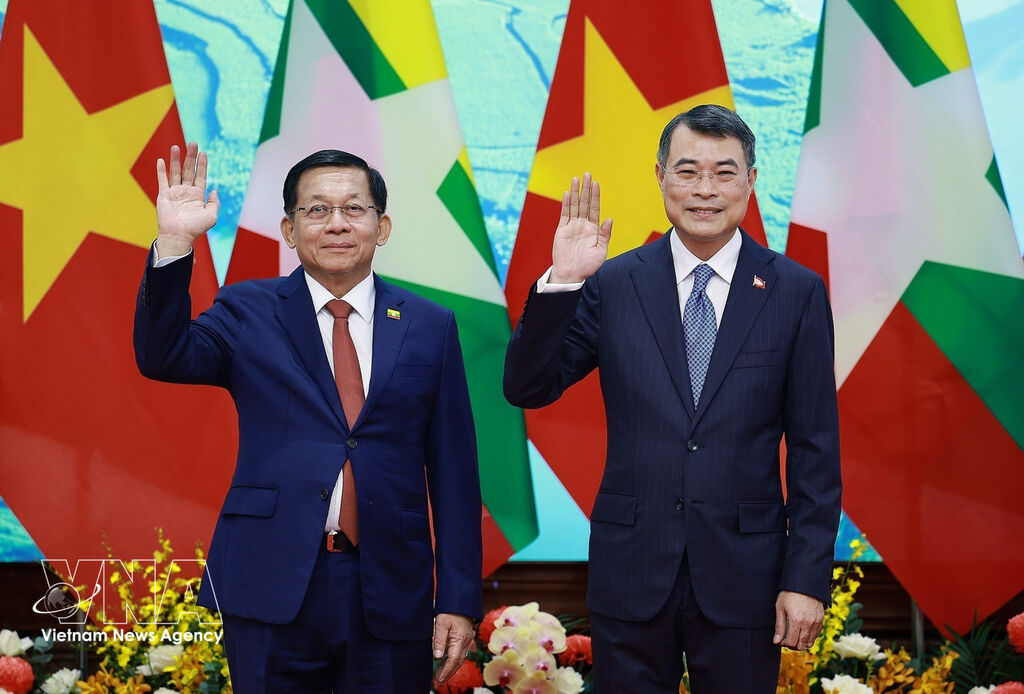
| Vietnamese Prime Minister Le Minh Hung (right) and Myanmar President Min Aung Hlaing. The two countries co-chair the 11th ACMECS Summit in Hanoi on November 28, 2026. (Photo: VNA) |
Hanoi (VNA) – The 11th Ayeyawady–Chao Phraya–Mekong Economic Cooperation Strategy (ACMECS) Summit, held in Hanoi on November 28 by Vietnam and Myanmar – the current ACMECS Chair, are poised to open a new chapter for subregional cooperation, turning potential into shared prosperity for the entire region.
The summit marks a significant milestone in strengthening solidarity, strategic connectivity, and subregional cooperation. As an important multilateral event hosted by Vietnam in 2026, it underscores the country’s sense of responsibility, standing, and core role in shaping regional dynamics.
ACMECS: The unified voice of five Mekong nations
The Ayeyawady–Chao Phraya–Mekong Economic Cooperation Strategy (ACMECS), formerly known as the Economic Cooperation Strategy (ECS), is a five-nation economic framework comprising Cambodia, Laos, Myanmar, Thailand, and Vietnam. It aims to bolster cooperation, narrow development gaps, enhance regional competitiveness, and promote sustainable development.
Initiated by Thailand, ACMECS was officially established in November 2003 at the Bagan Summit in Myanmar with four founding members, namely Cambodia, Laos, Myanmar, and Thailand. During that summit, leaders agreed to rename the mechanism after the three major river systems of the Mekong River basin.
Currently, ACMECS cooperation spans eight areas: trade and investment, agriculture, industry and energy, transport, tourism, human resources development, public health, and the environment.
ACMECS convenes annual ministerial meetings and biennial summits rotated alphabetically among member states. To date, ten summits have been held. Most recently, at the 10th ACMECS Summit chaired by Laos in 2024, leaders adopted the Vientiane Declaration and advanced joint efforts on water resources management in the Mekong River basin.
Over more than two decades, ACMECS members have made notable strides in expanding external partnerships and mobilising international development resources, particularly in renewable energy, water management, air pollution control, the digital economy, digital trade, and cybersecurity.
Key initiatives include Japan’s support for post-COVID-19 small and medium-sized enterprise (SME) recovery, and the Republic of Korea’s assistance in regulatory harmonisation to facilitate cross-border trade. Under this model, Mekong nations identify pressing needs while development partners contribute targeted expertise and resources.
Member states are currently finalising procedures to establish the ACMECS Development Fund to ensure financial self-reliance alongside external funding for priority projects, with all five nations pledging contributions. Simultaneously, the bloc continues to attract backing from major partners including the US, China, India, Japan, and the Republic of Korea.
Vietnam: A proactive, engaged, and responsible member of ACMECS
Vietnam officially joined ACMECS at its first ministerial meeting in Thailand in November 2004. Over the past 20 years, it has consistently regarded ACMECS as a strategic cooperation mechanism tied to its top regional partners.
As an active and responsible member, Vietnam has made substantial contributions to the bloc. Serving as the eastern gateway of the Mekong subregion, the country is an indispensable link in regional economic corridors.
It has proactively proposed and implemented new ideas, helped draft important documents, spearheaded initiatives, and provided development assistance for fellow members, particularly in human resources training and infrastructure development. It has also coordinated several specialised sectors, rolling out many practical programmes that foster comprehensive cooperation among the five countries.
Previously, Vietnam successfully hosted the 3rd ACMECS Summit in November 2008 and the 7th ACMECS Summit in October 2016, both in Hanoi.
11th ACMECS Summit: Towards a smart and sustainable future
Building on the success of its previous hostings, Vietnam is co-organising the 11th ACMECS Summit in Hanoi on November 28, alongside Chair Myanmar.
Themed "Strengthening Socio-Economic Development Towards Smart and Sustainable ACMECS", the summit focuses on reviewing past cooperation and charting future directions.
Deputy Minister of Foreign Affairs Nguyen Minh Hang said that aligned with the summit's core theme, member states have reached a strong consensus on three major strategic priorities.
The first is enhancing strategic connectivity and expanding development space. Serving as the top priority, this pillar aims to boost transport infrastructure, trade, investment, logistics, digital transformation, tourism, education, and people-to-people exchanges. Synchronised connectivity will not only maximise each nation's economic potential but also unlock new strategic development space, lower transaction costs, and facilitate cross-border production and business operations.
The second is addressing common challenges and water security. Leaders will hold in-depth discussions on coordination mechanisms for climate change adaptation, environmental protection and, above all, the sustainable and equitable management and utilisation of Mekong River water resources. This is recognised as vital to safeguarding long-term livelihoods, food security, and energy security for tens of millions of residents in the river basin.
The third is deepening alignment with ASEAN. Frameworks such as ACMECS and CLMV (Cambodia, Laos, Myanmar, Vietnam) will strengthen links with broader ASEAN development programmes while engaging major partners and international financial institutions. This alignment is designed to pool resources and initiatives, actively contributing to the ASEAN Community Vision 2045 and ensuring that no nation or subregion is left behind, according to Hang.
Minister of Foreign Affairs Le Hoai Trung, head of the organising committee for the 12th CLMV Summit and the 11th ACMECS Summit, emphasised that hosting these two summits underscores Vietnam’s proactiveness and responsible contributions to Mekong subregional cooperation.
He noted that the events help expand development horizons, strengthen trade and investment ties, enhance friendship among the neighbouring countries, and actively support the realisation of the ASEAN Community Vision 2045.
At the 11th ACMECS Summit, Prime Minister Le Minh Hung is scheduled to join fellow leaders in discussing shared priorities for the five Mekong nations. As host, Vietnam seeks to foster coordination among member states, advance the ASEAN Community-building process, and expand ties with development partners so that the tangible dividends of cooperation directly benefit citizens and businesses across the region./.