 |
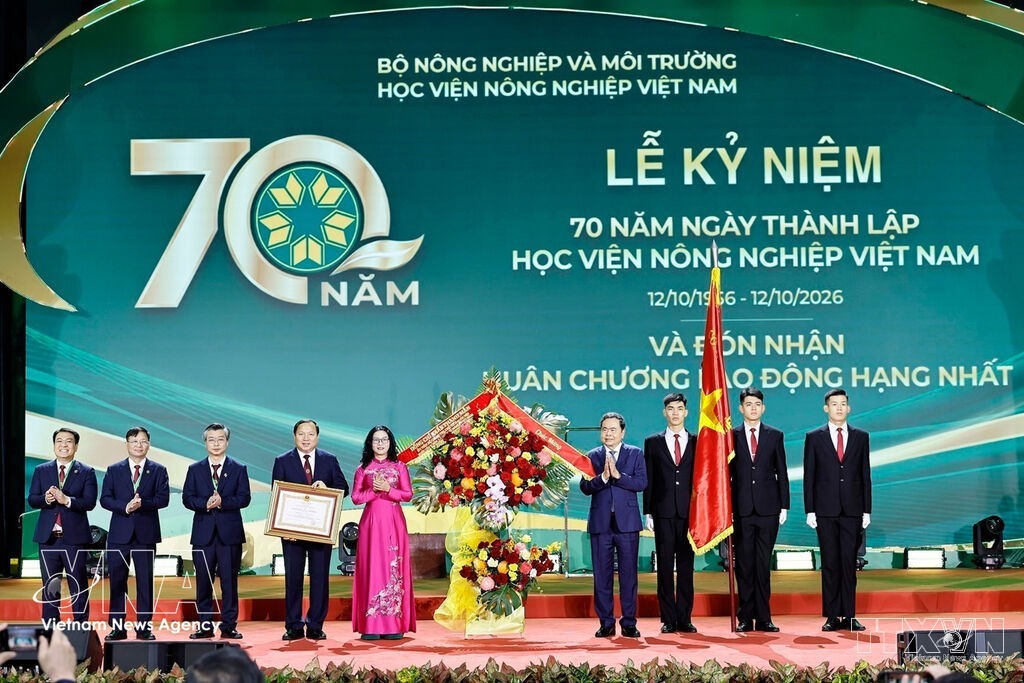
| NA President Tran Thanh Man (fourth from right) presents the first-class Labour Order to the Vietnam National University of Agriculture at the ceremony in Hanoi on October 10, 2026. (Photo: VNA) |
Hanoi (VNA) – President of the National Assembly (NA) Tran Thanh Man has requested the Vietnam National University of Agriculture (VNUA) to better integrate training and scientific research with agricultural production, turning research outcomes and technological advances into tangible benefits for farmers and the national economy.
He made the request at a ceremony marking the university’s 70th founding anniversary (October 12, 1956–2026) in Hanoi on October 10.
On behalf of the Party and State leadership, the top legislator presented the first-class Labour Order to the school in recognition of its outstanding achievements in training, scientific research and community service, contributing to the country’s socio-economic development.
In his remarks, the NA leader stressed that Vietnam is entering a new development era with the aspiration of becoming a prosperous and civilised country where people enjoy a better life. Meanwhile, the resolutions on science – technology development, innovation, national digital transformation, and educational breakthroughs, issued by the Party Central Committee, Politburo, NA and Government, offer a vast space for higher education institutions to grow.
He urged the VNUA to translate these major policies into concrete action plans, scientific products, and tangible contributions to the nation.
NA President Man asked the university to strongly overhaul its training programmes to cultivate "global citizens" for modern agriculture, decisively shifting from teaching what it has to meeting the actual demand of society, enterprises, and national development.
The VNUA should become a hub where young people with aspirations in agriculture, technology, and entrepreneurship come to learn, conduct research, and grow, he noted.
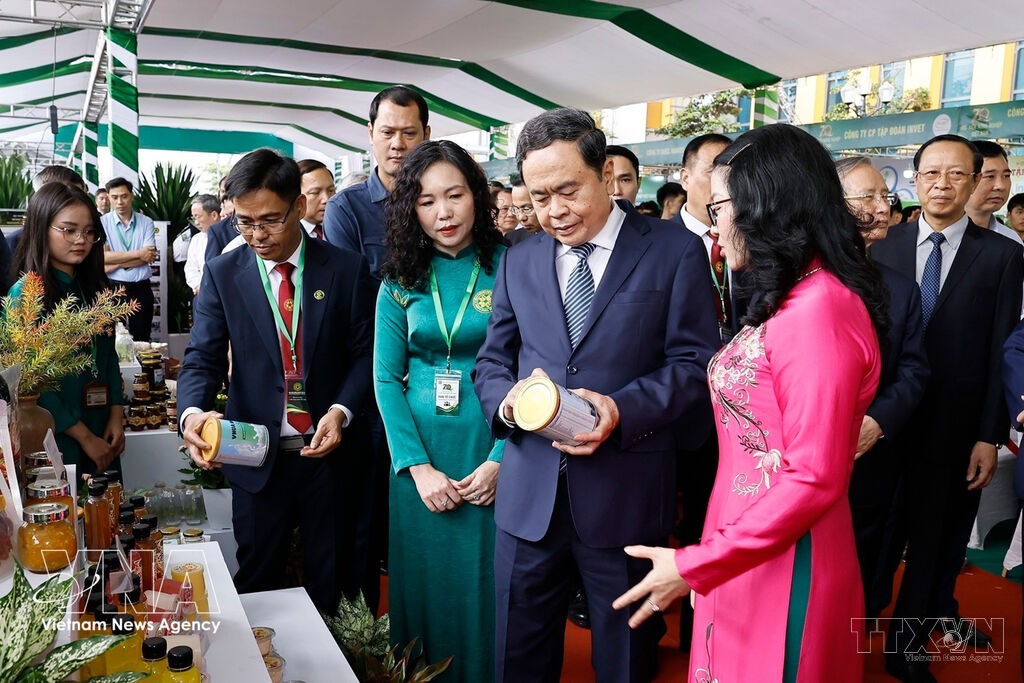 |
| NA President Tran Thanh Man and officials visit an exhibition of products made by the Vietnam National University of Agriculture at the ceremony on October 10, 2026. (Photo: VNA) |
Highlighting science, technology, innovation, digital transformation, and artificial intelligence as a core development driver, he urged the university to pioneer high-demand sectors and deliver real economic value, stressing that agricultural scientific outputs must help reduce costs, maximise benefits, boost farmers' incomes, and enhance global competitiveness.
He required the VNUA to serve as a bridge linking the State, universities, scientists, businesses, and farmers, expanding its presence beyond lecture halls and laboratories.
"Knowledge must be transferred from lecture halls to fields, technology from laboratories to production, research results to businesses, and scientific value to farmers. Concurrently, agricultural challenges in reality must return to classrooms and labs for research and solutions," he emphasised.
The parliamentary leader asked the university to actively advise and give feedback on agricultural, rural areas, and farmers-related policies; engage deeply in international research and training networks; attract global scientists and experts; and promote Vietnamese agricultural scientific products and brands worldwide.
Emphasising the need for digital transformation and modern governance, NA President Man called for a smart learning environment, streamlined apparatus, transparent governance, and strong support for young scientists, aiming to bring the VNUA into Asia's top 100 universities by 2045.
He expressed his confidence in the institution's tradition and new vision, urging it to continue upholding unity, innovation, creativity, integration, and development.
At the ceremony, Prof. Dr Nguyen Thi Lan, Director of the VNUA, highlighted the 70-year history since its precursor, the University of Agriculture and Forestry, was established on October 12, 1956. Through its development and international integration, the school has remained committed to developing agriculture and rural areas through education, scientific research and service to the country.
Moving forward, the VNUA pledges to continue comprehensive innovation in education, research, technology transfer, and governance to build an regionally reputable, smart, green, innovative, and humane research university, Lan stressed./.