 |
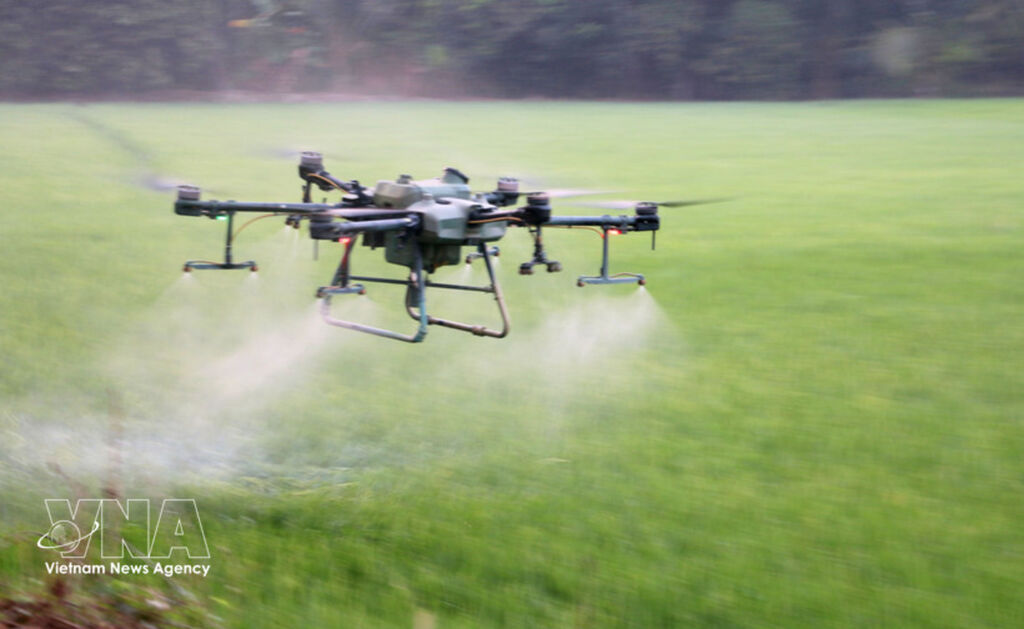
| Farmers in An Giang use drones for pesticide spraying, helping save costs, labour and time. (Photo: VNA) |
Hanoi (VNA) – The emerging low-altitude economy is unlocking a market worth hundreds of billions of US dollars as drones and air taxis move toward real-world deployment, yet Vietnamese firms remain largely confined to service roles, lacking control of core technologies and facing an uncertain position in the race to capture the “low-altitude skies.”
A race gaining altitude
The low-altitude economy covers economic activities conducted in lower airspace, ranging from drone delivery and infrastructure inspection to precision agriculture and electric vertical take-off and landing (eVTOL) air mobility.
Morgan Stanley estimates the sector could reach 9 trillion USD globally by 2050, signalling that low-altitude airspace is evolving into a new economic frontier rather than remaining an experimental field. Leading markets are moving beyond aircraft production to develop integrated ecosystems that combine manufacturing, software, data platforms and services.
In Vietnam, however, the industry is still in its infancy. Current activities are concentrated mainly in three areas: agricultural drones, commercial aerial imaging and infrastructure monitoring.
Agricultural applications have grown the fastest. Drones are increasingly used for crop spraying, seeding, fertilisation and monitoring plant health, helping farmers improve productivity while addressing labour shortages.
Companies such as AgriDrone Vietnam, SunDrone, Dronel and CT Drone have built business models around unmanned aerial systems. Most rely on imported drones, largely sourced from China, while focusing on operational services. Their customer base ranges from individual farmers to major agricultural firms including Hoang Anh Gia Lai, Bayer, ADC and Loc Troi.
A common model has emerged in which companies sell equipment, train operators and provide outsourced spraying services while building local drone fleets. While this approach generates quick revenue, it also reflects a structural constraint: the highest-value segments remain tied to technology ownership, which domestic firms have yet to achieve.
In commercial filming and photography, drones have quickly become standard tools across industries from real estate to tourism promotion. However, low barriers to entry have intensified competition, driving down service prices and squeezing profit margins.
Infrastructure inspection, though less visible, may offer more sustainable growth. Drones are increasingly deployed to monitor power transmission lines, track construction progress and conduct terrain surveys, supporting safer and more efficient operations.
Overall, Vietnamese companies remain active mainly at the application layer, importing equipment, providing services and training personnel, while higher-value areas such as design, manufacturing, software systems, batteries and sensors continue to be dominated by foreign players.
Ambitions for a drone hub
Momentum increased in October 2025 with the launch of the Vietnam Low-Altitude Economy Alliance (LAEP), co-founded by FPT CEO Nguyen Van Khoa and VinaCapital CEO Don Lam. The alliance brings together technology firms, investors, start-ups and industry experts with the goal of positioning Vietnam as a global drone hub.
FPT Chairman Truong Gia Binh described the moment as a rare opportunity for Vietnam to move beyond applications and participate in research and development, component manufacturing, unmanned traffic management systems and supporting infrastructure. The alliance aims to foster thousands of supporting enterprises, create around one million high-quality jobs and generate tens of billions of US dollars in economic value over the next 10–15 years.
Tran Anh Tuan, CEO of the Vietnam UAV Network, said Vietnam’s strengths in precision engineering, software, hardware and artificial intelligence could help the country integrate more deeply into global drone supply chains. He added that several US companies are exploring Vietnam as part of ongoing supply-chain diversification.
Challenges ahead
Significant obstacles remain. Technological capability is the most immediate barrier, as drone manufacturing requires deep integration of hardware, software, AI and battery technologies, demanding substantial investment and advanced research capacity.
The domestic market is also relatively small and fragmented. While demand is growing, it has yet to reach the scale needed to support large industrial players.
Regulatory constraints pose another challenge. Drone operations still require permits tied to specific locations and timeframes, complicating efforts to scale deployment. Airspace management and national security considerations further add to operational complexity.
Even if regulations become more flexible, questions about commercial viability persist. Drone delivery can be faster but more costly, while air taxis promise time savings yet remain financially out of reach for mass adoption. Even in advanced economies, many business models have yet to prove sustainable profitability.
Experts believe opportunities remain open for Vietnam, but through a more practical strategy. Rather than competing directly in core technology development, domestic firms could focus on segments with clear demand.
In precision agriculture, drones help reduce costs and increase yields. In infrastructure monitoring across power, oil and gas, and construction, they enhance safety and operational efficiency. Meanwhile, software and data services offer opportunities to develop flight management platforms, analytics solutions and integrated digital systems./.