 |
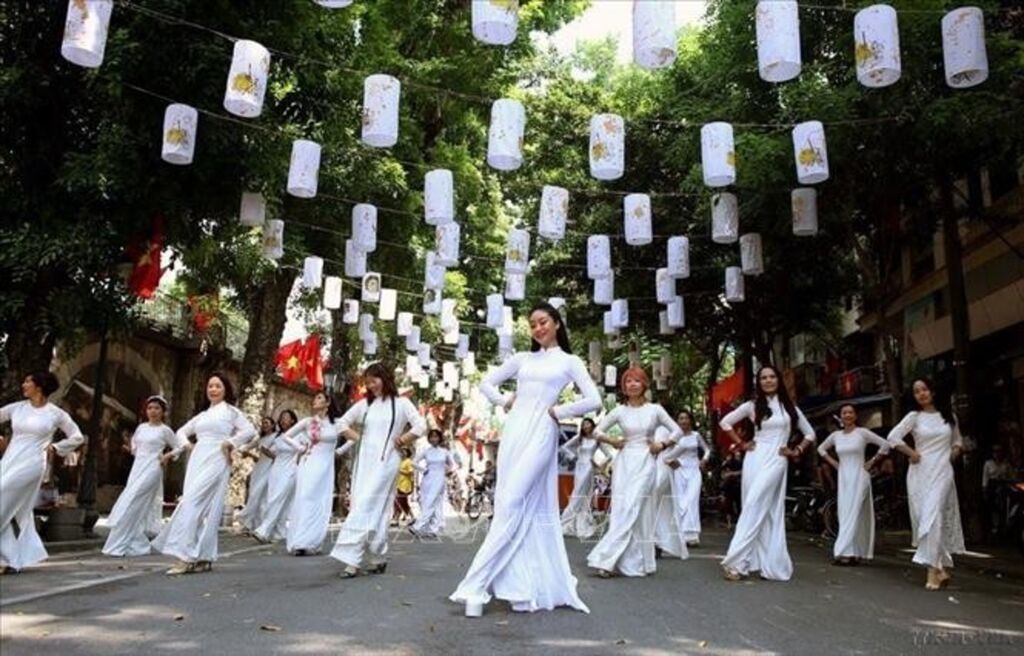
| A performance as part of activities marking 65 years since the liberation of Hanoi and 20 years since Hanoi is honored by UNESCO as a "City for Peace". (Photo: VNA) |
HCM City (VNA) – Sustainable development of culture and people as the foundation of social progress, the building of a Vietnamese value system in the new era, and positioning culture and people as the central axis of development underpinning education, science, the economy and entrepreneurship are emerging as the country’s key priorities.
These orientations not only help refine the theoretical framework for sustainable development based on culture and people, but also respond to practical demands as Vietnam advances in an era of deep integration and aspiration to rise.
Culture, people in era of nation’s rise
After 80 years since its founding and 40 years of “Doi Moi (Renewal), Vietnam is entering a new historical phase, described by Party General Secretary To Lam as the era of the nation’s rise.
Prof. Dr. Tran Ngoc Them, a leading Vietnamese cultural scholar, noted that integration represents the pathway of development, while aspiration embodies its driving force. Culture and people, he stressed, are the soul of development and the source of strength that transforms aspiration into reality.
In the era of integration and aspiration, culture serves as identity, collective memory and the nation’s spiritual foundation, ensuring integration with depth, humanity and national character. This allows Vietnam to integrate without losing itself, absorb global values while preserving its cultural identity, he said at the international scientific conference held in HCM City on December 19–20.
He also emphasised that people, equipped with knowledge, ethics and creativity, are both the subject and the goal of development. Vietnamese people today are not only citizens of a nation but also global citizens with strong cultural grounding, capable of harmonising tradition and modernity, national values and universal values. As such, people become the decisive factor in the success of integration and aspiration.
The draft documents of the 14th National Party Congress reaffirm the goal of building an advanced Vietnamese culture imbued with national identity, based on coherent national, cultural and family value systems and standards of the Vietnamese people. They stress comprehensive human development and the creation of a healthy, civilised cultural environment aligned with shaping the new socialist Vietnamese person.
Assoc. Prof. Dr. Trieu The Hung, Vice Chairman of the National Assembly’s Committee for Cultural and Social Affairs, noted that deep international integration, together with rapid digital transformation and the rise of artificial intelligence, presents both major opportunities and unprecedented challenges. These forces are reshaping value systems, moral standards, lifestyles and cultural identities.
He underscored the need for culture to go ahead of, accompany and guide development, with people placed at the centre of all policies, while ensuring harmony between economic growth, cultural development and social progress.
Strengthening cultural, creative resources
Experts agree that in the era of integration and development, Vietnamese people and culture serve as both the foundation and the driving force of sustainable growth. Successful integration cannot come at the cost of identity, and sustainable aspiration cannot be achieved without placing people at the centre.
Cultural and creative human resources play an important role in the transition towards a sustainable, knowledge-based and innovation-driven development model. They contribute to inclusive green growth, cultural identity, community cohesion, innovation, the achievement of the Sustainable Development Goals, and serve as bridges in international integration.
Research by Dr. Thai Tri Dung and colleagues at Hung Vuong University in HCM City shows that cultural and creative human resources are essential to economic, social and environmental development. However, shortages of high-quality personnel and shortcomings in training remain significant challenges. Although Vietnam has nearly 51 million people of working age and a favourable demographic structure, only about 10% of workers in creative industries receive formal, specialised training, while policies to support this sector remain fragmented.
To address these gaps, experts call for further institutional reforms, innovation in education and training, and stronger public–private partnerships. According to Assoc. Prof. and Dr. Le Chi Lan of Saigon University, education is the decisive factor for sustainable development and a key driver of Vietnam’s long-term growth.
Affirming creative people not merely as workers but as cultural and innovative actors highlights the need for coordinated, high-quality investment in cultural and creative human resources, enabling Vietnam to integrate deeply while preserving and promoting its national identity./.