 |
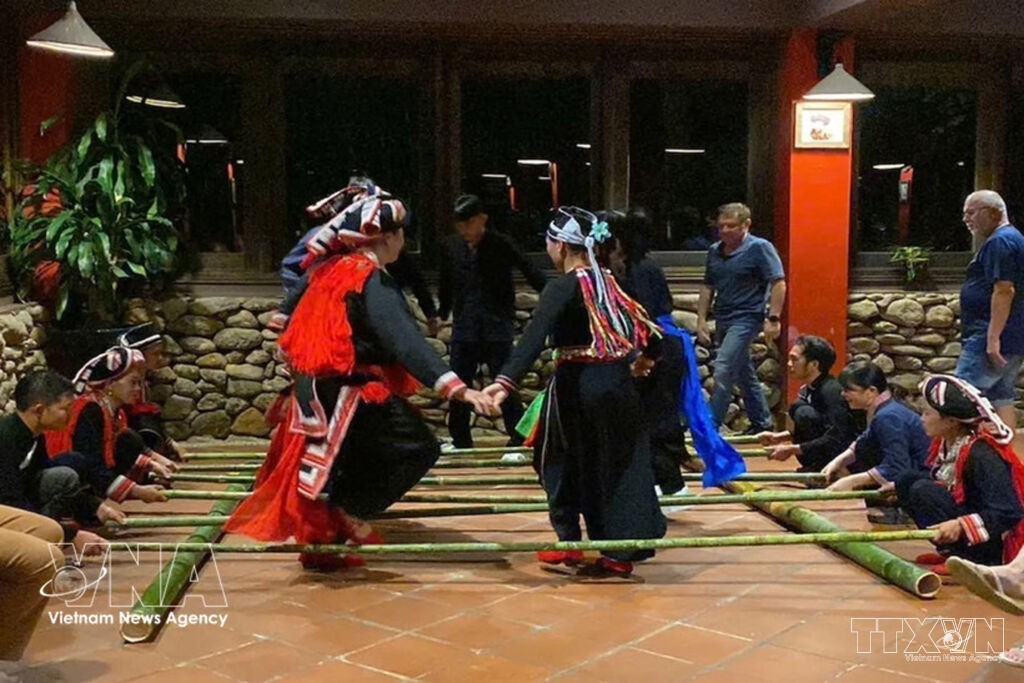
| Red Dao ethnic people perform bamboo dance, helping bring local culture into tourism experience programmes (Photo: VNA) |
Hanoi (VNA) – Regional connectivity is widely regarded as a “key” to enhancing the competitiveness of tourism destinations. However, amid current developments, stronger and more substantive regional links, combined with green transition and digital transformation, are needed to ensure sustainable tourism growth and better meet market and business demand.
Leveraging regional strengthsPham Van Thuy, Deputy Director of the Vietnam National Authority of Tourism (VNAT), said the tourism sector needs to renew its mindset by putting the market at the centre, shifting from promoting what localities have to developing products that tourists actually need.
Tourism products should be developed on a cultural foundation while leveraging the distinctive strengths of each locality. Tours and travel routes, meanwhile, should be designed around tourists’ needs.
The sector also needs to improve destination management, strengthen coordination between management agencies and businesses, enhance promotion and step up human resource training. It should roll out a unified national digital platform for “Tourism management and business”, connecting data and identifying businesses to build a national tourism database and promote science, technology and artificial intelligence in tourism management and development.
The VNAT has set ambitious tourism targets for 2026, including welcoming 25 million international visitors and serving 150 million domestic tourists and generating about 1.12 quadrillion VND (43.1 billion USD) in revenue.
Thuy said achieving these targets requires not only state management agencies but also the participation of the Vietnam Tourism Association (VITA), local tourism associations and the business community.
He urged the VITA to further promote its role in connecting regions and localities, enabling tourism associations to leverage natural resources and cultural identities to develop distinctive inter-regional products and enhance visitor experiences.
Tourism associations should also expand membership, contribute to policymaking and proactively develop products based on the strengths and identities of individual localities, he said.
Regional links tied to digital transformation, green transitionAccording to VITA Vice Chairman Nguyen Hong Hai, digital transformation and green tourism development are two inseparable pillars of Vietnam’s tourism development. Businesses need to step up the application of digital technologies, artificial intelligence and e-commerce while implementing the Vietnam Green Tourism Criteria, reducing plastic waste and developing sustainable products.
For tourism associations in northern provinces, promotion, marketing and development connectivity have been among the highlights during the first six months of 2026. Many localities have expanded markets, strengthened business links and developed products associated with regional characteristics.
VITA Vice Chairman Nguyen Manh Than, who is also Chairman of the Hanoi Tourism Association, said tourism development should be closely linked with production and livelihoods in rural areas.
He outlined three key goals: strengthening the engagement of Party committees and authorities with residents in developing green agriculture; promoting science, technology and innovation; and effectively tapping the potential of agricultural tourism. These efforts would create greater value for local products and community livelihoods, he said.
However, regional tourism connectivity still faces challenges, including limited financial capacity among some businesses, shortages of high-quality human resources, uneven digital transformation and limited operational resources among some associations. The effectiveness of cooperation programmes between localities also varies, while distinctive and competitive inter-regional products remain limited.
Hai noted that many small and medium-sized enterprises face difficulties in securing finance, qualified personnel and investment for digital transformation. Therefore, tourism associations need to strengthen joint promotion, connect businesses and focus on developing inter-regional products based on the natural resources, cultural heritage and distinctive features of each locality, while expanding into new visitor markets.
The VITA is expected to continue encouraging businesses to participate in VITA GREEN, review two years of implementing the Vietnam Green Tourism Criteria, survey green tourism models in Lam Dong province and support localities in developing distinctive tourism products./.