 |
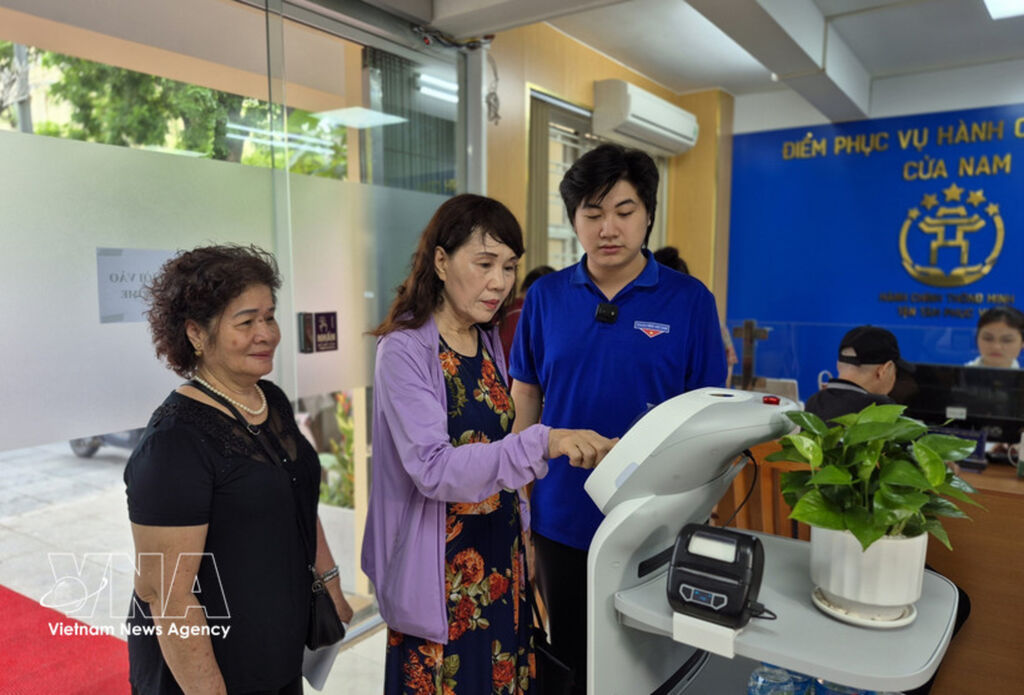
| Citizens experience an AI-powered robot designed to assist with administrative procedures. (Photo: VNA) |
Hanoi (VNA) – Digital transformation is becoming increasingly visible in everyday administrative transactions and interactions between citizens, businesses, and authorities, as Resolution No. 57-NQ/TW on breakthroughs in science and technology development, innovation, and national digital transformation is brought into practice.
From smart urban governance solutions to grassroots-level online public services, digital technologies are steadily narrowing the gap between authorities and enterprises.
From a renewed approach to governance
Party General Secretary To Lam has repeatedly emphasised the need to make science, technology, innovation, and digital transformation key drivers of a new growth model. He stressed that implementation must shift from merely “carrying out tasks” to delivering measurable, substantive outcomes, and from fragmented efforts to a more focused allocation of resources targeting strategic challenges.
The Party leader also called for the more decisive, systematic, and effective implementation of Resolution 57, with each task tied to concrete results. The year 2026 has been designated as a period of “breakthrough action and widespread impact,” requiring all levels and sectors to clearly define their responsibilities. These orientations are laying a critical foundation for digital transformation to move beyond policy and into real-life application.
A notable feature of Vietnam’s digital transformation process is the increasingly active role of technology enterprises in providing solutions for the public sector. The recognition of CTECh Technology JSC, a member of SGroup Vietnam, at the Sao Khue Awards 2025 highlights this trend. Its CGIS Urban platform, selected from more than 500 entries, was highly regarded in the category of digital government solutions.
The platform integrates spatial data and smart management tools, supporting planning, monitoring, and decision-making in modern urban governance. More than a technical solution, it reflects a shift in governance thinking, where data serves as a core foundation for timely, accurate, and transparent decisions.
However, according to Dr. Han Minh Cuong, Chairman of SGroup Vietnam, technology alone is not sufficient. He noted that governance mindset remains the decisive factor, emphasising the importance of placing users at the centre so that technology can simplify procedures, shorten processing time, and effectively support both officials and citizens.
This perspective aligns closely with the spirit of Resolution 57, which identifies digital transformation, science and technology, and innovation as key drivers for restructuring the growth model. In this context, technology is not only a management tool but also a means to improve service quality and generate tangible value for society.
Toward tangible progress in digital policy implementation
As Vietnam advances the implementation of a two-tier local administration model, workloads at commune and ward levels have increased significantly. In response, digital technology has become an essential support tool, helping to ease administrative burdens and improve efficiency.
Integration with the national population database and interconnected digital systems has significantly reduced processing times. Tasks that once required time-consuming manual verification can now be completed quickly in a digital environment.
At one-stop administrative service units, procedures have undergone notable transformation. Digitised records, continuously updated within the system, help minimise errors and enhance transparency. Citizens can track the progress of their applications online, reducing the need for repeated visits and long waiting times.
Businesses have also benefited from digitalisation. The adoption of electronic certification, for instance, has streamlined document storage and facilitated transactions, particularly in dealings with international partners.
At the grassroots level, public administrative service centres are demonstrating increasing effectiveness. Structured workflows, specialised staff allocation, and the application of digital tools have enabled faster processing of large volumes of applications while reducing backlogs.
Foreign residents in Vietnam have also noted these improvements. The widespread use of digital identification platforms and e-tickets in services such as air travel reflects broader progress in digital governance and public service delivery.
With clear policy direction under Resolution 57 and strong commitment across the political system, digital transformation is opening up new development space for a modern administrative system. By enhancing transparency, efficiency, and accessibility, digital technologies are helping bridge the gap between government, citizens, and businesses, contributing to a more responsive and service-oriented public administration./.