 |
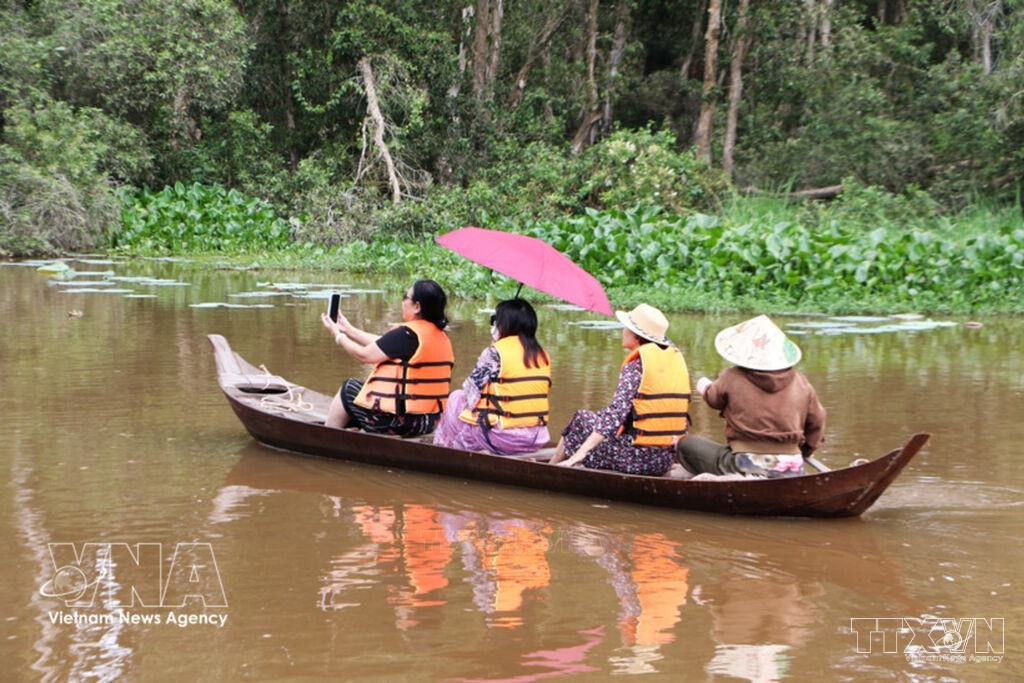
| Visitors travel by boat to admire the cajuput forest landscape during the flood season at the Tram Chim tourism site in Dong Thap province. (Photo: VNA) |
Dong Thap (VNA) – The annual flood season is opening up vast waterways and flooded fields across Dong Thap province, offering visitors unique experiences ranging from exploring river landscapes and sampling local produce to joining everyday activities of Mekong Delta residents.
At the Tram Chim tourism site, part of Tram Chim National Park in Tram Chim commune, visitors can try fishing with nets and hooks, setting traps and dismantling brush piles to catch field rats from August to November, the peak flood season.
Along the Muoi Nhe Canal in Sub-zone A1, dozens of brush piles made from dry branches are arranged on higher ground to attract rats. Nets are placed around the piles before they are dismantled, allowing visitors to catch the animals by hand.
Tran Van Tien, head of the brush-pile arranging group at the tourism site, said the rats caught by visitors are taken to the site's restaurant and prepared into exotic dishes, which are served free of charge upon request.
He said visitors have responded positively to the activities, which allow them to travel by boat through flooded forests, catch fish and rats, and experience local livelihoods. They also provide additional income for residents in the national park's buffer zone, who guide visitors while helping promote environmental sanitation, wildlife protection and biodiversity conservation.
Visitor Phan Thi Xuyen from Cao Lanh ward said travelling by boat through canals, forests and flooded fields brought her closer to nature, while the hands-on activities helped her better understand local livelihoods during the flood season.
In Hong Ngu ward, meanwhile, vast flooded fields provide a setting to experience the riverine culture of the border area. Following the success of the “Hong Ngu – Colours of the Border Waters” experience, the locality is maintaining a floating border market in the Binh Hoa residential area every Saturday and Sunday.
Visitors can enjoy local delicacies made from seasonal produce, travel by motorboat and take part in “field bathing”, a distinctive activity associated with the Mekong Delta flood season.
Nguyen Thi Diem Kieu, a student at Dong Thap University, said her first visit left a vivid impression of the lively atmosphere and friendliness of local residents. She plans to return with friends to experience more activities and enjoy the tranquil scenery.
Enhancing tourism quality through interaction
Pham Duc Hoa, Director of the Tram Chim tourism site, said the site previously focused mainly on boat tours of its forest ecosystem but is now developing seasonal products to provide new experiences and create stable livelihoods for residents in the national park's buffer zone.
During the flood season, activities include fishing, setting traps, catching rats and gathering wild vegetables, with local residents serving as guides and providing services and products for visitors.
Nguyen Thi Kim Yen, Vice Chairwoman of the Hong Ngu ward People's Committee, said such activities allow residents and tourists not only to admire the flood-season scenery but also to taste local food and experience distinctive cultural values.
Dong Thap welcomed about 5.5 million visitors in the first eight months of this year, including 432,000 foreigners, with tourism revenue estimated at 2.9 trillion VND (111.5 million USD). The province is expanding agricultural, community-based and craft-village tourism products, with greater emphasis on interaction and hands-on experiences.
Vo Van Chien, Deputy Director of the provincial Department of Culture, Sports and Tourism, said the sector will accelerate the digitalisation of heritage sites, aiming to complete digitalisation of all national and special national relics and the first phase of the Dong Thap Cultural Digital Map.
It will also shift from an approach focused mainly on sightseeing and learn toward greater interaction, enabling visitors to hear local stories, experience traditional crafts, enjoy local cuisine, participate in cultural activities and learn about community life, he added./.