 |
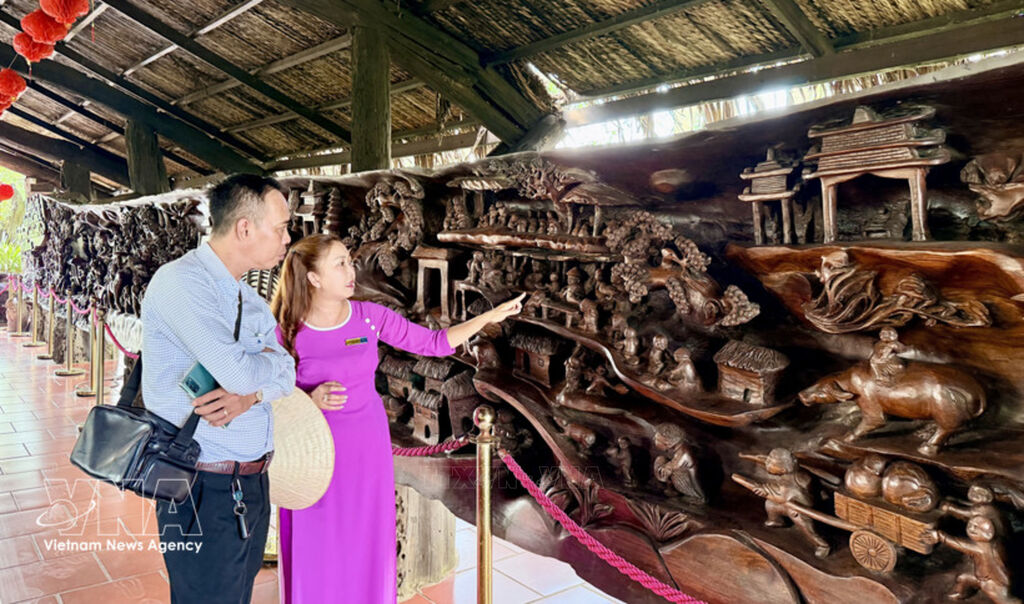
| Visitors admire a large driftwood sculpture measuring nearly 25 metres in length and weighing around 20 tonnes, regarded as one of the most intricate works of its kind in Vietnam. (Photo: VNA) |
An Giang (VNA) – In the heart of the Tien River, a distributary of the Mekong, Nguyen Van Nghi of An Giang province has spent more than two decades building what many now describe as an open-air “museum” of driftwood, a vast collection shaped by nature and reclaimed by human patience.
What were once tree trunks lying silently beneath the muddy waters have, through his hands, become singular sculptural works, forming an unusual visitor attraction amid the waterways of southern Vietnam.
Gathering “memories” of the river
More than 20 years ago, Nghi and residents of the Mekong Delta province’s Cu Lao Gieng commune would dive into the Tien River to retrieve fallen trees lodged in the riverbed, clearing the current to ensure safe passage for boats. Beneath the silt-heavy water, he began noticing large trunks worn smooth by time, their hardened cores exposed in twisting, intricate grain patterns.
“Each piece of wood seemed to carry its own form,” he recalled. “Some curved like a dragon, others resembled wings or the silhouette of a standing figure.”
Initially, he kept only a few pieces, reluctant to see their natural beauty reduced to firewood. Yet the more he salvaged, the more captivated he became. Over time, the number of driftwood pieces grew into the hundreds, along with his determination to preserve them.
Driftwood, he explained, is the dense heartwood of large trees that have been swept downstream and submerged for decades. As the outer layers decay, what remains is a uniquely durable core shaped by water and time – no two pieces alike. For Nghi, they are not lifeless remnants, but traces of time itself, fragments of the river’s memory.
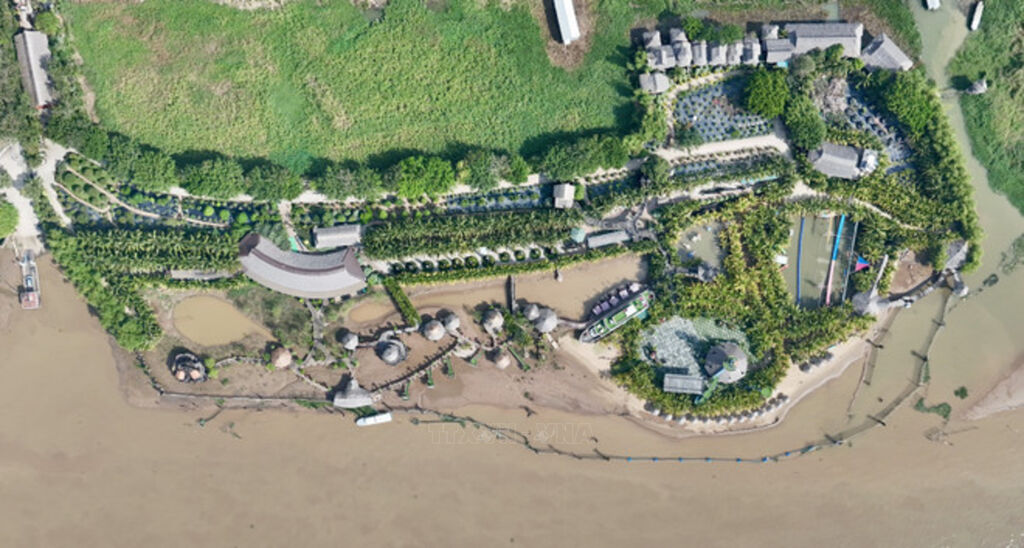 |
| The driftwood exhibition area on Con En (Cu Lao Gieng commune, An Giang province) stands out amid the tranquil Tien River. (Photo: VNA) |
As his collection expanded, he began to envision a shared space where the pieces could be arranged thoughtfully rather than left scattered or exposed to the elements.
Around three years ago, he set aside nearly six hectares of land on the local Con En Islet and sought approval to develop a visitor site centred on driftwood as its defining material. There were no detailed blueprints or elaborate architectural plans. Instead, each structure evolved from the wood's natural form. He would observe, reflect and position each trunk as though it had chosen its own place.
From the entrance onwards, driftwood is everywhere. Some trunks serve as pillars, others arch into bridges. Several large pieces are stacked and interlocked to create an observation tower rising approximately 26 metres above ground. From its summit, visitors can take in sweeping views of the Tien River and the orchards that blanket Cu Lao Gieng. Smaller pieces retain their organic shapes, repurposed as planters, pedestals or decorative accents.
Seven years carving the countryside spirit
Among the site’s most striking works is a monumental driftwood relief nearly 25 metres long and weighing around 20 tonnes. The piece depicts scenes of Vietnamese rural life stretching from north to south. To complete it, Nghi invited five artisans from the central city of Hue, who spent seven years meticulously carving the composition.
Minh Anh, a visitor from Ho Chi Minh City, expressed surprise at the scale and intricacy of the artwork. “I never imagined driftwood could form such a vast and detailed picture. Up close, you can truly appreciate the patience and craftsmanship that have breathed the soul of the Vietnamese countryside into such rugged material," she said.
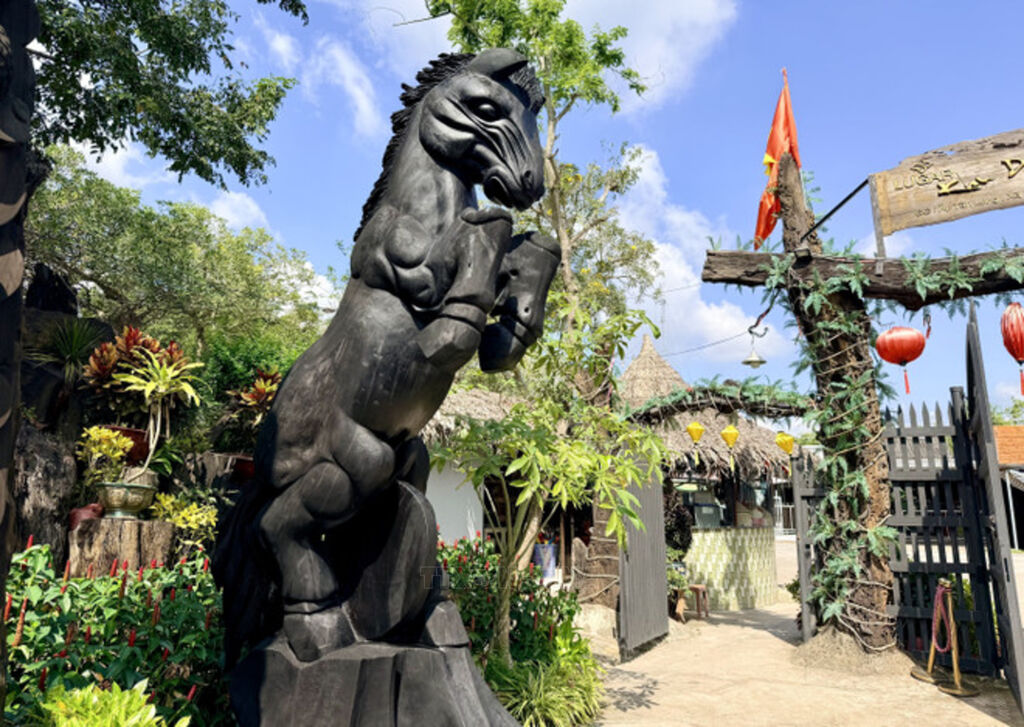 |
| A horse sculpture intricately carved from driftwood (Photo: VNA) |
After more than two decades of steadfast dedication, Nghi has effectively “awakened” the forgotten trunks once resting at the bottom of the river. Beyond an impressive collection, the site is gradually emerging as a distinctive highlight on An Giang’s tourism map, drawing tens of thousands of visitors each year eager to explore this unlikely museum./.