 |
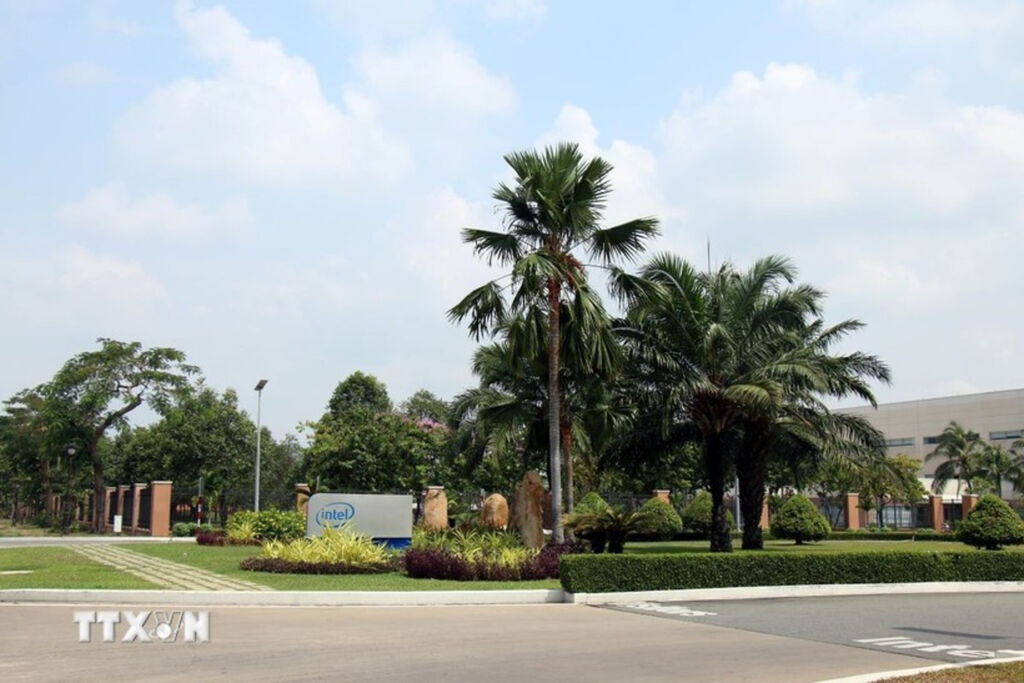
| The factory area of Intel, a major investor in the Ho Chi Minh City High-Tech Park (Photo: VNA) |
Ho Chi Minh City (VNA) – Ho Chi Minh City is shifting its investment strategy from prioritising volume to attracting high-quality, high-impact technology projects, with a focus on semiconductors, artificial intelligence (AI), data centres and research and development (R&D).
The strategy was outlined by representatives of the Saigon Hi-Tech Park (SHTP) Management Board at a press briefing on the city’s socio-economic performance held on June 18.
Le Thanh Nhan, head of the Investment Promotion Division at the SHTP Management Board, said foreign direct investment (FDI) remains a key driver of the city’s high-tech development. SHTP currently hosts 166 valid projects with total registered capital of 13.728 billion USD, of which FDI accounts for more than 11 billion USD, representing over 80% of total investment.
According to Nhan, FDI flows are increasingly moving away from assembly and processing activities towards strategic technology sectors. Notable projects include semiconductor R&D, testing and packaging operations by companies such as BESI, Genbyte and Dynamic Test Solutions. The AI and data centre sectors have also attracted major investments, including a 508-million-USD data centre cluster and the 480-million-USD Starmason project.
The spillover effect of FDI has helped domestic firms deepen their participation in the high-tech ecosystem. The share of investment from domestic enterprises at SHTP has risen from 10–12% to around 17–18%. Vietnamese companies such as Gremsy, Humasis-IVD Vietnam, Mismart and Orioled are gradually mastering advanced technologies and integrating into global supply chains, supporting the city’s strategy of using FDI as a foundation while strengthening indigenous innovation.
To prepare for a new generation of FDI attraction in line with Resolution No. 10-NQ/TW on the development of the foreign-invested sector, the city is expanding its high-tech development space. A newly approved 194.84ha expansion area in Long Phuoc ward is being planned under a “Green–Clean–Digital” model, with the goal of achieving carbon neutrality before 2050.
At the same time, the SHTP Management Board is working with Vietnam National University-Ho Chi Minh City to transform a 52.92ha site into a Strategic Technology Centre. The project is expected to include high-tech manufacturing zones, AI and data centre service clusters, and facilities for training, research and technology incubation.
The city will apply a new investor screening framework that prioritises quality and economic spillover effects over the number of projects. Data centre projects will be required to meet a minimum investment density of more than 100 million USD per hectare, high-tech manufacturing projects over 20.4 million USD per hectare, and R&D projects more than 11.5 million USD per hectare.
In addition to capital requirements, major investors will be expected to commit to R&D activities, workforce training, production localisation and technology transfer to Vietnamese enterprises.
However, the SHTP Management Board acknowledged ongoing challenges, including overlapping regulations, administrative bottlenecks, shortages of highly skilled workers, limited availability of clean land and increasing demand for specialised infrastructure to support AI, semiconductor and data centre industries.
Amid intensifying global competition for investment, Ho Chi Minh City aims to compete through institutional quality, innovation ecosystems and regional connectivity rather than low costs or preferential incentives. The city is also accelerating high-tech workforce development, attracting international experts, expanding social infrastructure for professionals and continuing administrative reforms.
The SHTP Management Board said the city will strictly reclaim land from delayed or inefficient projects to create space for substantive high-tech investments. Its ultimate goal is to foster a new generation of Vietnamese-branded technology enterprises capable of participating in and leading global supply chains./.