NA passes first-ever Law on Artificial Intelligence
To strike a balance between regulation and innovation, the draft law incorporates strict safeguards for high-risk AI systems, drawing on models from the EU and the Republic of Korea, while also introducing robust mechanisms to foster development, similar to Japan.
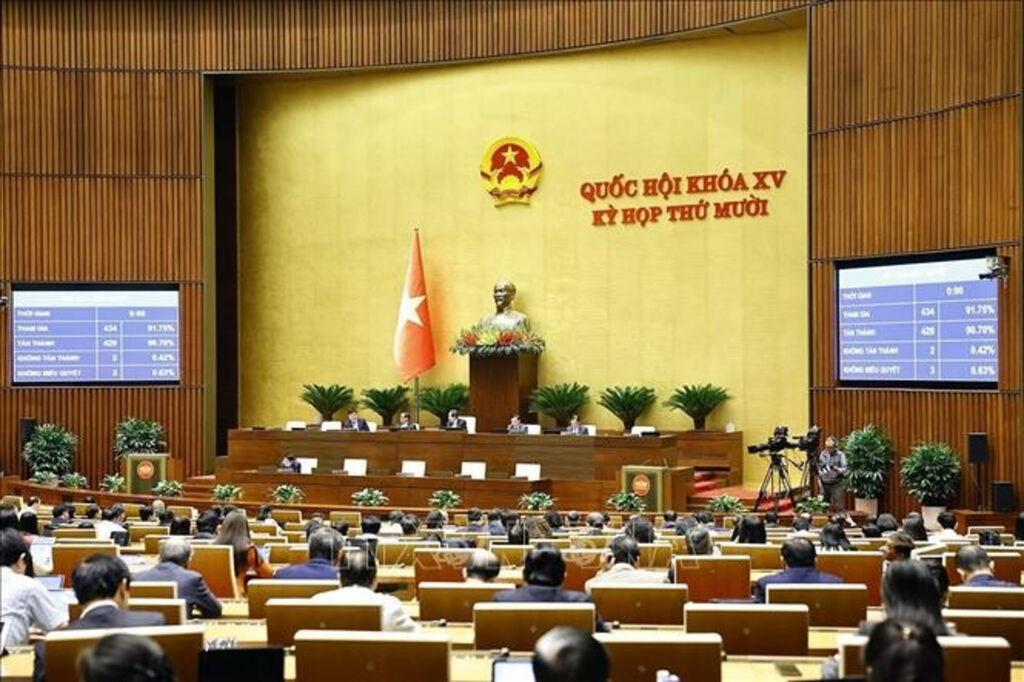
At the National Assembly's sitting on December 10, 2025 (Photo: VNA)

Hanoi (VNA) – The 15th National Assembly passed the first-ever Law on Artificial Intelligence (AI), alongside the Law on amendments and supplements to several articles of the Law on Intellectual Property, and the revised Law on High Technology during the ongoing 10th session in Hanoi on December 10.

The AI Law, spanning eight chapters and 35 articles, cleared the legislature with 429 of 434 deputies in favour (90.7%). The Law on amendments and supplements to several articles of the Law on Intellectual Property, limited to three articles, won 432 of 438 votes (91.33%), while the amended Law on High Technology, with six chapters and 27 articles, garnered 437 of 441 votes (92.39%).

Presenting a report examining the draft AI Law, Minister of Science and Technology Nguyen Manh Hung said there was broad consensus on its urgency.

The draft law establishes core principles, prohibited acts, and a risk management framework. Its drafting approach draws on global experience in governing intelligence systems: regulating inputs through data management, governing the use of AI through legal and ethical frameworks, and managing outcomes through accountability mechanisms.

To strike a balance between regulation and innovation, the draft law incorporates strict safeguards for high-risk AI systems, drawing on models from the EU and the Republic of Korea, while also introducing robust mechanisms to foster development, similar to Japan. These include top-tier incentives for AI, controlled sandbox testing with partial or full exemptions of compliance requirements, a National AI Development Fund with special financial mechanisms, and a voucher scheme to support startups.

Proposals for an independent National AI Committee have been scrapped, and oversight will be centralised under the Government, with the Ministry of Science and Technology as the lead coordinator.

Regarding technical standards, conformity assessment will apply exclusively to high-risk systems named on a Prime Minister-approved list.

To prevent the law from becoming obsolete, the draft avoids fixed lists of technologies or rigid risk classifications. Clause 4 of Article 13 grants the PM authority to issue and continuously update the list of high-risk AI systems in “real time,” without the need for legislative amendments.

The Law on AI will take effect on March 1, 2026./.

See Also

Vietnam's 11-month FDI rises 7.4%

Foreign direct investment (FDI) inflows into Vietnam maintained strong growth momentum over the past 11 months. The National Statistics Office (NSO) under the Ministry of Finance reported that total registered foreign investment during the period reached 33.69 billion USD, rising 7.4% from a year earlier.

National Cybersecurity Association opens branch in HCM City

The southern branch aims to become a coordinating body for cybersecurity tasks, workforce development, awareness-raising and the strengthening of digital defence capabilities across the region, contributing to the safe and sustainable growth of Vietnam’s digital economy.

Rising FDI strengthens Vietnam’s position among emerging IFM markets

According to the National Statistics Office of Vietnam, foreign investment inflows in the first 11 months of 2025 remained positive, with nearly 33.7 billion USD in newly registered capital and 23.6 billion USD in disbursed capital – the highest in five years. These inflows are creating a solid foundation for growing demand for IFM services across factories, logistics centres and office buildings, particularly as foreign investors continue to expand production in Vietnam.

Efforts stepped up to conserve Central Highlands Gong culture space

The Central Highlands Gong Culture Space, recognised by UNESCO in 2005 as a Masterpiece of the Oral and Intangible Heritage of Humanity, stands as a distinctive cultural symbol and a source of pride for ethnic minority communities in Dak Lak. The province is now stepping up efforts to safeguard and promote this treasured heritage amid the context of integration and development.

Key socio-economic development targets for 2026

Resolution No. 244/2025/QH15, adopted at the 10th session of the 15th National Assembly on November 13, 2025, sets the key socio-economic development targets for 2026, including a GDP growth rate of 10% or higher, and a per capita GDP of 5,400–5,500 USD.

Vietnam needs around 28 billion USD for green transition by 2030

Experts have emphasised the need for effective capital mobilisation mechanisms and practical support policies for businesses to achieve sustainable green transition, citing the updated Nationally Determined Contribution (NDC) estimates which showed that Vietnam will require around 28 billion USD for its green transition by 2030.