 |
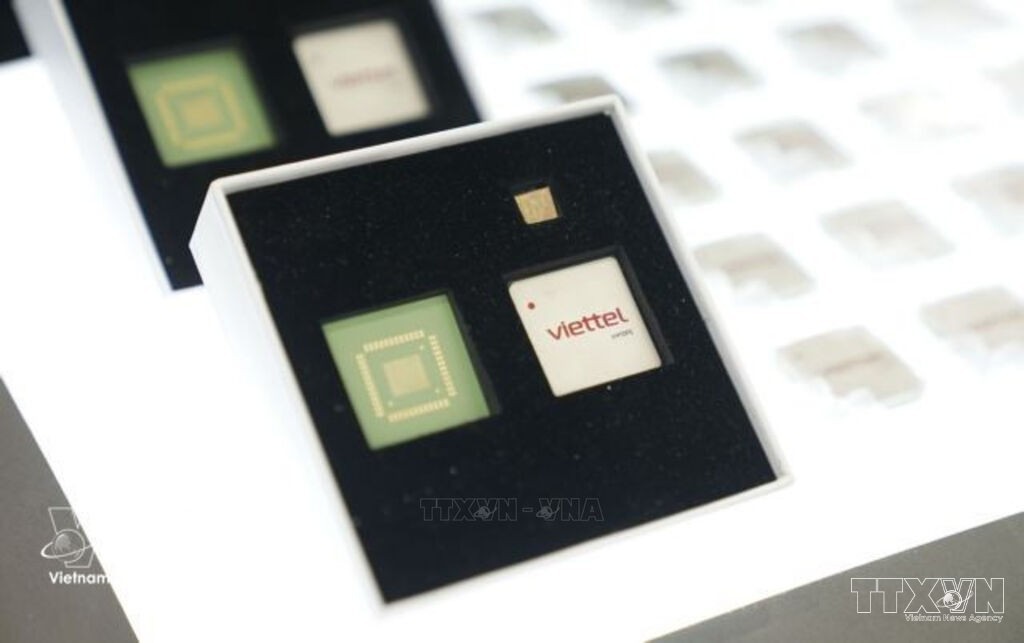
| A 5G DFE chip developed by Viettel. (Photo: VNA) |
Hanoi (VNS/VNA) - Vietnam’s proposed requirement that leading digital technology companies spend at least 3% of their annual revenue on research and development (R&D) can help add hundreds of millions of dollars for innovation, as the country seeks to build globally competitive technology firms.
This is one of eight proposed criteria for Vietnamese digital technology companies seeking to be seen as on par with firms in advanced economies, according to a draft circular recently unveiled by the Ministry of Science and Technology for public comment.
Under the draft, qualifying companies would need annual revenue of at least 1 billion USD, a workforce of at least 5,000, an established science and technology organisation, internationally recognised patents and R&D spending equivalent to at least 3% of total revenue.
The proposed framework would make R&D spending a mandatory quantitative criterion for the first time.
According to the ministry, the 3% threshold was selected after reviewing international experience and the current R&D spending of major Vietnamese technology companies.
Viettel, FPT and VNPT currently spend about 1% of their revenue on R&D, while CMC spends around 2% and MobiFone about 0.15%, the ministry pointed out.
If the proposed threshold is approved and takes effect, the five largest technology companies could add up to 7.6 trillion VND (291 million USD) in R&D funding annually. Viettel alone would need about 4.3 trillion VND more, followed by FPT with 1.3 trillion VND, VNPT with 1.2 trillion VND, MobiFone with 700 billion VND and CMC with 100 billion VND.
Vietnam currently has nearly 80,000 digital technology companies with rising capital demand for R&D, not only for product development but also for research centres, laboratories, testing facilities and scientific and technological workers.
According to experts at Vietnam National University Hanoi, funding for R&D currently accounts for about 0.4-0.5% of gross domestic product (GDP). The Ministry of Science and Technology is developing a plan to gradually raise total social investment in R&D to around 2% of GDP in the next few years.
This means that businesses will need to substantially increase their R&D spending, particularly as companies seek to move deeper into technology value chains and commercialise research results. Such investments typically have long payback periods, but are crucial to building technological capabilities.
Vietnamese companies currently finance most R&D activities from their own resources, including retained earnings, operating cash flow and science and technology development funds.
FPT has for years allocated about 5% of its previous year's pre-tax profit to R&D, while Viettel combines its science and technology development fund with retained profits to reinvest in core technologies, including 5G, semiconductors and artificial intelligence and defence technologies.
However, experts said relying solely on internal funding can place increasing pressure on companies as R&D needs grow, creating greater demand for bank credit and other financing channels.
The State Bank of Vietnam has asked credit institutions to implement a 500 trillion VND credit programme for science and technology, innovation, digital transformation and strategic infrastructure, with the participation of 21 commercial banks offering interest rates 1-2 percentage points below normal levels to help businesses access capital.
The Ministry of Science and Technology has also proposed a pilot scheme to subsidise 50% of loan interest costs through the National Technology Innovation Fund, with support capped at 6% a year for five years. Banks would continue to assess and approve loans based on market principles.
Tran Van Nhien from Eximbank's legal and compliance department said further improvements to the legal framework for intangible assets are necessary to encourage banks to provide more funding for R&D projects.
While intellectual property rights are recognised by law as collateral, their value depends heavily on the commercial potential of technology and a company's capacity for innovation, he said.
Improving mechanisms for valuing, securing and handling intangible assets could therefore help channel more credit into R&D and broaden financing options for technology companies.
The proposed criteria are part of Vietnam's broader efforts to build a stronger generation of globally competitive technology companies.
Under the Politburo’s Resolution 57-NQ-TW, the country aims to have at least five digital technology companies on par with those in advanced economies by 2030 and at least 10 by 2045.
At present, only Viettel and FPT have annual revenue exceeding 1 billion USD, according to the draft./.