 |
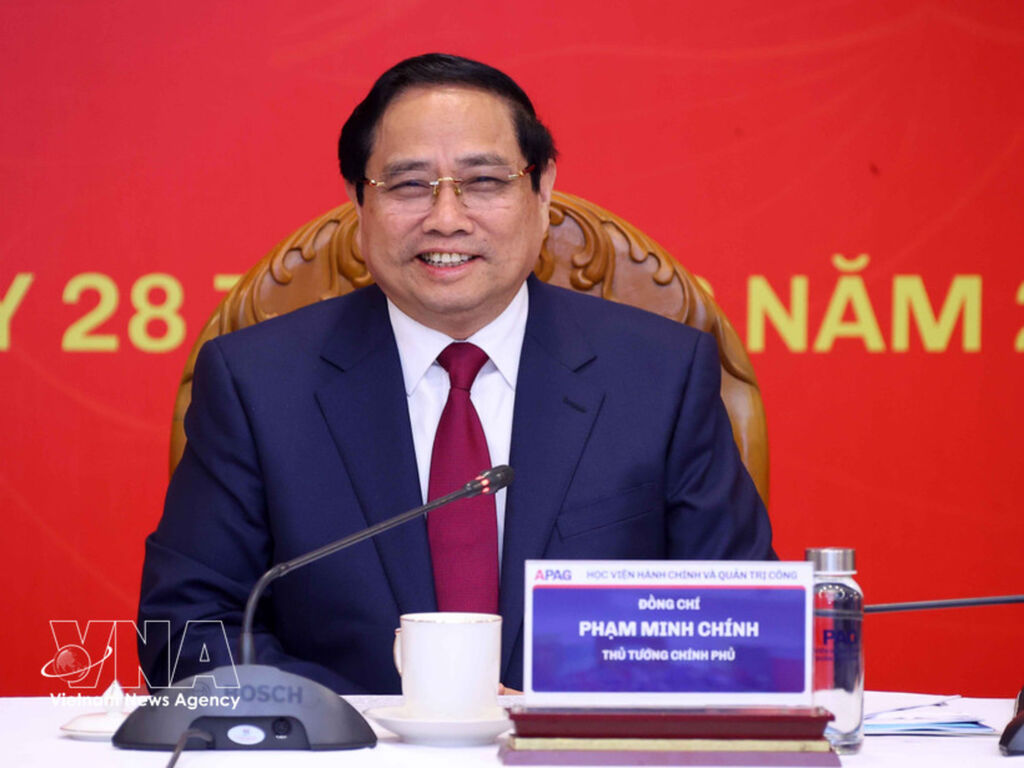
| Prime Minister Pham Minh Chinh addresses the working session with the Academy of Public Administration and Governance (APAG) in Hanoi on February 28. (Photo: VNA) |
Hanoi (VNA) – Prime Minister Pham Minh Chinh visited and worked with leaders of the Academy of Public Administration and Governance (APAG) in Hanoi on February 28, stressing that public administrative governance is the “hinge” of national development.
PM Chinh underscored that public administrative governance is central to organising the exercise of State power and translating the Party’s guidelines and the State's policies and laws into tangible development outcomes.
He distinguished between “management”, which focuses on execution, coordination of resources and supervision of activities, and “governance”, which shapes vision, strategy and operational mechanisms for sustainable development.
At the national level, governance represents a higher stage of state management, requiring more comprehensive and advanced executive capacity. In Vietnam, the concept of “national governance” was first formally introduced in the 13th National Party Congress documents, emphasising modernisation in line with the principle: “The Party leads, the State manages, and the people are the masters.”
Within this structure, public administrative governance holds the central position, he stressed. The PM described national governance capacity as a “strategic asset” and core soft power determining a country’s breakthrough potential, strategic autonomy and development standing. The biggest gap between policy and practical results, he noted, lies in governance and implementation capacity.
He highlighted the rapid, complex and unpredictable global changes as well as major domestic transitions, including digital, green, energy and structural transformations, as well as improvements in human resources quality. Vietnam is also streamlining its administrative system from four levels to three, while enhancing the quality of its grassroots personnel.
He noted that the 14th National Party Congress continued to prioritise building a modern, efficient, and effective governance system centred on citizens and businesses, grounded in science – technology, innovation, digital transformation and green transition.
Meanwhile, the Politburo has issued nine specialised resolutions on key areas to create a comprehensive framework for national governance in the new era, stressing the task of developing personnel and improving governance efficiency.
To meet new requirements, PM Chinh asked the APAG to take the lead in key areas, including implementing Party resolutions, developing a plan to become a national key university in public administration and governance, innovating training methods based on competency standards and outcomes, strengthening independent evaluation, expanding cooperation with domestic and international partners, and enhancing autonomy.
It needs to promote research and policy consultancy, upholding the philosophy of “placing learners at the centre”, developing a contingent of lecturers capably of engaging in policymaking, and advancing a digital, green and smart academy model. He also requested relevant ministries and the Ho Chi Minh National Academy of Politics to create favourable mechanisms, ensure greater autonomy, and provide adequate resources to support the APAG development.
According to APAG Director Assoc. Prof. Dr Nguyen Ba Chien, the academy performs undergraduate and postgraduate training, research, international cooperation and public services in administration, state management and governance under the direction of the Ho Chi Minh National Academy of Politics.
After merging into the Ho Chi Minh National Academy of Politics, it has stabilised its structure without disrupting operations. The academy now comprises five functional units, seven faculties, two centres, one scientific journal and three regional campuses in Ho Chi Minh City, Da Nang and Dak Lak, employing a 649-strong staff.
With a nationwide network, it closely links training with practical governance needs. Over the past year, it has continued academic programmes while enhancing capacity-building for officials, particularly amid the shift to a two-tier local government model.
The academy proposed standardising civil servant training based on competency frameworks, linking training with personnel evaluation, and expanding its role in policy consultancy and impact assessment./.