 |
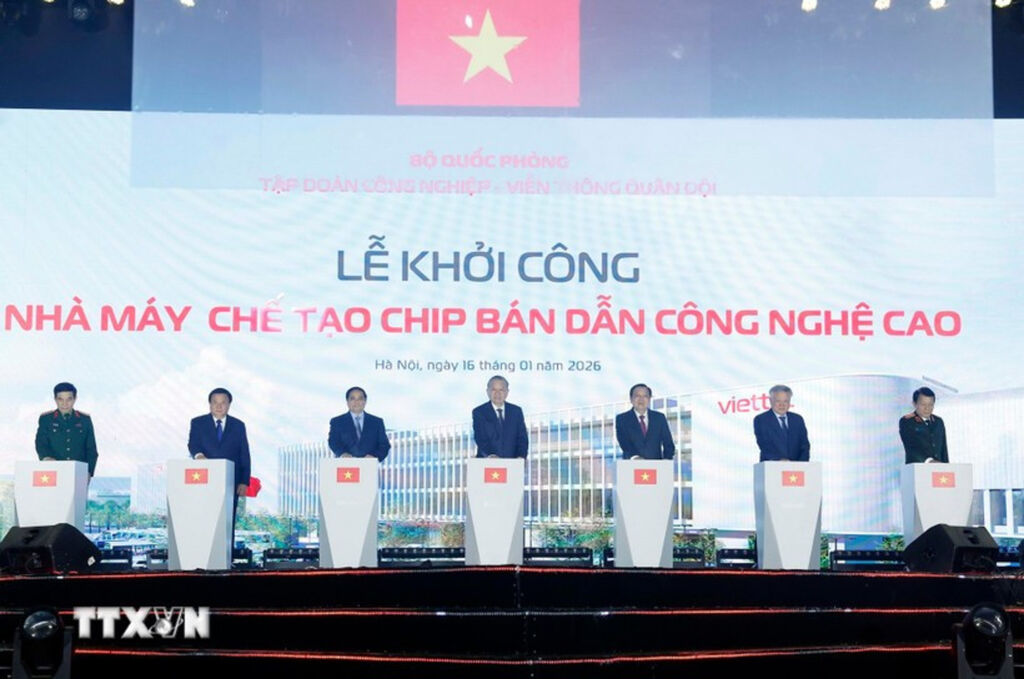
| Party General Secretary To Lam (centre) and Prime Minister Pham Minh Chinh (third from left) and other delegates break ground for Vietnam’s first semiconductor chip manufacturing plant. (Photo: VNA) |
Hanoi (VNA) – Although still at an early stage of development, Vietnam’s semiconductor industry has recorded notable progress thanks to the concerted engagement of the entire political system, driven by strategic policies on science, technology, innovation and digital transformation.
Thanks to a favourable policy framework, a series of large-scale investment projects, alongside expanded human resource training, is gradually shaping a national semiconductor ecosystem.
Policy-driven advantages
The Politburo's Resolution No. 57-NQ/TW on breakthroughs in the development of science, technology, innovation and national digital transformation; The Prime Minister’s Decision No. 1131/QD-TTg on strategic technologies; and Decision No. 1018/QD-TTg approving the national strategy for semiconductor industry development – which targets the establishment of 10 advanced testing and packaging plants by 2030 – have brought fresh momentum to Vietnam’s semiconductor sector.
In recent years, Vietnam has attracted major investment projects from leading global technology corporations such as Intel, Samsung, Amkor and Hana Micron, alongside growing participation from domestic enterprises including Viettel, FPT and VNChip. On January 16, the Viettel Military Industry and Telecoms Group (Viettel) broke ground on Vietnam’s first semiconductor chip manufacturing plant based on the 32nm process at the Hoa Lac Hi-Tech Park, with trial production expected to begin in 2028. Earlier, on January 28, FPT announced the establishment of an advanced semiconductor chip testing and packaging plant – the first of its kind in Vietnam fully mastered by Vietnamese engineers.
According to Deputy Minister of Science and Technology Bui Hoang Phuong, Vietnam possesses significant advantages in capturing global supply chain shifts, including its strategic geopolitical position in Southeast Asia, high economic openness, an extensive network of free trade agreements, and a large electronics manufacturing base with hardware exports exceeding 132 billion USD in 2024. The country also benefits from a young and abundant workforce, with around 1.9 million people employed in the technology sector and more than 7,000 chip design engineers.
Documents prepared for the 14th National Party Congress identify science, technology, innovation and digital transformation as key drivers of rapid and sustainable development. In this context, developing and mastering strategic technologies such as semiconductors is regarded as a critical pillar for enhancing national autonomy, competitiveness and Vietnam’s position in global value chains. Phuong stressed that strong and consistent political determination from the highest leaders remains Vietnam’s greatest advantage in advancing this field.
Human resources for “semiconductor race”
Human resources are seen as a decisive factor in semiconductor development. The Government has approved the programme on developing human resources for the semiconductor industry to 2030, which aims to train at least 50,000 university-level and higher personnel. Of these, around 15,000 will specialise in chip design, while 35,000 will serve manufacturing, packaging and testing. The programme also targets the training of an additional 5,000 artificial intelligence experts and the upskilling of 1,300 university lecturers and researchers.
According to the Ministry of Education and Training, around 35 higher education institutions are currently involved in semiconductor-related training, a figure expected to rise significantly over the next two to three years. Major universities such as Vietnam National University, Ho Chi Minh City; Hanoi University of Science and Technology; Vietnam National University, Hanoi; and the University of Da Nang, along with a number of public and private universities, have opened new programmes and specialisations in semiconductor technologies.
To support training and research conditions, the Ministry of Science and Technology recently issued Circular No. 30/2025, allowing enterprises to import used machinery and equipment for semiconductor production with a maximum age of 20 years, double the previous limit.
Meanwhile, educational and research institutions are not subject to age restrictions on imported equipment. However, all equipment must meet strict criteria on technology standards, environmental protection, occupational safety and energy efficiency. For production lines, efficiency must reach at least 85% of the original design capacity, in order to avoid importing obsolete, inefficient or energy-intensive systems.
According to regulatory authorities, this approach is intended to help enterprises and training institutions access technologies suited to their investment capacity while ensuring technical standards essential for the industry's development.
With an increasingly complete policy framework, expanding investment inflows and a structured human resource development strategy, the semiconductor industry is expected to become a strategic technological pillar of Vietnam in the coming period.
Nevertheless, experts held that to realise the goal of deeper integration into global value chains, ensuring training quality, mastering core technologies and building a coherent ecosystem linking enterprises, educational institutions and regulatory agencies remain key challenges for Vietnam’s semiconductor industry./.