 |
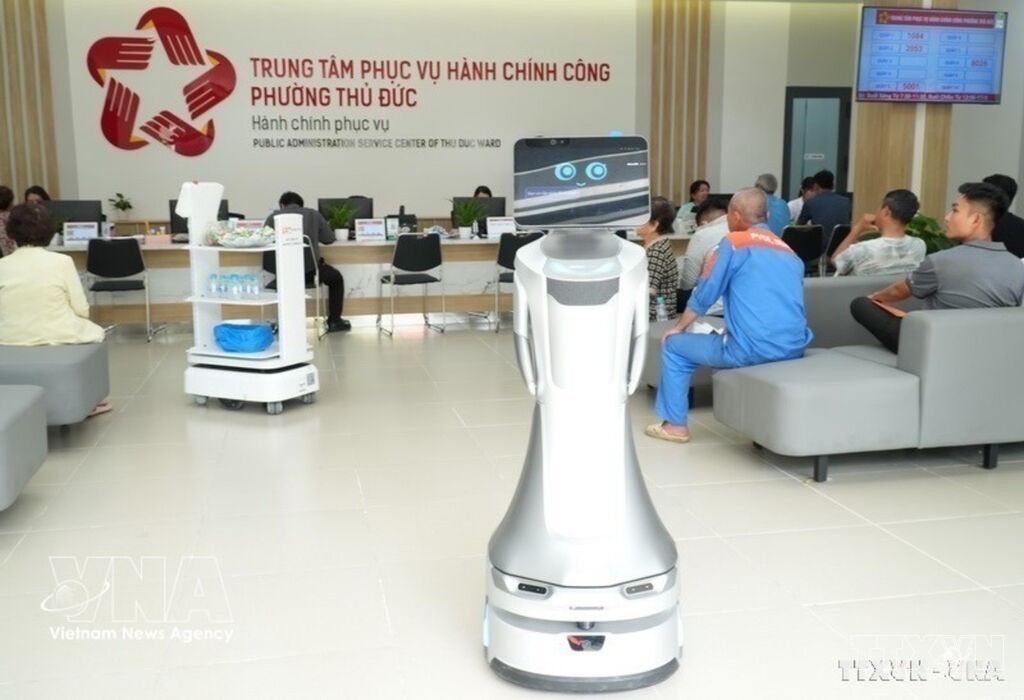
| Thu Duc ward, Ho Chi Minh City, has put a robot into trial operation to assist residents with procedures for online public services. (Photo: VNA) |
Hanoi (VNA) – The Politburo’s Resolution No. 57-NQ/TW, dated December 22, 2024, on breakthroughs in the development of science and technology, innovation and national digital transformation has been implemented regularly, systematically and methodically.
The entire political system has shifted from a mindset of “implementation” to one centred on “enabling and delivering results”, and from “completing tasks on paper” to “creating concrete products” that serve people and businesses and make positive contributions to national development.
Enhancing competitiveness and technological self-reliance
To concretise the views set out in the resolution, Deputy Prime Minister Ho Quoc Dung on August 28 signed Decision No. 1671/QD-TTg approving the national strategy on artificial intelligence (AI) through 2030, with a vision to 2045.
While Resolution 57 identifies AI as one of the strategic technology sectors and sets the goal of placing Vietnam among the three leading countries in Southeast Asia in AI research and development by 2030, the strategy provides a specialised action framework to promote AI research, development and application, and build a Vietnamese AI ecosystem.
Through this, AI will become an important driver for enhancing competitiveness and technological self-reliance and achieving development goals through 2045.
Under the strategy, AI is not only placed within the scope of research, development and application, but is also becoming a core capability in identifying problems and designing, organising and operating activities of the State, the economy and society.
Human resources, infrastructure and data have been identified as the foundations, while institutions and AI governance are considered breakthrough areas. Implementation is linked to the responsibility of leaders and places people at the centre, while promoting AI skills among the public and developing AI infrastructure, data, models and platforms in a coordinated manner, ensuring safety, security and sovereignty.
Nguyen Khac Lich, Director of the Authority for Digital Technology and Artificial Intelligence under the Ministry of Science and Technology, said the results and extent of AI transformation would serve as a basis for adjusting tasks and policies and prioritising resource allocation.
The ministry has put into operation a one-stop AI portal at ai.dda.gov.vn, providing a single online address where businesses, developers, State agencies, experts and members of the public can carry out procedures, make declarations, conduct searches and interact with management agencies.
The National Technology Innovation Fund (NATIF) has recently issued a notice on receiving applications for the first round of interest-rate support in 2026 for businesses implementing investment projects and plans involving technology transfer, application, and innovation.
Applications will be accepted until 5pm on September 20, 2026, with the funding for this round expected to amount to 50 billion VND (1.91 million USD).
 |
| A worker at the Bong Sen factory of Nestlé Vietnam is operating the production line using an automated control panel. (Photo: VNA) |
Technology addresses practical needs in everyday life
To ensure that digital transformation is no longer an unfamiliar concept for the public and does not remain limited to platforms and applications, many localities have gradually brought technology into areas of practical needs, helping people use it to address specific issues in their daily lives.
Nghi Loc is the first commune in the central province of Nghe An to establish an intelligent operations centre (IOC), contributing to the development of a more professional, modern and transparent public administration that better serves people and businesses.
The Department of Science and Technology in the northern port city of Hai Phong has launched a new version of the Smart Hai Phong application as a unified digital interaction channel, helping people and businesses access information, services and utilities while strengthening connections with government agencies in the digital environment.
From national-level policies to models and solutions implemented by localities and businesses, Resolution 57 is being concretised through practical results.
Science and technology, innovation and digital transformation are no longer merely long-term orientations but are increasingly becoming tools for addressing issues in State management, production, business and social life.
Putting people and businesses at the centre, and taking products and practical effectiveness as the yardsticks, are creating momentum to unlock resources, expand the application of technology, and enhance technological self-reliance./.