 |
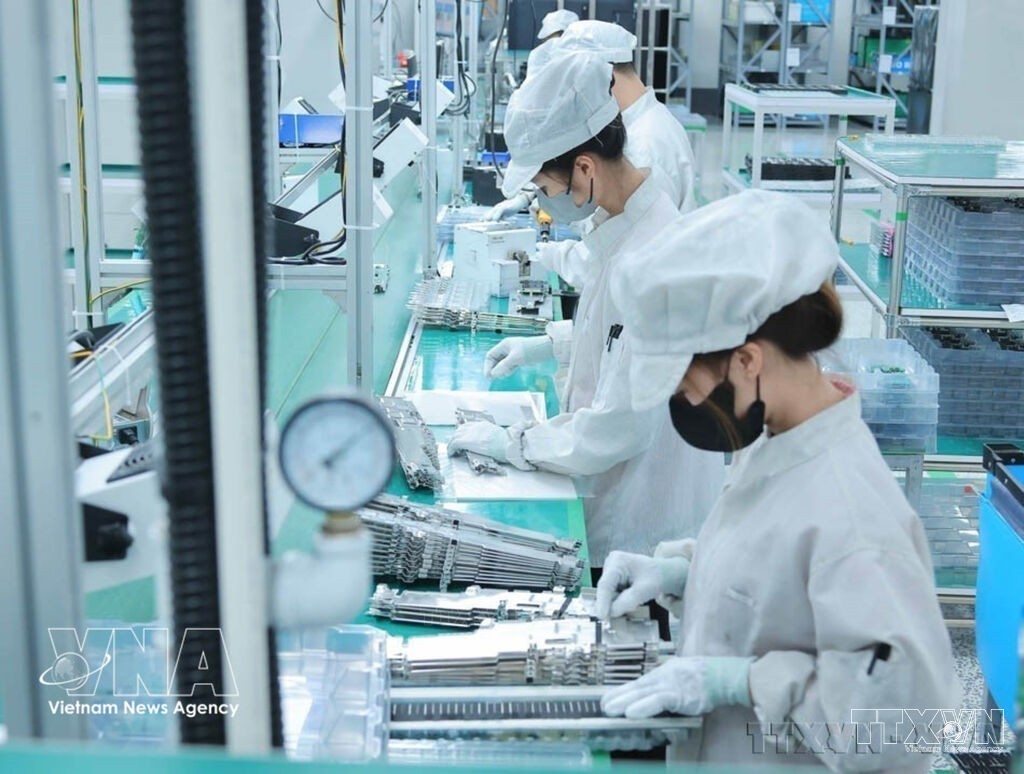
| Production at Bumjim Electronics Vina Co., Ltd invested by the Republic of Korea in Quang Ninh province (Photo: VNA) |
Ho Chi Minh City (VNA) – Resolution No. 19-NQ/TW on renewing Vietnam’s development model has identified productivity, knowledge, technology and human capital as core drivers of a new growth model, while placing smart, green and circular economic development at the heart of the country’s long-term development strategy.
New growth drivers
Adopted at the 3rd plenum of the 14th Party Central Committee, the resolution sets the goal of making Vietnam a developed, high-income country by 2045, with an economy driven mainly by knowledge, science and technology, innovation, green and circular economies, strategic autonomy and deep international integration.
Economist Dr. Doan Anh Tu from Khanh Hoa University said the shift toward a productivity-, knowledge-, technology- and human-based growth model is decisive, with smart economy and artificial intelligence (AI) serving as key drivers.
He stressed that science and technology, innovation, digital transformation and AI must be translated into higher productivity rather than pursued as ends in themselves. At the same time, people should be placed at the centre of development, not merely viewed as a resource but as the ultimate objective of development policies.
According to Tu, the shift is more than an economic policy adjustment, as it could determine Vietnam’s development trajectory for decades to come. It is the only way for Vietnam to escape the middle-income trap, as successful economies have generally shifted from growth based on capital accumulation to productivity and innovation.
The new model is also expected to strengthen strategic autonomy amid intensifying global competition, particularly by deepening mastery of core technologies such as semiconductors, AI, and quantum technology, while enabling Vietnam to participate more deeply in higher-value segments of global value chains.
Instead of remaining primarily a manufacturing base, Vietnam could develop into a regional and global hub for chip design and production, data centre, and research and development centres, creating higher-income jobs and improving living standards.
Tu also highlighted the model’s role in building a sustainable innovation ecosystem and enhancing the economy’s resilience to geopolitical, financial and technological shocks.
Sustainable development
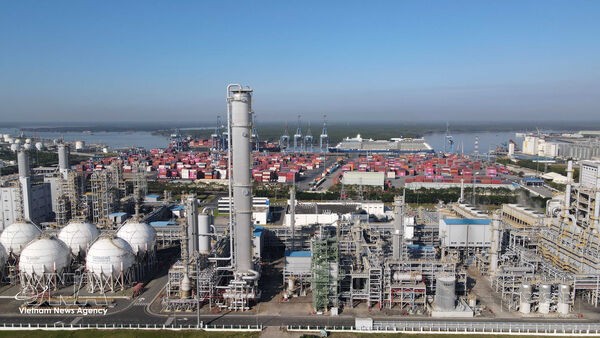
The resolution’s emphasis on smart, green and circular economies is also in line with global development trends, as green transition and circular economy are increasingly becoming requirements for each country and each business.
Businesses are expected to play a key role in achieving an efficient, innovative and green economy by 2035. Experts warned that failure to meet increasingly stringent environmental, social and governance (ESG) standards could result in lost market share.
Pham Van Duc, sales director of Greenovation Packaging - Green Pallet in Long Thanh Industrial Park, Dong Nai province, said international buyers are paying greater attention to sustainable production and traceability, particularly for agricultural, food and consumer goods exported to major markets such as the EU and US.
Green Pallet produces three million moulded compressed-wood pallet bases annually, using recycled wood and wood waste, without formaldehyde. Its fully automated production line is powered mainly by solar energy, helping reduce carbon emissions.
Meanwhile, the textile industry, one of Vietnam’s major export sectors, is also pursuing circular production.
Assoc. Prof. Dr. Nguyen Thi Thanh Phuong, Director of the Ho Chi Minh City Institute of Environmental Industry, said circular economy requires optimal use of resources and energy, minimising waste throughout the product life cycle and prioritising material reuse and recycling over landfilling or incineration.
Emphasising that the circular transition is the key to sustainable development, higher added value and long-term viability, Phuong recommended that Vietnamese textile and garment enterprises swiftly embrace the transition to gain a competitive edge in the future.
Experts and businesses said smart, green and circular economic development is an essential component of sustainable development and will help Vietnam achieve the targets set for 2035 and 2045, while advancing its longer-term vision of becoming a green and innovative economy and a leading smart manufacturing hub in Asia by 2130./.