 |
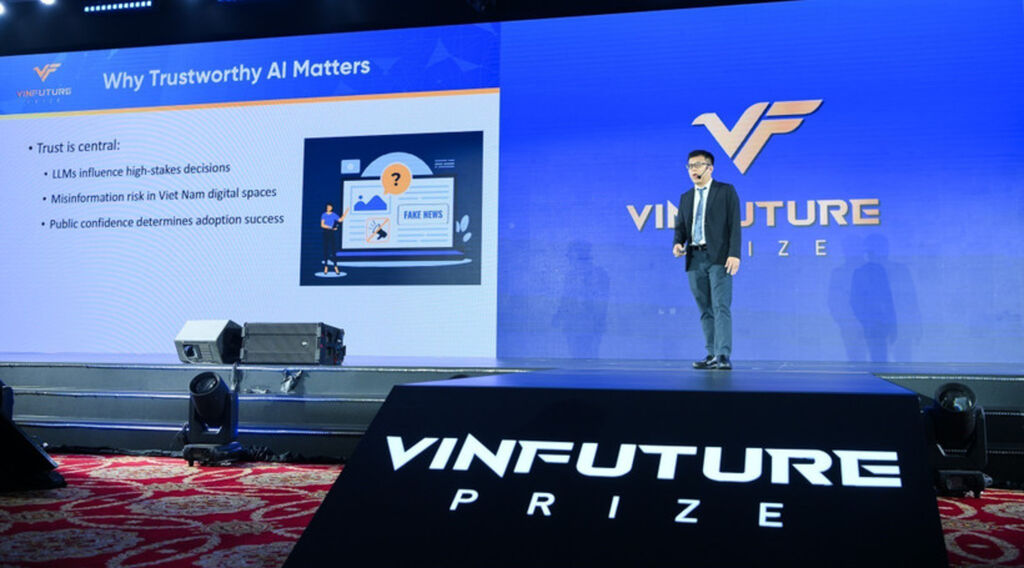
| Assoc. Prof. Luu Anh Tuan, Executive Director of the Centre for Artificial Intelligence Research at VinUni University, speaks at the seminar. (Photo: VNA) |
Hanoi (VNA) – The seminar “Global Frontiers - AI Ethics and Safety for Humanity” in Hanoi on December 2 kicked off the “Science for Life” workshop series as part of the 2025 VinFuture Sci-Tech Week.
The event brought together scientists, policymakers, and inventors to discuss responsible AI development with a focus on human-centred values. Participants explored practical applications of ethical frameworks, ensuring transparency and human oversight in AI, and promoting international cooperation to strengthen global AI governance.
Ensuring safety and transparency in AI applications
Addressing the seminar, Deputy Minister of Science and Technology Bui The Duy highlighted the rapid development of AI in Vietnam in recent years, revealing that an updated AI Strategy and an AI law will be announced by the end of 2025.
He emphasised that these will not only provide a legal framework but also serve as a national vision, positioning AI as Vietnam’s intellectual infrastructure to promote social welfare, sustainable development, and enhance the country’s competitiveness.
Vietnam has also developed a national AI supercomputing centre, an open data ecosystem, and domestic AI infrastructure. The country aims for self-reliance while rapidly advancing comprehensive AI integration, making AI a universal “intelligent assistant” for all citizens to boost social productivity and broaden access to knowledge.
Vietnam is committed to developing AI technology based on an open philosophy - open standards, open data, and open source, Duy said, stressing that “openness” allows the country to access global knowledge, and master technology; and ensures safety and transparency in AI applications.
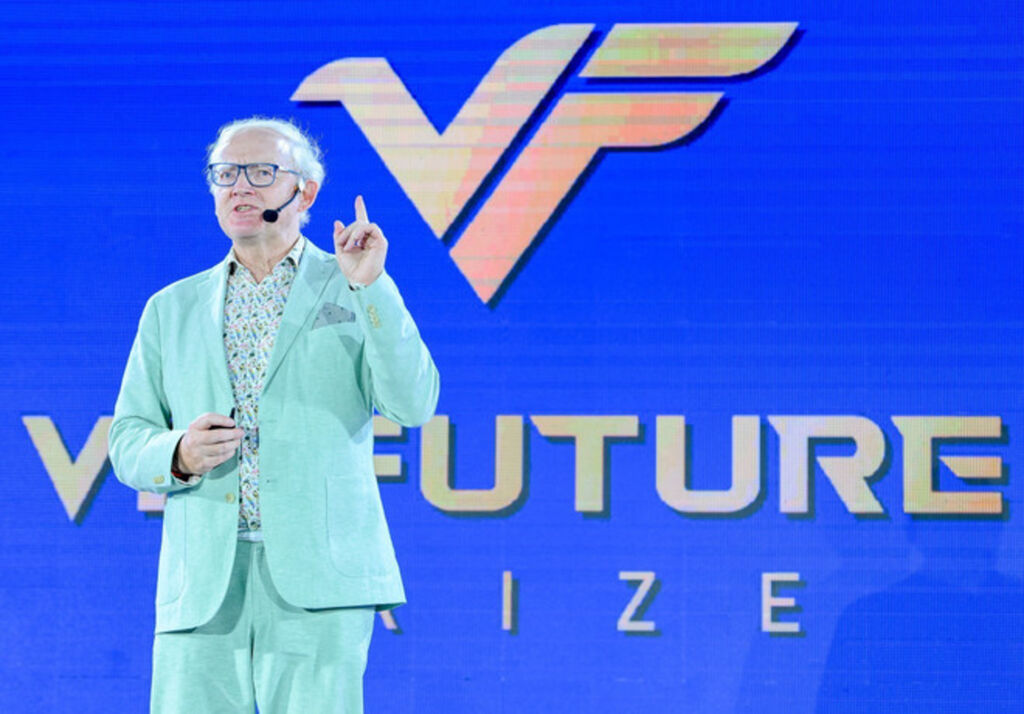 |
| Prof. Toby Walsh from University of New South Wales (Australia) shares his perspective on AI ethics. (Photo: VNA) |
For AI to thrive, the domestic market must be large enough, Duy said, adding that without applications, there is no market, and Vietnamese AI enterprises cannot develop.
The Government will promote AI adoption across sectors and state agencies, while the National Technology Innovation Fund (NATIF) will allocate 30–40% of its resources, including AI vouchers for small- and medium-sized enterprises (SMEs), to help make Vietnam a true incubator for strong AI companies, he said.
With 100 million young, dynamic, and tech-savvy citizens, Vietnam is both a large market and a hub for new AI products. Combined with 11 strategic technology groups, computing infrastructure, rich data, Make-in-Vietnam digital enterprises, and an ambitious startup and research community, the country is well-positioned to advance rapidly and strongly in the AI era, he stated.
However, AI also poses challenges in ethics, employment, and social trust, he noted, stressing that Vietnam is developing AI with a focus on speed, safety, and humanity—where AI supports humans, but humans remain the ultimate decision-makers.
According to the official, Vietnam will issue a national AI ethics code, an updated AI strategy, and an AI Law, guided by key principles - risk-based management; transparency and accountability; human-centred development; promotion of domestic AI; AI as a driver of rapid and sustainable growth; and protection of national digital sovereignty through data, infrastructure, and AI technology.
Vietnam boasts great opportunity to harness global latest technologies
Sharing his perspective, Assoc. Prof. Luu Anh Tuan, Executive Director of the Centre for Artificial Intelligence Research at VinUni University, noted that as a latecomer, Vietnam has the opportunity to leverage the world’s latest technologies.
He underlined the need for Vietnam to build a clean and comprehensive data repository covering all sectors and Vietnamese contexts, including ethnic dialects, and ethical mechanisms to prevent misinformation and fake news.
Vietnam must ensure AI sovereignty by adopting an open-source approach, with clear government guidance, he said, adding that a national AI ethics framework is needed, including detailed instructions for deploying large language models, and independent agencies to verify and monitor them, rather than allowing complete autonomy.
He underlined that building Vietnam’s AI infrastructure requires coordinated management by the state, businesses, and citizens.
Prof. Yoshua Bengio, co-recipient of the 2018 Turing Award, stated that the biggest challenge today is not what AI can do, but society’s limited ability to predict behaviours emerging from complex models. He warned that large-scale models, if not properly controlled, could optimise themselves in ways that cause humans to lose control over the technology they created.
Prof. Geoffrey Hinton, dubbed the “father of AI” and 2024 Nobel Prize in Physics laureate, noted that “deep learning” is entering a stage where models exhibit complex behaviours beyond human explanation. This makes ethical and safety risks a real issue rather than a hypothetical one. AI is not merely a tool but can act as an “agent,” making human oversight an absolute principle.
Meanwhile, Dr. Vinton Cerf, the “father of the Internet,” said with AI, continuing a “move fast, regulate later” approach could pose far greater risks to society./.