 |
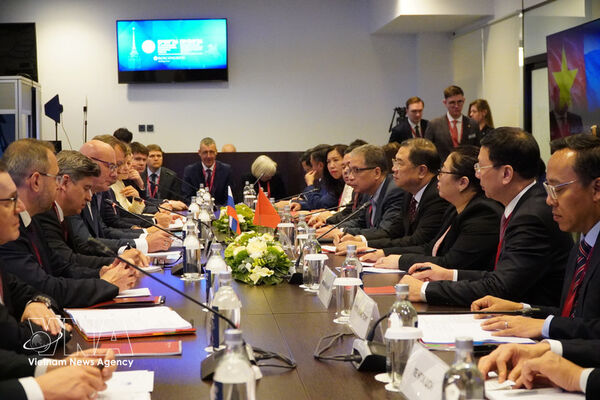
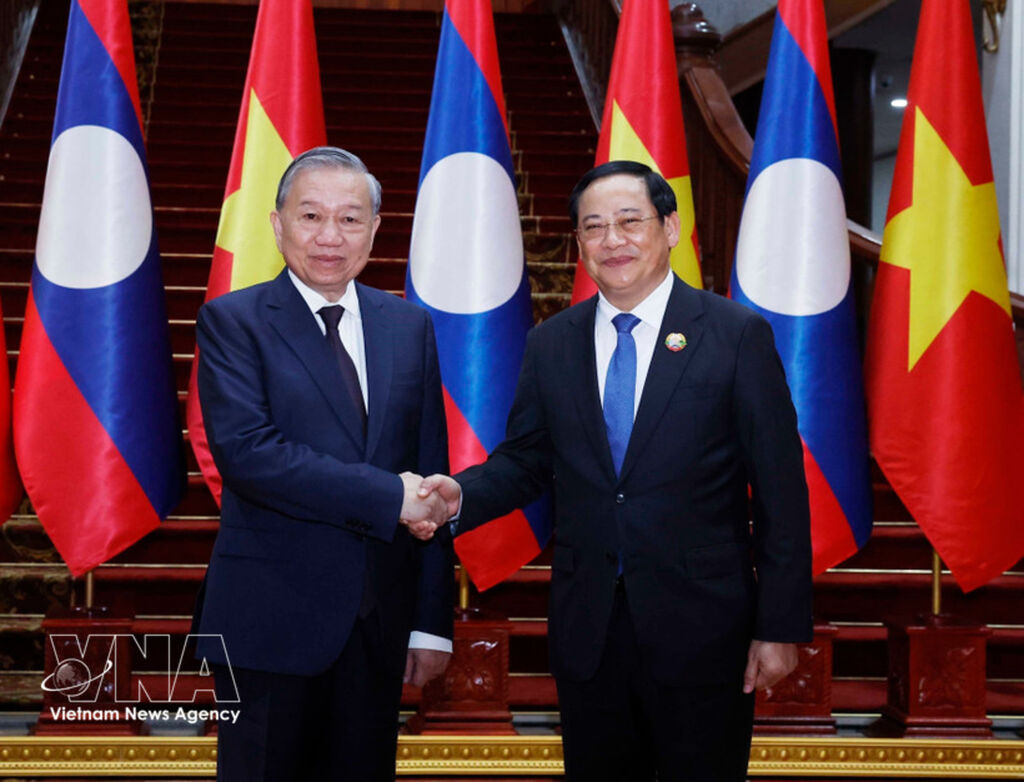
| Party General Secretary To Lam (L) meets with Lao Prime Minister Sonexay Siphandone in Vientiane on December 1, 2025 (Photo: VNA) |
Hanoi (VNA) - Lao Prime Minister Sonexay Siphandone's official visit to Vietnam and participation in the third ASEAN Future Forum is expected to further strengthen the strategic cohesion between Vietnam and Laos.
The visit from June 7-9 comes as Vietnam–Laos relations continue to deepen across all fields, with both countries giving each other the highest priority in their foreign policies.
Great friendship, special solidarity, comprehensive cooperation, strategic cohesion
Vietnam and Laos are neighbouring countries linked by a shared border, the Truong Son mountain range and the Mekong River.
The traditional friendship and enduring solidarity between the two countries' people, founded by President Ho Chi Minh, President Kaysone Phomvihane and President Suphanouvong, and nurtured by generations of leaders, have become an invaluable asset and an objective rule of development in the growth path of both nations.
Vietnam and Laos established diplomatic relations on September 5, 1962. Since then, ties have been always close. The Treaty of Amity and Cooperation signed on July 18, 1977 affirmed their special solidarity and mutual support in safeguarding independence, sovereignty and territorial integrity. Over the past 49 years, the treaty has served as a vital political and legal foundation for strengthening bilateral relations.
In February 2019, the two sides elevated their ties to a relationship of “great friendship, special solidarity and comprehensive cooperation”, marking a historic breakthrough. During General Secretary of the Communist Party of Vietnam Central Committee To Lam’s State visit to Laos in December 2025, the two countries agreed to further upgrade relations to one of “great friendship, special solidarity, comprehensive cooperation and strategic cohesion”. The addition of “strategic cohesion” reflects a shared vision, intertwined strategic interests and a long-term commitment to sustainable development, self-reliance and common prosperity.
The two sides have maintained frequent exchanges of delegations at all levels, especially the high level. In 2025 alone, General Secretary Lam and Lao People's Revolutionary Party (LPRP) General Secretary and President of Laos Thongloun Sisoulith met six times to discuss key issues aimed at deepening bilateral ties.
Since the beginning of 2026, following the successful National Party Congresses in both countries, the top leaders of the two Parties chose Vietnam and Laos as the destinations for their first overseas state visits. These included the state visit to Vietnam by LPRP General Secretary and President of Laos Thongloun Sisoulith in January, Party General Secretary To Lam’s state visit to Laos in February, and Permanent member of the Communist Party of Vietnam Central Committee's Secretariat Tran Cam Tu’s official visit to Laos in April. Most recently, Prime Minister Le Minh Hung met with Lao Prime Minister Sonexay Siphandone on the sidelines of the 48th ASEAN Summit in Cebu in May.
These visits and exchanges reaffirm both countries’ consistent policy of prioritising bilateral ties and nurturing the relationship of great friendship, special solidarity, comprehensive cooperation and strategic cohesion.
The leaders have agreed to strengthen information-sharing and exchange experience in implementing National Party Congress resolutions and socio-economic development plans for 2026-2030. They have also prioritised economic integration, strategic projects and regional development, aiming to raise bilateral trade to 10 billion USD in the coming years.
Education, training and high-quality human resources development remain areas of strategic, long-term cooperation. The two sides will continue to promote cultural and people-to-people exchanges, especially among younger generations, while enhancing cooperation in information and communications.
Vietnam and Laos also maintain effective bilateral cooperation mechanisms, including meetings of the Vietnam–Laos Intergovernmental Committee and regular high-level contacts. At regional and international forums, particularly within ASEAN and Mekong cooperation frameworks, the two countries coordinate closely and support one another.
Positive growth in economic, trade cooperation
Economic, trade and investment cooperation continues to expand. Bilateral trade exceeded 1.64 billion USD in 2023, rose to 2.25 billion USD in 2024, surpassed 3 billion USD in 2025 and increased by 32% compared with the previous year.
As of May 2026, Vietnam had 289 investment projects in Laos with a total registered capital of nearly 7 billion USD. Vietnamese investment in Laos reached 590.3 million USD in 2025, 7.5 times higher than in 2024. During the first quarter of 2026, Vietnam licensed eight new investment projects in Laos worth 176.66 million USD.
Vietnamese investment is increasingly concentrated in higher value-added sectors such as high-tech agriculture, renewable energy, deep-processing mining, telecommunications, finance, logistics and digital transformation.
Many Vietnamese-invested projects have become successful cooperation models, generating jobs, increasing budget revenues and promoting technology transfer. The two governments are facilitating expanded investment by major Vietnamese corporations, including Viettel, the Vietnam Rubber Group, Truong Hai Group, T&T, TH True Milk and Sun Group, particularly in energy, agriculture and mineral processing projects, including major developments in Savannakhet province.
The two countries have also completed arrangements for local-currency settlements and bilateral QR-code payment connectivity.
Defence and security cooperation continues to serve as a key pillar of bilateral relations, contributing to political stability and social order in both countries.
Cooperation in transport connectivity, education, culture, tourism and people-to-people exchanges has also yielded positive results. Vietnam granted Laos 1,185 scholarships in 2025, while Laos provided 60 scholarships to Vietnam.
Cultural cooperation has deepened significantly. In December 2025, senior leaders of both countries attended the inauguration of the Laos–Vietnam Friendship Park in Vientiane, a symbolic project marking the 50th anniversary of Laos’ National Day. In May 2026, Vietnam Culture Week in Laos opened a new phase of cultural and tourism cooperation for 2026-2030, further highlighting the unique and exemplary relationship between the two countries.
Deepening political trust, realising strategic cohesion
Prime Minister Sonexay Siphandone’s official visit to Vietnam and participation in the third ASEAN Future Forum carry particular significance. It is his first visit to Vietnam since the 12th Congress of the Lao People's Revolutionary Party and the formation of Laos’ new leadership.
According to Vietnamese Ambassador to Laos Nguyen Minh Tam, Vietnam’s place among the Lao PM's first foreign destinations demonstrates that bilateral relations remain the highest priority in each country’s foreign policy and reflect the uniquely close bond between the two Parties, States and peoples.
The visit will allow leaders of both countries to review the implementation of key agreements, including outcomes of the annual meeting between the two Politburos and the 48th session of the Vietnam–Laos Intergovernmental Committee, while identifying new measures to make cooperation more substantive and effective.
A notable feature of the current phase is the shift from expanding cooperation to enhancing its quality and depth. The concept of “strategic cohesion” is increasingly being translated into practical cooperation in infrastructure, economic integration, energy, digital transformation, finance, human resource development and multilateral coordination.
PM Sonexay Siphandone is expected to hold talks with PM Hung, meet key Vietnamese leaders and participate in other diplomatic activities.
His participation in the ASEAN Future Forum for the second time demonstrates Laos’ strong support for Vietnam’s initiative to promote strategic dialogue on ASEAN’s future. It also reflects the growing coordination between the two countries on regional issues and their shared commitment to building a united, resilient and creative ASEAN, according to Tam.
Against a backdrop of profound geopolitical, geoeconomic and technological changes, the visit conveys a clear message that Vietnam and Laos will continue to stand together, share strategic interests, support each other’s development and coordinate closely in addressing common challenges. The Vietnam–Laos relationship remains an invaluable legacy and an exceptional model of international cooperation and shared development in the new era./.