 |
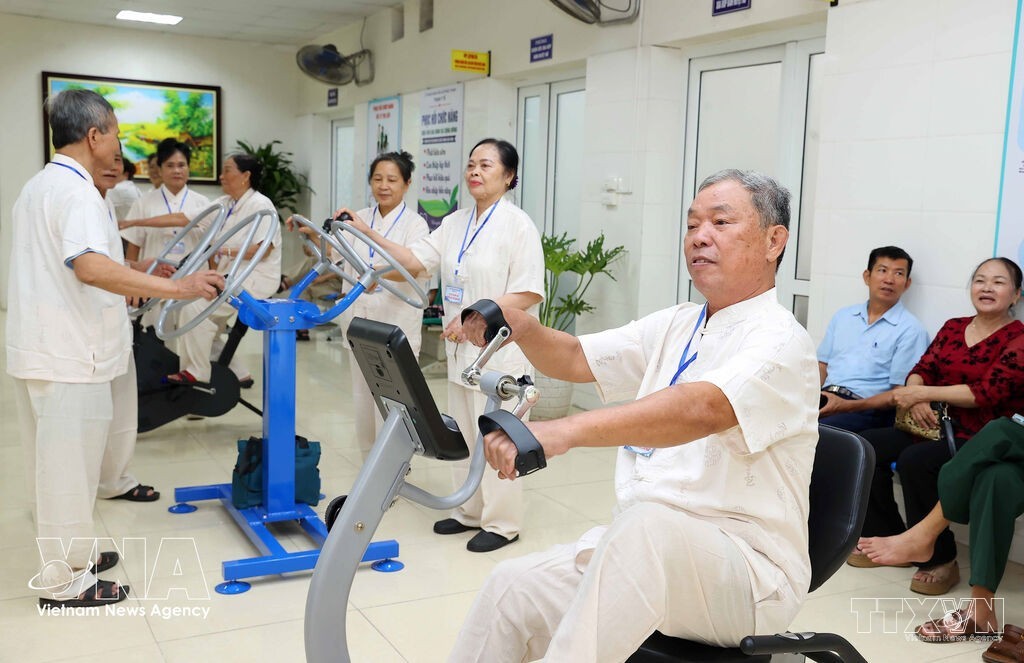
| People have access to appropriate care, rehabilitation and support services within their communities (Photo: VNA) |
Hanoi (VNA) - Vietnam needs to proactively adapt to rapid population ageing by improving policies and care systems, while creating conditions for older people to continue contributing to their families, communities and society and expanding the space for the silver economy, said insiders.
The International Day of Older Persons 2026, themed “The Age of Longevity: Rethinking Systems for Longer Lives,” highlights the need to develop healthcare, social security, labour-market and social-service systems in response to increasing life expectancy. For Vietnam, rapid population ageing is not only a demographic issue but also a development challenge.
Action strategy for the ederly
Vietnam began its ageing process in 2011 and is expected to become an ageing society by 2034, when people aged 65 and above will account for 14% of the population. The proportion is projected to exceed 21% by 2050.
Deputy Minister of Health Nguyen Thi Lien Huong said policies and the legal framework on older persons have continued to be improved towards broader coverage and better access to basic social services. Resolution No. 72-NQ/TW of the Political Bureau calls for developing elderly-care and rehabilitation facilities and improving coordination between healthcare and elderly-care services.
She said more than 2.5 million older people currently receive social retirement allowances, while about 80% have health-monitoring records and more than 69% receive annual health check-ups. However, only about 42% received pensions, social insurance allowances or social retirement allowances in 2025, below the 55% target. Elderly-care facilities and care workers also remain insufficient.
 |
| An elderly woman from the Dao Thanh Y Club in Eo village in Tuyen Quang province passes down the traditional brocade weaving craft of the Dao ethnic group to young people (Photo: VNA) |
Ngo Anh Tuan, Deputy Head of the Department of Elderly Care under the Vietnam Association of the Elderly (VAE), called for a shift from addressing problems after they arise to proactive prevention and risk management, while ensuring older people’s legitimate rights and interests.
He proposed strengthening the VAE’s role in communications, social supervision and policy-making, developing data systems to identify risks early, and expanding community-based care models. Digital transformation, artificial intelligence and big data should also be used to forecast ageing trends, assess care needs and identify risks facing older people, he said.
Developing daycare services to expand silver economy
Developing care services suited to the needs of older people and their families can create new jobs, services and markets, contributing to the development of the silver economy.
Nguyen Thi Kim Thanh, Chairwoman of Nhan Ai International JSC, proposed developing daycare services as part of the elderly-care system. She said daycare could bridge the gap between family care and long-term residential care, enabling older people to remain with their families while receiving daytime support.
Daycare facilities could provide health monitoring, nutrition, medication management, physical exercise, rehabilitation and social activities, helping older people maintain mobility, independence and social connections.
To expand the model, Thanh proposed incorporating daycare into development plans for elderly care and the silver economy, establishing quality standards, encouraging social participation and public-private partnerships, and developing community-based daycare networks linked with home care, healthcare, rehabilitation and long-term care.
She also called for developing a professional elderly-care workforce and greater use of technology and data to connect older people, families, caregivers, service providers, healthcare facilities and communities.
Against the backdrop of rapid population ageing, daycare can serve as a bridge between families and professional care services, contributing to a more comprehensive care system and expanding the space for Vietnam’s silver economy./.