 |
| The medical team performs the domino multi-organ transplant at Viet Duc University Hospital on March 13, 2026. (Photo published by VNA) |
Hanoi (VNA) – Vietnam has successfully carried out its first domino multi-organ transplant, a landmark medical achievement that underscores the country’s rapidly advancing organ transplantation expertise, the Department of Medical Service Administration under the Ministry of Health and Viet Duc University Hospital announced on March 19.
The milestone operation was made possible by the organ donation of a 42-year-old woman who was admitted to Viet Duc University Hospital on March 11 following a serious traffic accident. Despite intensive resuscitation efforts, she fell into a deep coma with a Glasgow score of three, lost all light reflexes, and was declared brain-dead. Her family’s decision to donate her organs enabled multiple critically ill patients to receive life-saving transplants.
According to Assoc. Prof. and Dr Duong Duc Hung, Director of the hospital, surgeons retrieved the donor’s heart, liver, two kidneys and several tissues for transplantation.
Among the most complex cases was a 53-year-old man diagnosed with hereditary amyloidosis, a rare disorder caused by abnormal protein deposits that progressively damage multiple organs, especially the heart. Given the severity of his condition, doctors performed a simultaneous heart–liver transplant on March 13, a procedure rarely undertaken worldwide due to its technical complexity and the level of coordination required.
After roughly seven hours of surgery, the transplanted heart began beating immediately in the operating room, while the new liver quickly produced bile, indicating good early organ function.
In a further breakthrough, doctors applied the domino transplantation technique for the first time in Vietnam. Although the amyloidosis patient’s liver carried a genetic mutation, its structure and function remained largely normal. Instead of discarding the organ, surgeons transplanted it into a 64-year-old man suffering from liver cancer, whose survival prospects were extremely limited without transplantation.
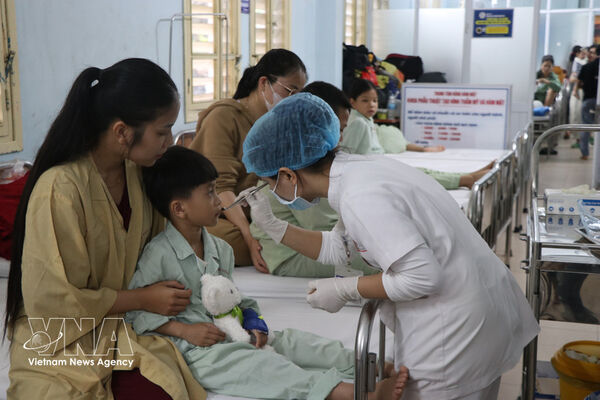
The domino liver transplant lasted about six hours and was conducted alongside other procedures by multiple surgical teams working simultaneously. Both transplant recipients showed favourable postoperative progress, remaining conscious and able to sit up and eat within 72 hours.
The case demonstrated how a single organ donor can save multiple lives, moving beyond the traditional “one donor – one recipient” approach.
 |
| The transplant recipients have since recovered and are in stable health. (Photo published by VNA) |
Hung explained that while there is a potential risk of disease development in the domino liver recipient, it would likely take 20–30 years to emerge and is not inevitable. In contrast, patients with advanced liver cancer often survive only months, or at most about a year, without transplantation, whereas successful transplantation can extend survival by many years, even beyond a decade with proper care.
Doctors noted that domino transplantation is significantly more demanding than conventional procedures, as surgeons must preserve and prepare the removed organ for reuse while ensuring safety and compatibility. The simultaneous heart–liver transplant further increased the operation’s complexity, requiring precise surgical techniques and close coordination among specialised teams.
The approach is particularly suitable for older patients or those with severe illnesses such as liver cancer, where immediate life-saving benefits outweigh potential long-term risks.
The success highlights Vietnam’s growing medical capacity, bringing its transplantation expertise closer to that of advanced healthcare systems. Mastery of complex procedures, including combined heart–liver transplantation, domino liver transplantation, and efficient organ coordination, has helped position Viet Duc University Hospital among the region’s leading transplant centres./.