 |
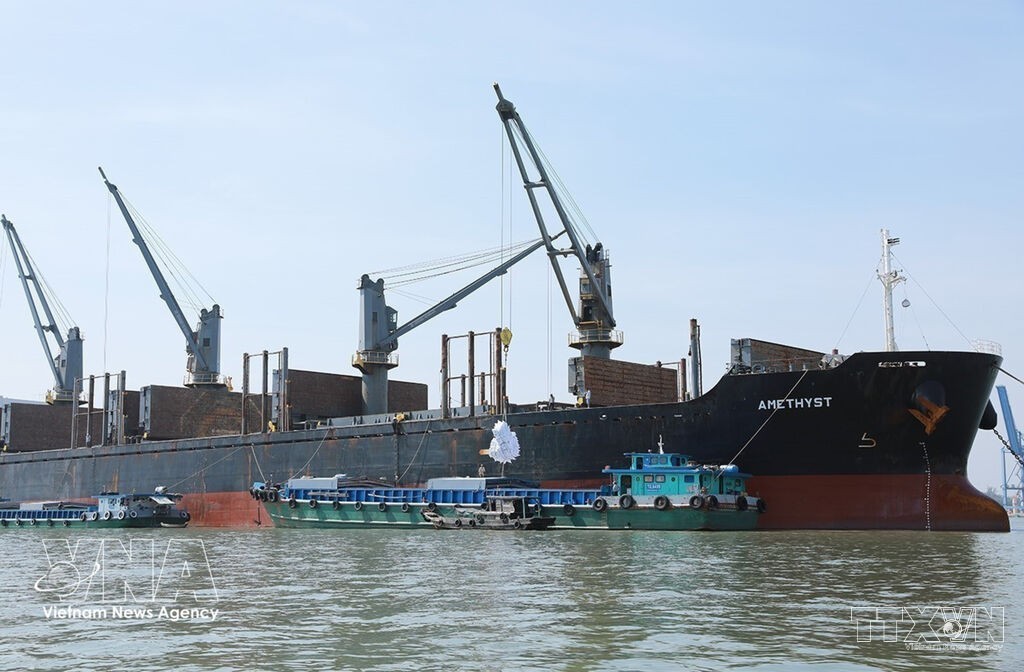
| Transporting and loading commercial rice for export by the Southern Food Corporation. (Photo: VNA) |
Hanoi (VNA) – Vietnam recorded a trade surplus in September after nine consecutive months of trade deficits, according to a socio-economic report for the third quarter and first nine months of 2026 released by the National Statistics Office under the Ministry of Finance on October 3.
The report showed that total export and import turnover reached 117.69 billion USD in September, up 7.3% from the previous month and 42.4% year-on-year. Notably, the goods trade balance returned to a surplus of 1.27 billion USD after nine consecutive months of deficit.
In the first nine months, total trade turnover reached 888.02 billion USD, up 30.4% year-on-year. Exports rose 24.5%, while imports increased 36.7%, resulting in a trade deficit of 19.42 billion USD.
Specifically, exports reached 59.48 billion USD in September, up 8.5% from the previous month and 39.1% year-on-year. Exports by the domestic economic sector increased 9.9%, while those by the foreign-invested sector, including crude oil, surged 46.5%.
In the third quarter, exports reached 167.85 billion USD, up 30.4% year-on-year and 17% from the second quarter.
In the first nine months, exports totalled 434.30 billion USD, up 24.5% year-on-year. The domestic economic sector contributed 83.89 billion USD, up 7.5% and accounting for 19.3% of total exports, while the foreign-invested sector, including crude oil, generated 350.41 billion USD, up 29.4% and accounting for 80.7%.
Thirty-five export items recorded turnover of more than 1 billion USD each, collectively making up 94.3% of total exports. Seven items posted export turnover of more than 10 billion USD each, accounting for 70.7% of the total.
Manufactured and processed industrial goods accounted for the largest share of exports at 392.79 billion USD, or 90.4%, followed by agricultural and forestry products at 30 billion USD (6.9%), seafood at 9.10 billion USD (2.1%), and fuels and minerals at 2.41 billion USD (0.6%).
Meanwhile, imports reached 58.21 billion USD in September, up 6% from the previous month and 45.8% year-on-year. Imports by the domestic economic sector rose 22.1%, while those by the foreign-invested sector increased 54.6%.
In the third quarter, imports totalled 170.33 billion USD, up 42.2% year-on-year and 8.8% from the second quarter.
In the first nine months, the figure reached 453.72 billion USD, up 36.7% year-on-year. The domestic economic sector accounted for 118.17 billion USD, up 23.5%, while the foreign-invested sector contributed 335.55 billion USD, up 42%.
Forty-five import items recorded turnover of more than 1 billion USD each, accounting for 94.5% of total imports, including six items with turnover exceeding 10 billion USD, which together accounted for 63.1%.
Production materials accounted for the overwhelming majority of imports, at 426.92 billion USD or 94.1%. Machinery, equipment, tools and spare parts made up 58.3%, while raw materials and fuels accounted for 35.8%. Consumer goods stood at 26.80 billion USD, or 5.9%.
In the first nine months, the US remained Vietnam's largest export market, with export turnover reaching 140.0 billion USD. China was Vietnam's largest import market, with import turnover of 187.34 billion USD.
Vietnam enjoyed a trade surplus of 122.62 billion USD with the US, up 23.8% year-on-year; 36.06 billion USD with the EU, up 25.3%; and 2.65 billion USD with Japan, up 85.9%.
Meanwhile, the country posted a trade deficit of 121.48 billion USD with China, up 43%; 43.75 billion USD with the Republic of Korea, up 90.4%; and 15.49 billion USD with ASEAN, up 48.1%./