 |
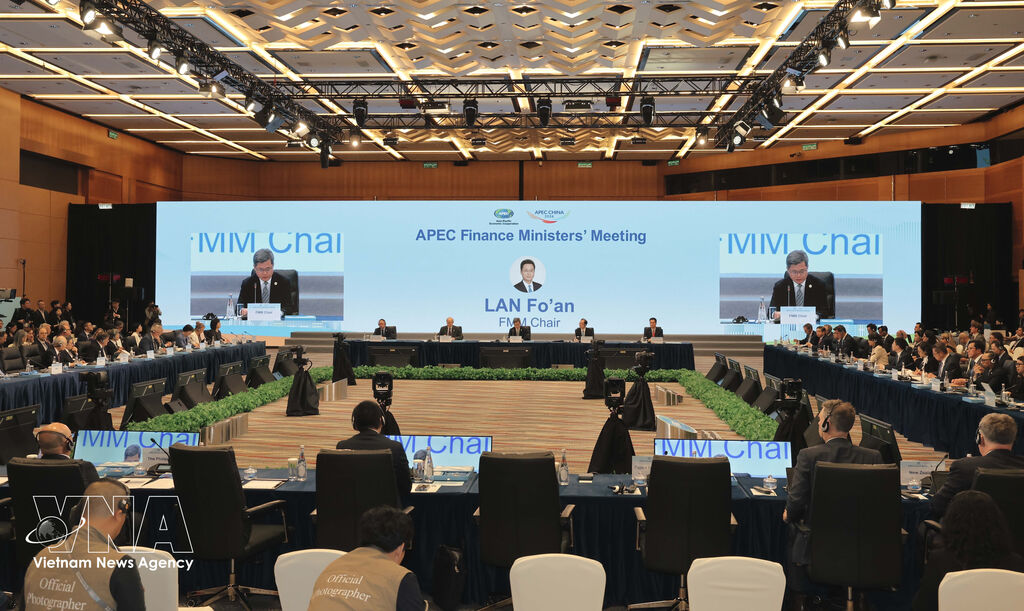
| Vietnam attends the 33rd APEC Finance Ministers’ Meeting (FMM 2026) in Hong Kong (China) (Photo: VNA) |
Hanoi (VNA) – Vietnam is officially assuming the role of host of APEC 2027 at the closing ceremony of the 33rd APEC Finance Ministers’ Meeting (FMM 2026) on October 21, according to the Ministry of Finance.
The two-day meeting, held in Hong Kong (China) as part of APEC 2026, saw Finance Minister Ngo Van Tuan deliver a key address on Vietnam’s macroeconomic situation and outlook, as well as policy directions to maintain macroeconomic stability and lay the groundwork for the country’s double-digit growth target in 2027.
On October 21, Tuan and the Vietnamese Ministry of Finance delegation are scheduled to attend further sessions and hold bilateral meetings before Vietnam formally takes over the APEC host role at the closing ceremony.
At the invitation of Finance Minister Lan Fo’an of China, host of APEC 2026, Tuan is among the main speakers at a key discussion on macroeconomic developments, alongside senior representatives of the Chinese and US finance ministries.
That Vietnam was invited to deliver the keynote address at this important macroeconomic policy dialogue reflects the host economy’s and other APEC members’ recognition of the country’s standing and credibility, as well as its notable achievements in macroeconomic governance in recent years, the ministry said.
During the discussion, Tuan shared assessments of the global and regional economic situation and highlighted Vietnam’s macroeconomic performance in the first nine months of 2026.
Global economic growth is projected at 3.1% in 2026 and 3.4% in 2027, supported by flexibility in energy markets and investment in artificial intelligence (AI). However, the world economy continues to face risks from geopolitical tensions, high interest rates and technological gaps among economies.
Vietnam’s economy performed positively in the first nine months of 2026, with GDP growing by 9.01% and the consumer price index (CPI) rising by 4.52%, Tuan said.
The country also received several encouraging signals, including an upgrade to emerging market status for the stock market, an investment-grade rating and its entry into the upper-middle-income group. Foreign direct investment (FDI) inflows also reached a record high, with registered capital totalling 50.36 billion USD.
Meanwhile, the structure of state budget expenditure was optimised, with the share allocated to development investment rising to around 40% and recurrent spending curbed through the streamlining of the administrative apparatus. Public debt remained at a safe level of approximately 35–36% of GDP, providing fiscal space for investment in strategic infrastructure and key projects.
“These results stem from the effective coordination of targeted expansionary fiscal policy, flexible monetary policy and institutional reforms," the minister noted. "Looking towards 2027, Vietnam aims to achieve double-digit growth while maintaining macroeconomic stability and renewing its growth model based on science and technology.”
At the meeting, the global and regional macroeconomic outlook is a central topic of discussion among representatives of international organisations and member economies. Assessments by the International Monetary Fund (IMF), the Asian Development Bank (ADB) and the Asian Infrastructure Investment Bank (AIIB) highlighted the interplay between geopolitical risks and technology-driven growth, particularly advances in AI.
International financial institutions also warned that conflicts in the Middle East could disrupt supply chains and energy transportation, while El Niño could threaten food security. These factors could put upward pressure on prices and push regional inflation to 4.2%.
Representatives of member economies shared policy measures aimed at strengthening macroeconomic resilience.
The US Treasury highlighted the role of technological innovation in stimulating investment flows and praised supply chain adjustments and stockpiling measures to mitigate the impact of volatility in energy markets.
China’s Ministry of Finance outlined its goal of maintaining economic growth at around 5%, accelerating the green transition and reviving aggregate demand through a 30-trillion-CNY public investment disbursement plan linked to efforts to strengthen the social safety net./.