 |
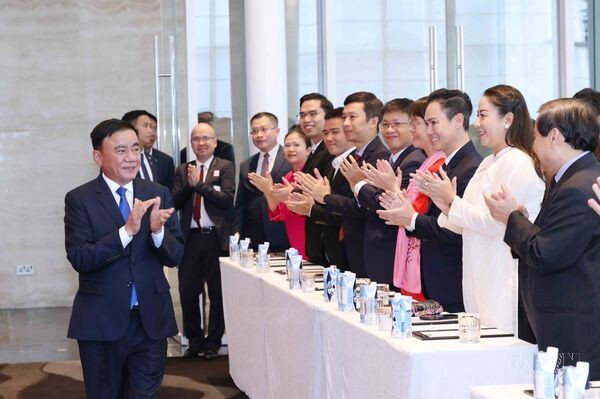
| ABVietFrance Vice President Nguyen Minh Tuan (L) at a seminar co-hosted by the ABVietFrance and EDHEC Business School in Lille city (Photo: VNA) |
Paris (VNA) – With their skills, management knowledge and global connections, Vietnamese entrepreneurs in France can connect to the European market as “value bridges”, according to the Vietnamese Entrepreneurs Association in France (ABVietFrance).
Talking to Vietnam News Agency (VNA) correspondents in France, ABVietFrance Vice President Nguyen Minh Tuan said the Political Bureau’s Resolution No. 23-NQ/TW marks a new approach to the overseas Vietnamese community, recognising it as an important bridge between Vietnam and the world.
The shift creates opportunities for OVs to directly contribute to the homeland’s development, he said.
This approach is particularly relevant to the Vietnamese community in France, which numbers about 350,000 members, according to ABVietFrance. France has the largest Vietnamese community in Europe, also one of the largest worldwide.
The community’s resources go beyond capital, Tuan said, noting that through integrating into French society, Vietnamese entrepreneurs have accumulated professional expertise and networks, market access, and knowledge of EU regulations.
Under Resolution No. 23, OV entrepreneurs can take on a bigger role by connecting businesses, promoting technology transfer, sharing management know-how, helping Vietnamese companies break into European markets, and linking French and Western European businesses and investors with Vietnam.
Regarding the Vietnam-EU economic ties, Tuan cited figures showing that two-way trade rose from about 55.4 billion USD in 2020 to more than 73.8 billion USD in 2025 following the implementation of the EU-Vietnam Free Trade Agreement (EVFTA), with Vietnam exporting more than 56 billion USD to the EU last year.
However, Tuan said the focus should go beyond export growth to increasing Vietnamese value added in exports. Domestic businesses need to move from simple processing and supply activities towards mastering technology, product design, brand development and direct market access.
Vietnam should also increase imports of machinery, technology, professional services and high-value products from France and the EU, he said, as such imports can strengthen domestic production capacity and competitiveness.
ABVietFrance has prioritised helping Vietnamese businesses grasp French and EU market requirements and regulations. They’ve also worked on building connections with French companies, research institutes, and universities for technology and knowledge transfer, while enhancing management skills and meeting quality, environmental, social, and governance (ESG) standards. Other efforts include improving traceability and innovation, and linking Vietnamese businesses with French and European firms to engage more deeply in supply chains, Tuan said.
For her part, ABVietFrance General Secretary Nguyen Minh Hanh said administrative difficulties related to nationality and citizen identification should also be addressed to facilitate OVs engagement with their homeland.
She proposed studying a “Vietnam Foreign Trade Counsellor” model based on France’s “Conseiller du Commerce extérieur” (CCE) system, under which experienced entrepreneurs and experts could voluntarily support Vietnamese businesses through their expertise and international networks.
For younger generations and Vietnamese students who remain in France, Hanh said contributing to Vietnam does not necessarily require returning home. They can contribute from where they live by opening international networks and opportunities for young Vietnamese and helping foreigners gain a better understanding of Vietnam.
If every Vietnamese overseas becomes an active and effective “ambassador” of the country, the connections between Vietnam and the world will grow stronger, she said./.