 |
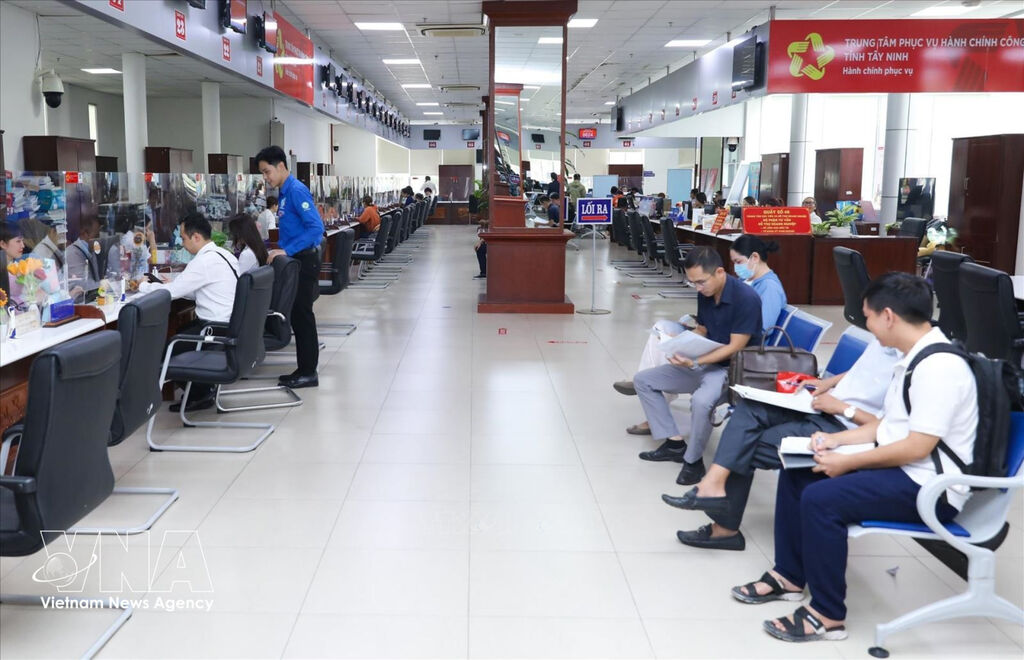
| Citizens at the Public Service Centre of Tay Ninh province to process administrative procedures. (Photo: VNA) |
Hanoi (VNA) – Deputy Prime Minister Ho Quoc Dung has signed a decision ratifying the programme implementing Project 06 on developing applications of population data, identification and electronic authentication to serve national digital transformation for 2026–2030, with a vision to 2035.
The project aims to comprehensively promote the development and application of population data, digital identity and electronic authentication across all sectors to accelerate national digital transformation and effectively support the pillars of digital government, digital economy and digital society.
It also seeks to help realise the goals set out in the 14th National Party Congress Resolution and key policies on breakthroughs in science-technology development, innovation and national digital transformation.
By 2030, the project targets completion of core digital platforms and utilities, ensuring that citizens and businesses can access fast, convenient and secure digital services without administrative boundary-related barriers. It also aims to build an interconnected national population data ecosystem with “accurate, sufficient, clean, live, unified and shared” data serving socio-economic development and national governance.
It focuses on six key groups of objectives for 2026–2030, including administrative reform and online public services; digital economy and society development; digital citizen development; expansion of digital infrastructure and data ecosystems; social welfare and the fight against crime; and support for scientific research and innovation.
Looking ahead to 2035, Vietnam envisions becoming a comprehensive and sustainable digital nation where all transactions between citizens and government agencies are conducted online. National databases, with population data at the core, will be interconnected and efficiently utilised to support smart governance and real-time decision-making.
Citizens are expected to benefit from personalised and automated digital services tailored to major life events, while digital technologies and data will be widely applied in healthcare, education, transport, agriculture, justice and security. Vietnam also aims to rank among the world’s top 50 countries in innovation and digital transformation and become a regional hub for data connectivity and digital industry development in Asia.
To achieve these goals, the project outlines a range of tasks and solutions, including improving legal frameworks related to population data and digital services, expanding digital infrastructure, and enhancing data integration and sharing.
A key measure is the introduction of a unified digital login system, allowing users to access multiple software platforms and public service systems with a single account through one-time authentication.
The project also emphasises the application of artificial intelligence (AI) and virtual assistants to support public services and administrative procedures. The Ministry of Public Security, in coordination with the Government Office and the Ministry of Science and Technology, is tasked with deploying AI-powered virtual assistants by September 2026.
Local administrations are expected to study and propose the establishment of “Digital Citizen Stations” at public locations, administrative offices and service centres by January 2027.
To support socio-economic development, the project will promote the use of electronic identification accounts in transactions and public services, while encouraging the development of applications based on population data and digital identity in sectors such as finance, banking, healthcare, education, tourism, logistics and e-commerce.
The project also calls for research into smart city solutions such as digital twins and digital location models connected with population and electronic identity databases.
Regarding digital citizen development, authorities will focus on enabling citizens to exercise their rights and obligations online, including contributing feedback on draft laws and legal documents, monitoring the use of personal data, and accessing digital public services.
The VNeID application will be further developed into a multi-utility national digital platform supporting digital transformation and digital citizenship. It will allow users to store personal digital documents, access online public services, link payment accounts and e-wallets, and serve as a secure communication channel between citizens, businesses and the State.
The project also aims to complete the creation of digital document wallets and personal data repositories on VNeID, while developing digital tools such as electronic identity accounts, digital signatures and digital payment systems./.