 |
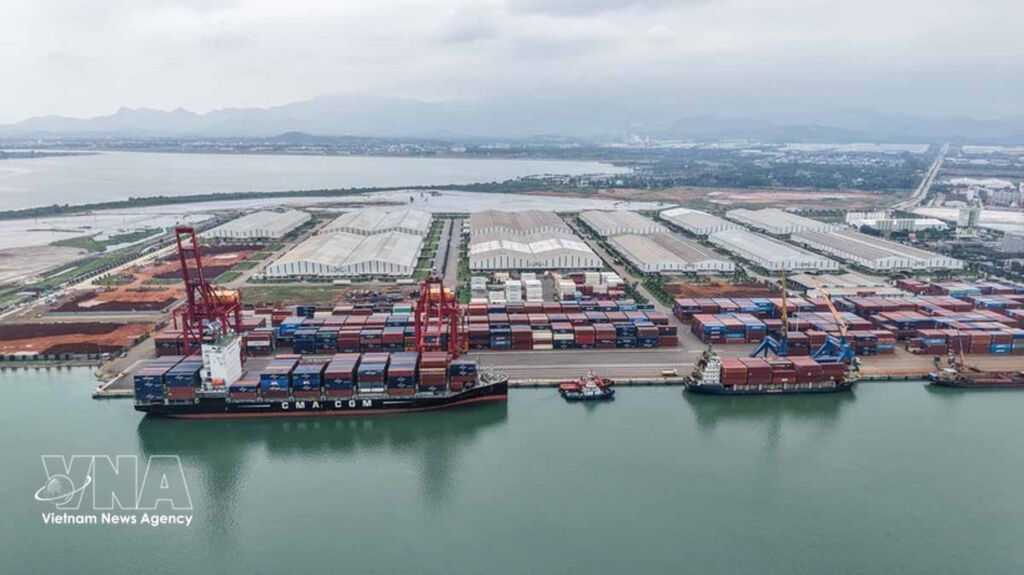
| Chu Lai International Seaport. (Photo: VNA) |
Hanoi (VNA) – With expanded development space and the emergence of new economic models, the central region – a coastal gateway of Vietnam – is gaining fresh momentum to develop logistics and attract strategic investment to seaport infrastructure.
New development space
Logistics and seaports have long been strengths of central coastal provinces. However, these advantages have yet to be fully tapped, meaning the marine economy has not become a key growth driver in many localities.
Tran Thanh Hai, Deputy Director of the Agency of Foreign Trade under the Ministry of Industry and Trade, said the region boasts solid logistics infrastructure, with major seaports such as Chan May, Da Nang, and Chu Lai – Ky Ha, well connected to road, expressway, rail and aviation networks.
The central region from Quang Tri to Quang Ngai contributes about 12–15% of Vietnam’s total import – export turnover. Key export commodities include agro-forestry-fishery products, textiles – apparel, footwear, processed food and raw materials. While Quang Tri and Hue focus on minerals, construction materials and garments, Quang Ngai, with the Dung Quat Economic Zone, is strong at exporting oil and heavy industrial products. Da Nang serves as a logistics and services hub, exporting software, electronic components and processed seafood. Meanwhile, Quang Nam, now part of Da Nang, was previously a centre for automobile and precision engineering industries.
Despite these advantages, the region’s export scale remains modest compared to the northern and southern hubs. This is largely due to fragmented logistics infrastructure, high transport costs, and the lack of internationally scaled trade and service centres. Seaports are scattered across localities, with no major hub capable of concentrating cargo for transshipment, while large integrated logistics centres remain limited.
Besides, most logistics firms in the region are small and medium-sized enterprises with limited capacity and weak integration into global supply chains. Although Da Nang accounts for about 40% of the logistics workforce in the central key economic region, many businesses still operate under traditional models and have yet to strongly adopt Industry 4.0 technologies.
These constraints highlight that the region’s logistics landscape remains underdeveloped and incomplete.
However, Hai noted that central Vietnam is entering a new phase of opportunity. Administrative boundary adjustments have expanded development space, enabling more comprehensive planning of inter-provincial logistics infrastructure and the formation of tightly linked supply chains.
Notably, the Government’s approval for Da Nang to establish a free trade zone is expected to mark a turning point, creating stronger international connectivity and fostering logistics and value-added service centres. With preferential tax policies and minimised administrative procedures, the model is likely to help attract large-scale foreign direct investment to the logistics industry and promote the development of regional hub ports.
Attracting strategic capital
Investment in seaports and logistics is gaining pace across the region, with both domestic and foreign investors showing strong interest.
In Da Nang, following the completion of shared infrastructure at Lien Chieu Port, authorities are accelerating the bidding process for the development of this port's container terminal complex. Covering around 172.6 hectares with total investment estimated at over 1.75 billion USD, the project will include eight container berths with a total quay length of 2,750 metres, capable of accommodating vessels of up to 18,000 TEUs. It is expected to become a modern international port and a key growth driver for the region.
Beyond Lien Chieu, Da Nang is investing in a coordinated logistics network, including Chu Lai, Tien Sa and Ky Ha ports, alongside upgrades to Da Nang International Airport, Chu Lai Airport, expressways, railways and industrial zones.
Other localities are also stepping up investment. In Dak Lak province, Hoa Phat Group has started work on the Bai Goc Port project with total investment of about 16.3 trillion VND (nearly 620 million USD). Designed to handle vessels of up to 220,000 DWT and with an annual capacity of 26.7 million tonnes, the port will play a strategic role in enhancing regional connectivity. Hoa Phat is also developing Phase 1 of the Hoa Tam Industrial Park, worth nearly 4.2 trillion VND. Together, Bai Goc Port and the Hoa Tam Industrial Park are expected to play a critical role in expanding development space, enhancing logistics infrastructure connectivity, and attracting investment in Dak Lak.
Meanwhile, Khanh Hoa province is developing modern logistics centres in Van Phong, Cam Ranh and other key areas, aiming to attract strategic investors and strengthen integrated transport, seaport, and warehouse infrastructure.
With expanded development space, new economic models and rising investment flows, central Vietnam is well positioned to turn logistics into a major driver of national growth./.