 |
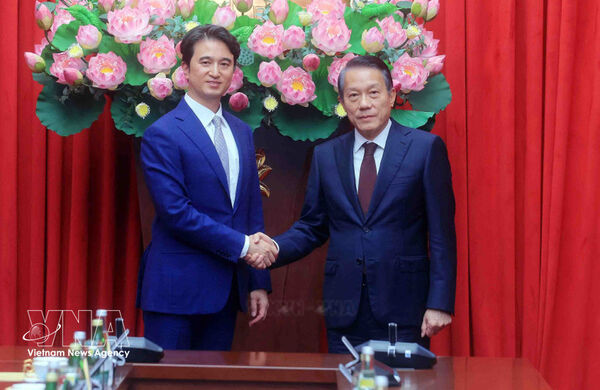
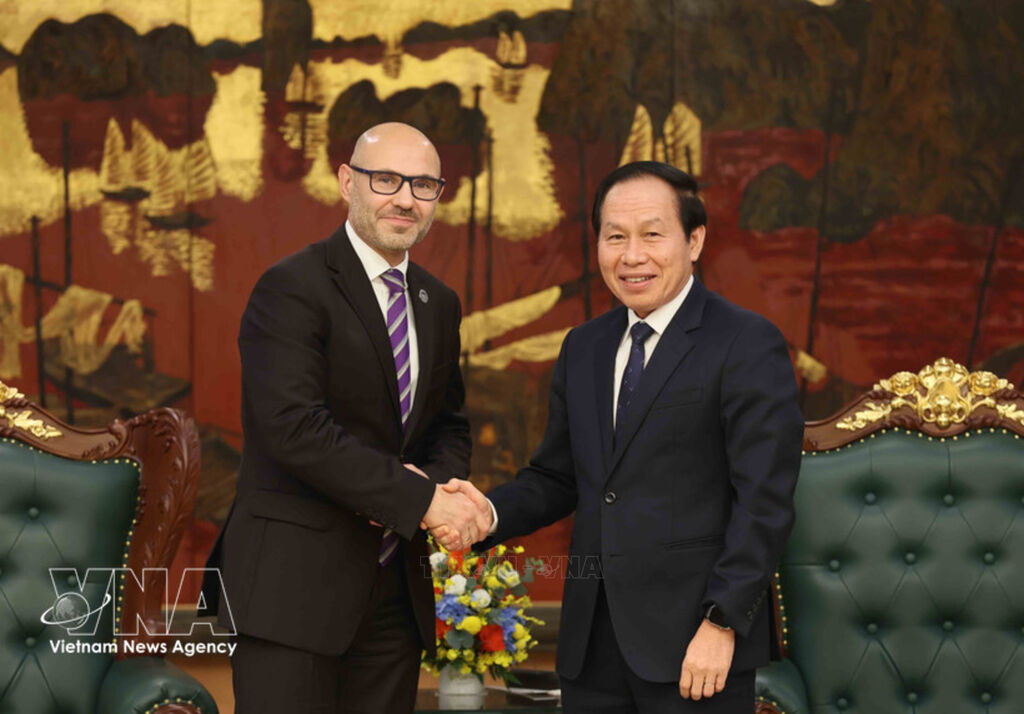
| Deputy Prime Minister Le Tien Chau (R) receives Dr. Marcin Czepelak, Secretary-General of the Permanent Court of Arbitration (PCA), in Hanoi on November 18, 2026. (Photo: VNA) |
Hanoi (VNA) – Deputy Prime Minister Le Tien Chau received Dr. Marcin Czepelak, Secretary-General of the Permanent Court of Arbitration (PCA), in Hanoi on the afternoon of November 18.
Speaking highly of the achievements of the PCA’s Hanoi Office over its four years of operation, Chau expressed his hope that the first international hearing will soon be held in Vietnam, paving the way for the country to become a trusted venue for dispute settlement, chosen by countries in the region and around the world.
He noted that, amid numerous changes in the regional and global situation, Vietnam consistently upholds the United Nations Charter and international law, particularly the principle of settling international disputes by peaceful means.
He recognised the PCA’s important role in safeguarding international peace and security and helping countries resolve disputes through arbitration and mediation, particularly those involving the interpretation and application of the 1982 United Nations Convention on the Law of the Sea (UNCLOS).
The Deputy PM called on the PCA to continue working with Vietnam to organise specialised training courses on international dispute settlement for officials from ministries and sectors; facilitate internships and employment opportunities at the PCA for young Vietnamese officials and legal professionals; and introduce and connect international experts with Vietnamese agencies and legal training institutions.
In addition to supporting the settlement of public international law issues, Chau expressed his hope that the PCA will share its experience, skills and expertise in resolving international investment disputes.
Vietnam’s approach to such disputes is to prevent them early and proactively, while promptly addressing investors’ feedback and recommendations. In 2026, the National Assembly of Vietnam adopted a resolution on coordination mechanisms and specific policies in this field. The country has also established a specialised court at the Vietnam International Financial Centre, he added.
The Deputy PM proposed that the PCA connect Vietnamese ministries and sectors, as well as the specialised court at the Vietnam International Financial Centre, with offices and partners in the PCA’s network. This will help Vietnam stay informed about international dispute settlement activities, proactively improve its institutions and effectively manage the risks of potential disputes.
He assigned the Ministry of Justice, the Ministry of Foreign Affairs and other relevant ministries and agencies to work with the PCA’s Hanoi Office and relevant bodies to implement specific cooperation initiatives.
Czepelak expressed his confidence that Vietnam will be an excellent host country and could become a regional hub for dispute settlement.
He noted that Vietnam is undergoing rapid and robust development and said the PCA wished to cooperate with and support the country in developing an appropriate legal framework to attract resources more effectively and realise its development goals.
Vietnamese legal experts have gradually gained international recognition in recent years, including through the election of Vietnamese candidates to the UN International Law Commission for two consecutive terms. In 2026, Vietnam had its first judge elected to the International Tribunal for the Law of the Sea.
Vietnam is also completing procedures to nominate an arbitrator for election to the PCA for the 2026–2030 term./.