 |
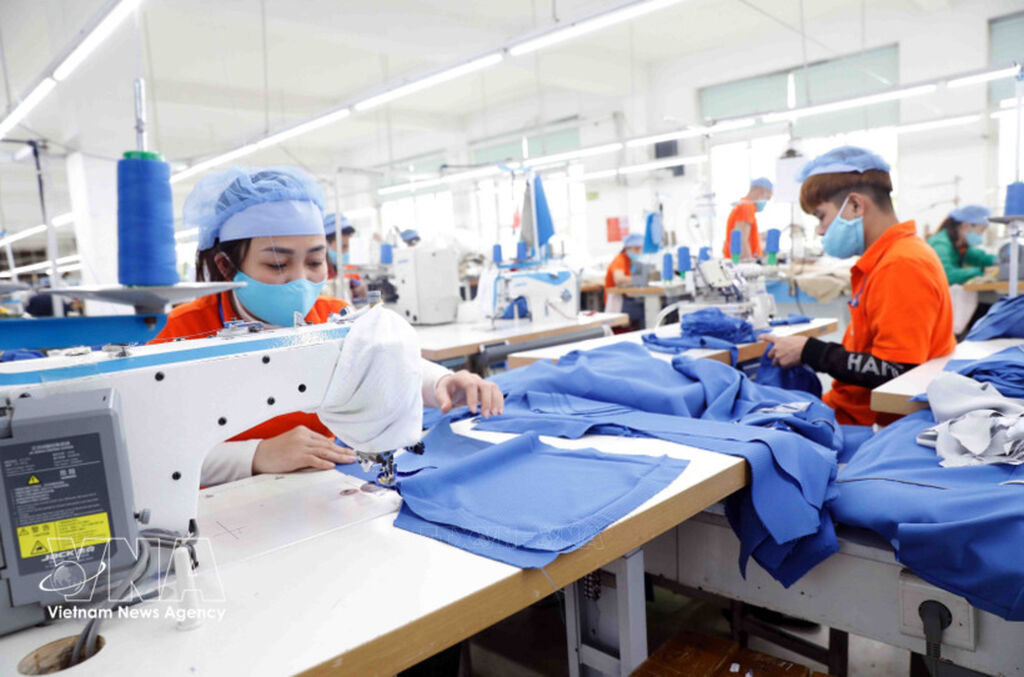
| Workers make clothes for export to the Japanese market at Hung Viet Garment Company in Hung Yen province (Photo: VNA) |
Hanoi (VNA) – Amid mounting global economic volatility and challenges, Vietnam’s textile and garment industry is rolling out a range of coordinated measures to maintain production momentum, with safeguarding workers’ livelihoods and incomes a top priority.
Commenting on the issue, Pham Xuan Hong, Chairman of the Ho Chi Minh City Association of Garment Textile Embroidery Knitting (AGTEX), said that despite facing widespread difficulties in the global economy since the beginning of the year, businesses have firmly embraced a pragmatic business philosophy, under which the top priority is not maximising profit margins but maintaining jobs and ensuring stable incomes for workers who remain committed to their factories.
He noted that stable employment has been maintained for more than 1.86 million workers at industrial enterprises.
Alongside pressure to maintain employment, increasingly demanding requirements from partners regarding quality and designs are forcing businesses to respond flexibly, even to small orders.
According to import-export balance report data, textile and garment exports reached 39.84 billion USD in the first ten months of 2026, up 3.9% year on year. In October alone, export turnover stood at 4.08 billion USD, up 0.9% from September and 9.8% from October 2025. Domestic businesses have maintained robust production, with many having full order books for the final months of the year, providing a basis for the sector to target export earnings of 48–49 billion USD in 2026.
To achieve the annual target, textile and garment businesses are jointly implementing several core tasks, including diversifying export markets and partners, developing the supporting industries for raw materials and accessories to establish integrated supply chains, investing in technological innovation linked to AI, stepping up high-quality workforce training, promoting green transformation based on circular economy models, and building brands in both domestic and international markets.
Vietnamese textile and garment products are currently available in 137 countries and territories. The US remains the key market, accounting for around 40% of exports, alongside traditional markets such as the European Union, the Republic of Korea, Japan, China and ASEAN member states, as well as potential markets in Africa and the Middle East.
Market expansion enables businesses to spread risks, proactively seek customers and adapt to changing demand across global supply chains. At the same time, closer links among businesses along the supply chain are being prioritised to improve coordination, share resources and better meet stringent requirements from international partners.
However, behind the growth figures lies pressure to improve the quality of growth, as tariff fluctuations, geopolitical conflicts and risks of supply chain disruptions can directly affect costs, delivery schedules and the ability to retain orders. Customers are paying increasing attention to the origins of raw materials, production conditions and resource consumption. The sector therefore faces the need to strengthen its self-reliance in materials, technology and design.
Under its supporting industry development programme for 2026–2035, the sector aims to raise the localisation rate in textiles and garments to 60% by 2030, helping businesses meet rules of origin and increase value added across production chains.
To achieve this target, support initiatives are focused on improving suppliers’ capabilities in quality, management, technology and delivery, while tightening links across the spinning, weaving, dyeing, finishing and garment-making stages. Throughout this process, workers remain central to the sector’s development and need continuous training to master new technologies, with productivity gains going hand in hand with higher incomes and sustainable, quality employment./.