 |
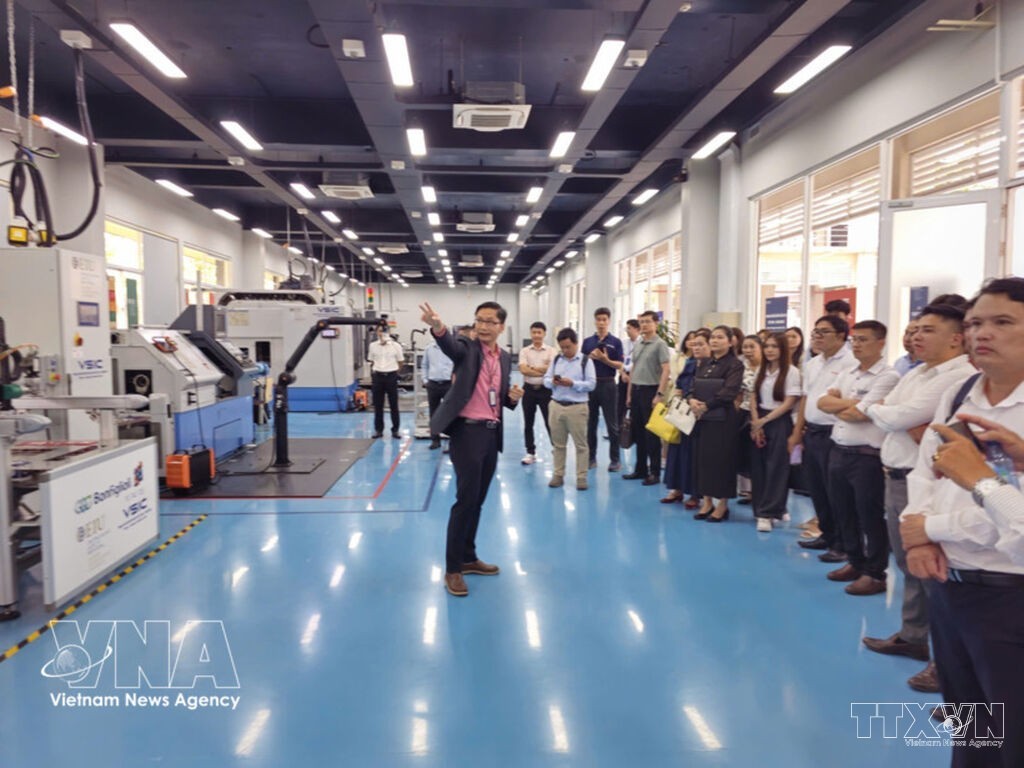
| Delegates tour the facilities of the industrial innovation centre at Eastern International University in Binh Duong ward, Ho Chi Minh City (Photo: VNA) |
Hanoi (VNA) – All university students will be required to graduate with digital competencies and knowledge of artificial intelligence (AI) under a new regulation issued by the Ministry of Education and Training (MoET), marking the first time these skills have been made compulsory learning outcomes for undergraduate programmes.
The requirement is among the key provisions of the ministry's Circular No. 54/2026/TT-BGDDT on higher education curricula, which establishes a unified framework for the design, implementation and quality assurance of bachelor's, master's and doctoral programmes.
Under the circular, learning outcomes must be defined as measurable and assessable competencies, providing the basis for curriculum design, teaching, assessment, quality improvement, credit recognition and degree awarding.
For undergraduate programmes, graduates must demonstrate digital competencies, AI-related knowledge, proficiency in a foreign language, and the ability to adapt and pursue lifelong learning.
Master's programmes must equip students with research, innovation, applied knowledge, and development capabilities. Doctoral programmes are required to foster independent research capacity, the ability to propose new technologies or solutions, produce scientific publications or applied research outcomes, and guide research and innovation.
The circular also sets minimum credit requirements for each qualification level. Undergraduate programmes and Level-6 qualifications must comprise at least 120 credits, while specialised programmes require a minimum of 150 credits. Master's programmes must include at least 45 credits, and doctoral programmes 90 credits.
Curricula must clearly align educational objectives, learning outcomes, course content, teaching methods, assessment and quality assurance conditions. They must also specify compulsory and elective components to enable students to build learning pathways suited to their abilities and career goals.
Along with foundational and specialised knowledge, undergraduate programmes must include supplementary training in foreign languages, digital competencies, AI and other essential knowledge and skills. Meanwhile, academic and research-oriented programmes are required to strengthen scientific research and innovation activities, while application-oriented programmes must place greater emphasis on practical training, internships, professional experience and real-world projects.
The circular also introduces detailed requirements for interdisciplinary, multidisciplinary, double-major, major-minor and integrated programmes, as well as specialised tracks such as honours engineering and honours bachelor's programmes, among others.
These regulations provide a legal foundation for higher education institutions to develop academic programmes tailored to the specific characteristics of each discipline, training objectives, and workforce demands, while ensuring learning outcomes and maintaining quality education.
It also tightens faculty requirements. In undergraduate programmes, full-time lecturers holding doctoral degrees must teach at least half of the specialised curriculum. The proportion rises to at least 75% for specialised Level-7 and master's programmes. All doctoral lecturers must hold PhDs, maintain active research and scientific publications, and meet supervision requirements for doctoral candidates.
To ensure quality, higher education institutions must provide adequate practice facilities, libraries, digital learning resources, information technology platforms and other teaching support systems.
Special provisions are also introduced for disciplines such as health sciences, teacher education, the arts, sports, ethnic minority and rare languages, reflecting their specific professional and training requirements./.