 |
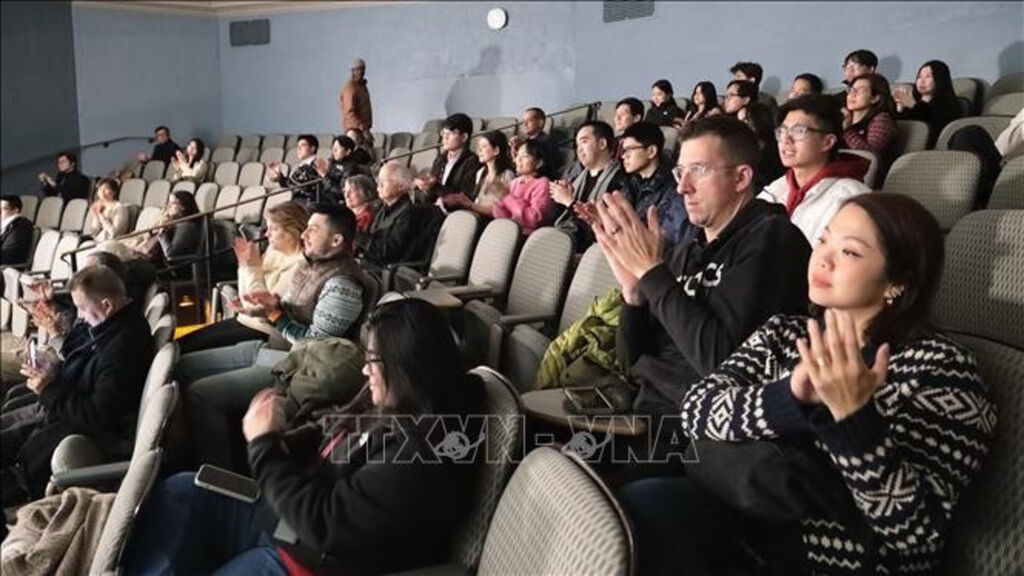
| Audiences at the screening of the documentary "Once Upon a Bridge In Vietnam" at Harvard University (Photo: VNA) |
Washington D.C. (VNA) – The documentary "Once Upon a Bridge In Vietnam" by French-Vietnamese director François Bibonne has been screened at Harvard University in Boston, Massachusetts, offering an opportunity for the spirit and image of Vietnam and its people to resonate at one of the world’s leading centres of scholarship.
Speaking to the Vietnam News Agency (VNA), Bibonne said his memories of Vietnam are shaped by intimate images recalled through his grandmother’s stories – village wells, banyan trees, and folk songs she called “the sounds of home”.
Those memories have long inspired him to return and do something meaningful for his homeland. This motivation gave rise to the "Once Upon a Bridge In Vietnam" series, conceived as an emotional yet gentle bridge connecting international audiences with the S-shaped country. While "Once Upon a Bridge I" weaves together Quan ho folk songs, traditional culture, landscapes and people, "Once Upon a Bridge II" presents a special bridge, bringing Vietnam to the world through football.
Held at Harvard University, the screening drew students, lecturers, researchers in Southeast Asian and Vietnam studies, as well as members of the Vietnamese and Vietnamese-origin community living and studying in Boston.
From the opening scenes, the film immersed viewers in a distinctly Vietnamese rhythm of life – Hanoi’s traffic sounds, the green of rice fields, fiery football stands, and folk melodies and monochord music echoing in a modern setting. The documentary became an “open classroom” on Vietnam where lessons are conveyed through images and music rather than textbooks.
Bibonne adopted an everyday perspective, capturing children playing football on dirt fields, passionate fans in cities and rural areas, and the raw excitement in the stands. Interwoven with these images is traditional music – from the monochord and Quan ho melodies to gong performances – blended with the sounds of urban life and the football pitch.
This combination enabled Harvard audiences, even those who have never visited Vietnam, to sense the “Vietnamese spirit” – community bonds, simple joys, aspiration, and pride in national colours. Through Bibonne’s lens, football becomes a bridge inviting international friends to explore Vietnam’s cultural depth.
The post-screening discussion between the director and the audience unfolded in an open and warm atmosphere. Questions focused on his personal journey as a French-Vietnamese returning to his roots, his approach to traditional music, and his choice of football as a medium connecting Vietnam with the world. The exchange also broadened into reflections on national identity and the role and responsibility of young overseas Vietnamese in telling “Vietnam’s story” globally.
The screening of a documentary about Vietnam at Harvard carried significance beyond artistic value. It testified to the appeal of authentic and nuanced stories about a Vietnam undergoing dynamic transformation while preserving its cultural identity.
For the Vietnamese and Vietnamese-origin community in the US, the event offered a fresh yet familiar view of their homeland. For international audiences, it provided a closer and more human understanding of Vietnam – not only through history or economic data, but through laughter on football fields, the haunting sound of the monochord, and the bright eyes of people across the S-shaped land./.