 |
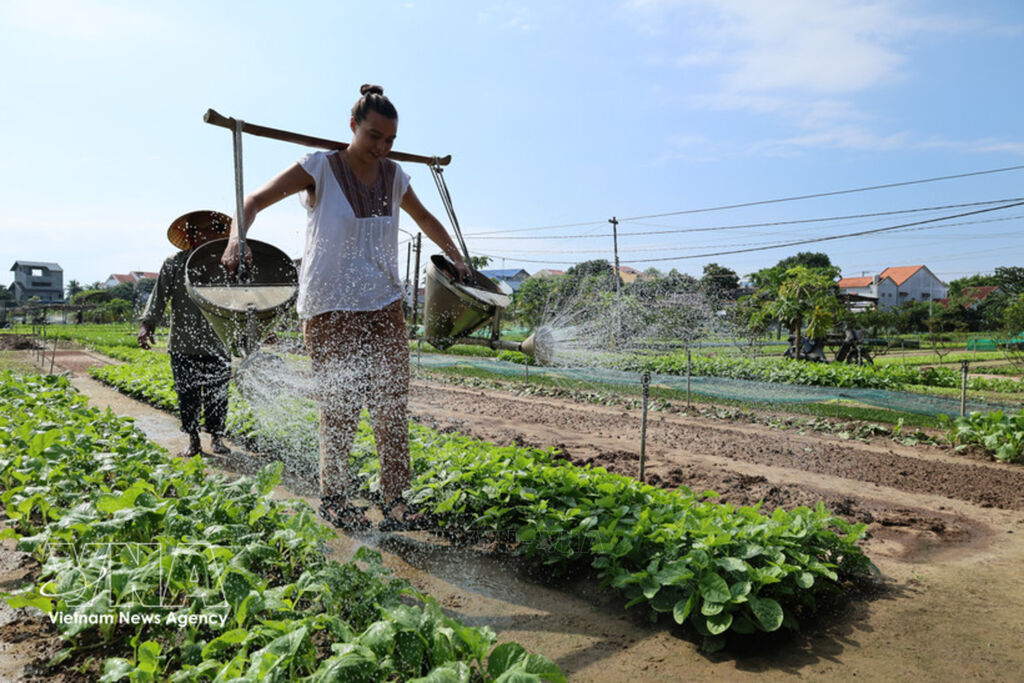
| A foreign tourist experiences farmers’ daily watering activities in Tra Que vegetable village, Da Nang city. (Photo: VNA) |
Hanoi (VNA) – The central city of Da Nang is stepping up efforts to develop green, responsible and sustainable tourism, making environmental protection an integral part of its destination competitiveness.
It aims not only to become environmentally friendly but also to promote green governance, operations, tourism products and visitor experiences.
Da Nang’s tourism sector continues to translate development objectives into concrete actions, promoting the city’s role as one of the three national tourism growth poles, together with Hanoi and Ho Chi Minh City, identified in the Politburo’s Resolution No. 26-NQ/TW and relevant tourism development plans.
The 2025 expansion of the city’s administrative boundaries has created greater development space and brought together diverse resources, ranging from urban areas, beaches and cultural heritage sites to traditional craft villages and mountainous ecosystems.
Nguyen Thi Hoai An, Deputy Director of the municipal Department of Culture, Sports and Tourism, said this offers opportunities to develop distinctive and competitive tourism products while promoting the responsibility for natural resources and environmental protection.
The city has stepped up waste sorting at tourism business establishments and waste collection in major tourist areas, including Son Tra Peninsula, Cu Lao Cham and beaches. Community initiatives such as “Clean Up Son Tra”, “Clean Up Da Nang – Go Green Stay Green”, marine waste collection, coral reef protection and “Waste for Green Plants” have also helped raise environmental awareness among businesses, residents and visitors.
With more than 2,400 accommodation establishments and over 67,000 rooms, the accommodation sector is considered a key driver of Da Nang’s green transition.
Hoai An said green transition does not necessarily require substantial investment, as businesses could begin with practical measures such as saving electricity and water, reducing plastic waste and using resources efficiently.
The municipal Department of Culture, Sports and Tourism has advised the city People’s Committee to introduce the Da Nang Green Stay criteria, encouraging accommodation providers to adopt environmentally friendly practices and gradually improve their operations.
Deputy Director of the Vietnam National Authority of Tourism Vu Quang Dung recommended that Da Nang focus on four priorities: strictly managing the carrying capacity of tourist destinations, balancing tourism development between the eastern and western areas, integrating digital transformation with green transition, and institutionalising a local green tourism criteria framework.
The city should establish quantitative indicators to control visitor numbers in ecologically sensitive areas such as Son Tra Peninsula and Cu Lao Cham, as well as world heritage sites including Hoi An and My Son.
It should also expand tourism development westward through community-based ecotourism and rural tourism, linking clean agricultural products at the farmgate with high-end tourism services.
Applying smart digital data to green management, including energy auditing and automated waste management at major hotels along the coast and Han River, is another priority.
In the coming period, Da Nang’s tourism sector will strengthen cooperation among accommodation providers, travel agencies, transport companies, restaurants, craft villages and local communities. OCOP (One Commune One Product) items and indigenous cultural experiences will be incorporated into tourism programmes to create interconnected value chains.
The city also plans to tap the tourism potential of its southern areas, including Tam Ky, Phu Ninh and coastal and island communes, through community-based tourism, traditional crafts, agricultural ecotourism and local cuisine.
These efforts will go hand in hand with landscape conservation, cultural preservation and ecosystem protection, while ensuring local residents play a central role in tourism development and benefit more equitably from the sector./.