Hanoi, Ho Chi Minh City to begin motorcycle emissions testing from July 2027
After the two major cities in 2027, the scheme will expand to other cities from July 1, 2028, and to the remaining provinces from July 1, 2030.
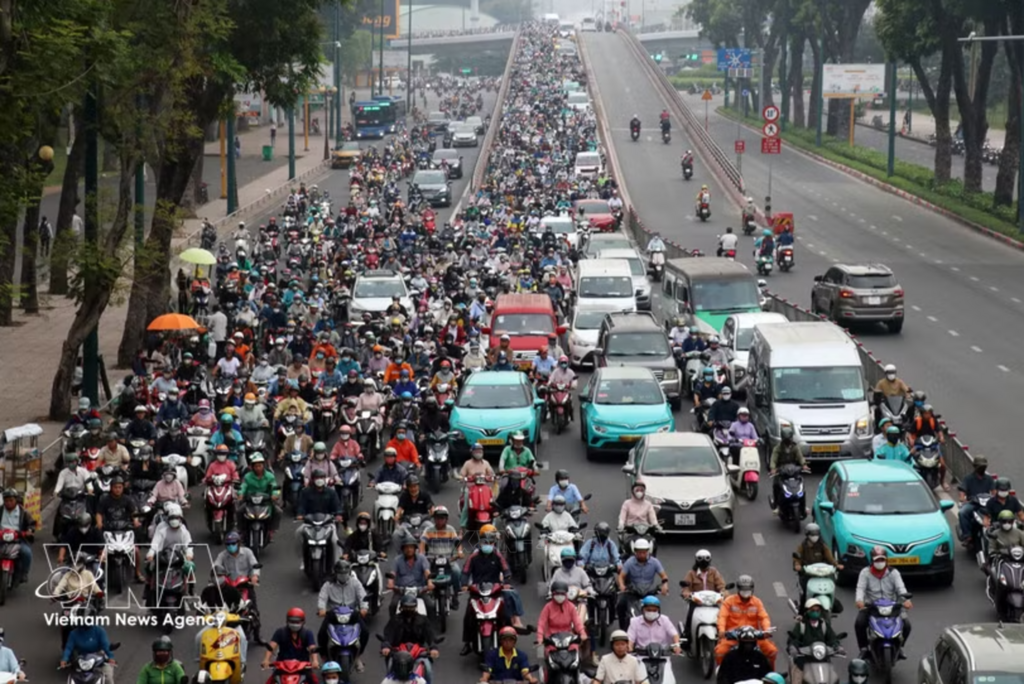
Vehicles on a street in Ho Chi Minh City. (Photo: VNA)

Hanoi (VNA) – Motorcycles and mopeds in Hanoi and Ho Chi Minh City will be subject to mandatory emissions inspections from July 1, 2027, under a newly issued roadmap by the Prime Minister.

Under Decision No. 13/2026/QD-TTg, the national technical regulation on emissions for motorcycles and mopeds will be implemented in phases nationwide. After the two major cities in 2027, the scheme will expand to other cities from July 1, 2028, and to the remaining provinces from July 1, 2030. Localities may opt for earlier implementation depending on actual conditions.

The regulation sets out emission standards based on the year of manufacture or import. Motorcycles produced before 2008 will be subject to Level 1 standards, while those made between 2008 and 2016 must meet Level 2 limits. Vehicles manufactured from 2017 to June 30, 2026, will be required to comply with Level 3 standards, and those produced from July 1, 2026, onwards must meet the stricter Level 4 limits.

For mopeds, those manufactured before 2016 must meet Level 1 standards, while those produced between 2017 and June 30, 2027 must comply with Level 2. Vehicles manufactured on July 1, 2027, will be subject to Level 4 standards.

Notably, from January 1, 2028, all motorcycles and mopeds operating in Hanoi and Ho Chi Minh City must meet at least Level 2 emission standards, regardless of their year of manufacture.

In addition, vehicles entering designated low-emission zones in Hanoi, as stipulated by the Law on the Capital, will be required to comply with specific emission standards set by the municipal People’s Council./.

Related News

Major environmental targets for 2026–2030

The Resolution of the 14th National Party Congress sets several environmental targets for the 2026–2030 period, including maintaining forest coverage at 42 percent, cutting greenhouse gas emissions by 8–9 percent, treating and reusing 65–70 percent of wastewater in river basins, and expanding marine and coastal protected areas to at least 6 percent of Vietnam’s maritime area.

Green transport remains inevitable path for sustainable cities

The transition to transport powered by clean energy is becoming an inevitable trend in efforts to reduce greenhouse gas emissions, improve urban air quality and lessen dependence on fossil fuels. In Hanoi, the development of electric buses, the promotion of green transport and the gradual building of a sustainable transport system not only help realise the city’s green growth goals but also contribute to Vietnam’s commitment to achieving net-zero emissions by 2050.

See Also

Hanoi targets 30% public transport use to ease traffic congestion

To tackle the issue, Hanoi has developed a comprehensive plan for the 2025–2030 period, focusing on 10 key groups of solutions. These include improving mechanisms to attract investment in transport infrastructure, adjusting traffic planning to better match urban development, and accelerating construction of ring roads, radial routes and bridges across the Red River.

Ministry works to ensure rice production, exports align with market developments

Accordingly, between January and March, rice output reached 3.64 million tonnes; livestock production attained 2.28 million tonnes of meat, up 4.9%; fisheries output reached 2.7 million tonnes, up 3.3%; and forestry production totalled 12 million cubic metres of timber, an increase of over 3%. The sector’s export turnover reached 16.69 billion USD, up 5.9%, with a trade surplus of 4.78 billion USD, up 12%.

All People’s Health Day promotes early disease prevention

The launch marked the first year the activity has been implemented in a coordinated manner nationwide. Members of the public were able to visit free screening areas, receive nutritional advice, participate in mass exercise performances, enjoy artistic programmes, and join a walk in response following the ceremony.

Key rules to prevent online fraud

As technology advances at fast speed, 2026 is expected to mark a new phase of cybercrime, with criminals increasingly exploiting AI tools such as deepfakes, voice cloning and virtual personas to carry out ever more sophisticated impersonation scams. In this evolving landscape, prevention goes beyond simply verifying information, it requires strict and reliable authentication processes.