 |
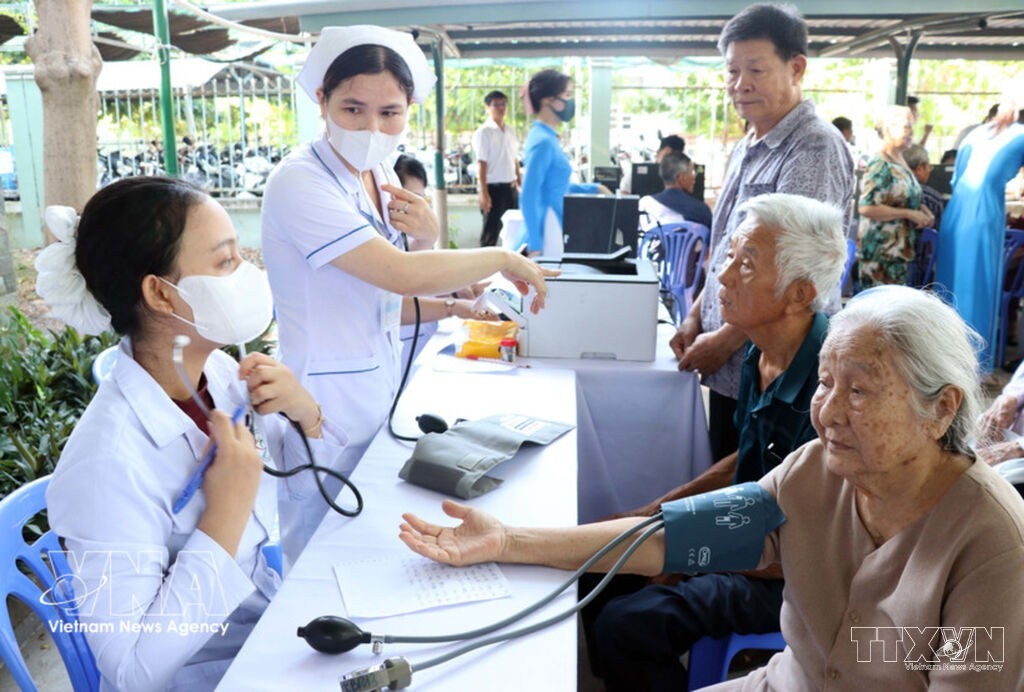
| Medical workers from Ninh Thuan General Hospital in Khanh Hoa province provide check-ups for elderly people. (Photo: VNA) |
Hanoi (VNA) – Vietnam's health insurance system covered about 94.4 million medical examinations and treatments in the first half of 2026, while efforts to strengthen digital management and cost control helped improve the implementation of the national health insurance policy, according to Vietnam Social Security (VSS).
The figures were announced at a nationwide online conference held by VSS on July 30 to review the implementation of health insurance policies in the first six months of the year and outline measures to control healthcare spending in the remainder of 2026.
According to the agency, by the end of June, 3,672 medical facilities nationwide had signed up to provide health insurance-covered services, including 2,354 public and 1,318 private healthcare establishments, 26 more than in 2025.
The network comprises 94 specialised hospitals, 1,498 basic-level facilities and 2,080 primary healthcare providers, helping meet the country's growing and increasingly diverse healthcare needs.
Health insurance covered around 94.4 million patient visits during the January-June period, similar to the same period last year. Inpatient treatment accounted for 10.3% of total cases, slightly higher than in 2025.
Total health insurance spending reached 84.77 trillion VND (3.22 billion USD), up 11.1% year-on-year and equivalent to 54.4% of the full-year spending estimate.
Opening the conference, VSS Director Le Hung Son said the agency had implemented a wide range of measures to improve the delivery of health insurance and better protect the interests of participants.
He noted, however, that rising healthcare costs pose growing challenges in the second half of the year, requiring stronger management, higher-quality medical claims assessment and stricter enforcement of regulations.
Son urged local authorities to carefully assess the implementation of health insurance policies, identify shortcomings and adopt practical solutions. He also called for greater use of data analysis to monitor healthcare spending, detect unusual cost patterns at medical facilities and prevent overspending that could affect the balance of the health insurance fund and the rights of insured patients.
VSS said it had worked closely with local authorities to implement new health insurance regulations that took effect this year, while ensuring timely reimbursement for medical services and improving the quality of claims assessment to safeguard participants' legitimate rights.
The agency has also accelerated digital transformation by expanding the use of information technology, data analytics and artificial intelligence in health insurance management. Early warning systems have helped detect unusual spending patterns and curb abuse of the health insurance fund. As a result, the number of provinces and centrally-run cities with health insurance spending exceeding the national average has fallen from 28 to 13.
Despite these achievements, VSS acknowledged several challenges. Average healthcare costs per insured patient increased by 11.7% from a year earlier, with spending rising sharply in several localities, including Hanoi, Ho Chi Minh City, Vinh Long, Ca Mau and Son La.
The conference also identified delays in processing some reimbursement claims, inconsistent cost monitoring and shortcomings in the use of medical services and equipment at some healthcare facilities. Participants stressed the need for stronger financial discipline, more effective supervision and greater accountability to ensure the sustainable operation of Vietnam's health insurance fund while protecting participants' benefits./.