 |
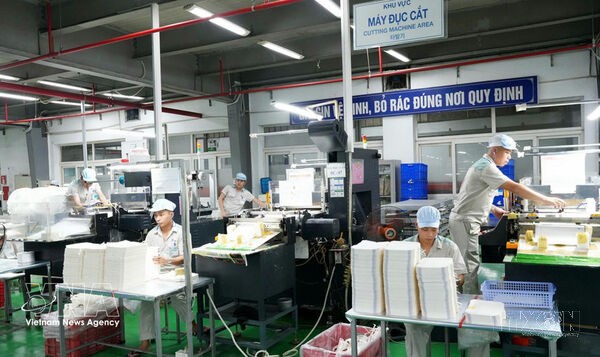
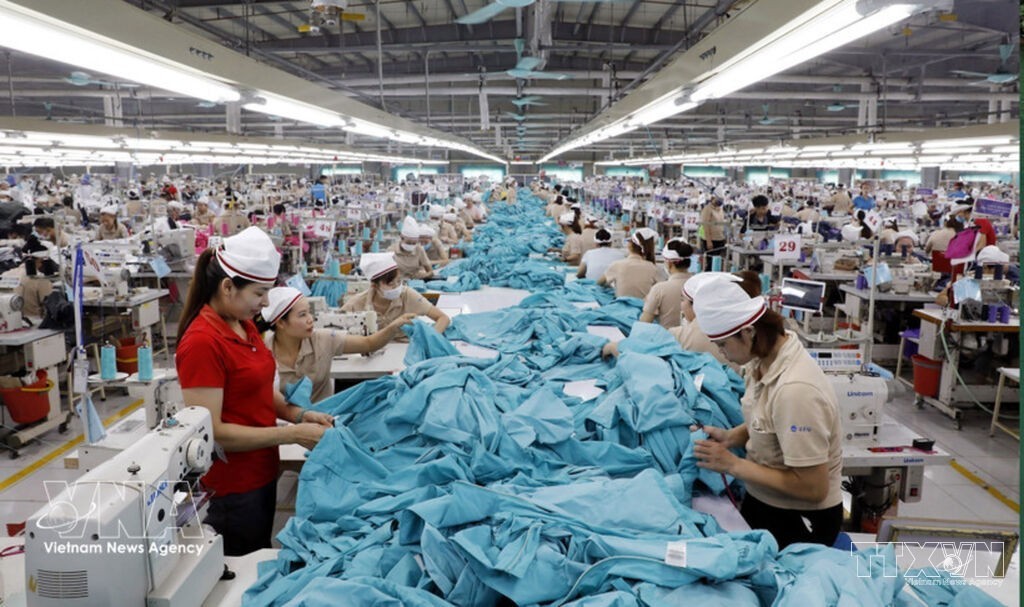
| Workers produce garments for export at Viet Pan Pacific World Co., Ltd. of the Republic of Korea in Hiep Hoa commune, Bac Ninh province (Photo: VNA) |
Hanoi (VNA) – International media outlets and leading global financial institutions have shown confidence in Vietnam's economic prospects, citing stronger foreign investment quality, sustained structural reforms and the country's improving position in the global economy.
A shifting investment landscape
The Business Times of Singapore recently reported that Vietnam moving up the value chain is attracting high-quality investment from Asia in the first half of 2026 despite shifts in the composition of foreign direct investment (FDI).
According to official data cited by the newspaper, Vietnam drew 34.65 billion USD in newly pledged capital, additional capital for existing projects, and foreign investors’ capital contributions and share purchases during the January–June period, up 61% year-on-year.
New commitments from mainland China fell 54% to 977 million USD in the first six months, cutting its share of the total to 5.6% from 22.9% a year earlier. Including inflows from Hong Kong and Taiwan, investment from Greater China also fell more than 48% to 1.84 billion USD, from 3.55 billion USD.
At the end of June, it only represented 10.6% of the total new commitments to Vietnam, from 38.2 % in the first half of 2025 and 36.5% at the end of last year, The Business Times said.
Meanwhile, Singapore and the Republic of Korea together accounted for about 73 % of the 17.39 billion USD in newly registered capital in the first half, a total already exceeding the amount attracted in all of 2025. This reflected increased investment commitments from Singaporean and Korean investors to Vietnam.
The Business Times said the shift indicates that Vietnam continues to attract foreign investment while reshaping its FDI structure towards higher-value projects amid changing regional trade dynamics.
It also highlighted rising investment from the RoK as evidence that Vietnam is securing larger-scale projects. Although the number of Korean-invested projects remained largely unchanged – at more than 200, average investment per project surged to 25.8 million USD from around 1.1 million USD previously.
Enhancing Vietnam's position
Vietnam's improving international standing has also been recognised by other global institutions.
Earlier this month, the World Bank upgraded Vietnam and the Philippines to upper-middle-income status following years of strong economic growth. The Straits Times of Singapore said the move would reinforce investor confidence in both countries.
The WB described Vietnam's export-led growth model as reflecting broad-based progress across major industries rather than dependence on a single sector.
According to The Straits Times, Vietnam, one of Asia's fastest-growing economies, is targeting double-digit growth from 2026, partly supported by business-friendly reforms and large-scale infrastructure investment.
The Business Times also noted that manufacturing, exports and construction have been the narrative of Vietnam’s growth story for at least the last five years as the Southeast Asian economy benefited from the restructuring of the global supply chain.
In the background, a quieter engine is now picking up steam, as retail sales and consumer-service spending surge to prominence, it noted.
Meanwhile, global credit rating agency Fitch Ratings forecast Vietnam's medium-term growth to outperform many economies with similar credit ratings.
According to Fitch Ratings, this reflects expectations that Vietnam will continue to adapt to attract robust FDI into high value-added industries. Growth is also expected to be supported by increased public infrastructure investment, favourable demographics, continued expansion of the services sector and broad structural reforms.
The agency also expects Vietnam's strong political consensus to support the effective implementation of policy priorities, including improving the investment climate, boosting productivity through technology and innovation, and strengthening private sector development./.