 |
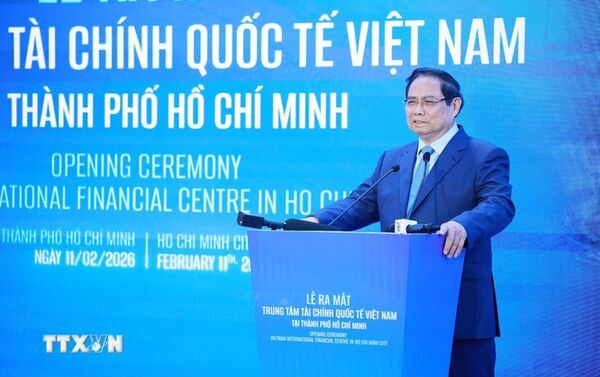
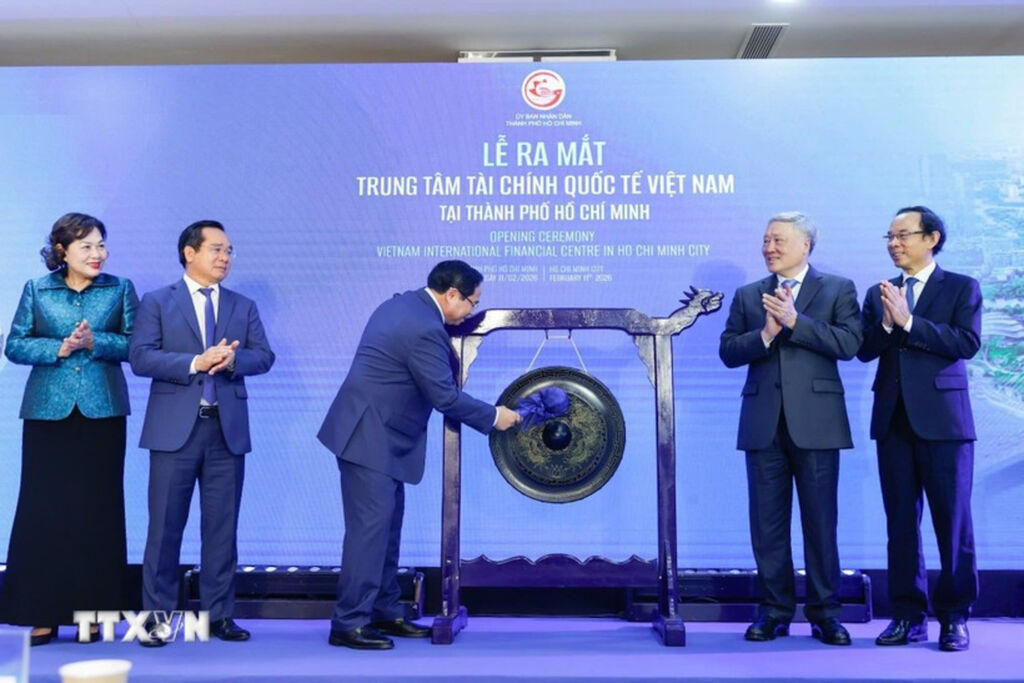
| Prime Minister Pham Minh Chinh strikes the gong to inaugurate the Vietnam International Financial Centre in Ho Chi Minh City. (Photo: VNA) |
Ho Chi Minh City (VNA) - Following the inauguration of the International Financial Centre (IFC) in Da Nang city, Vietnam has officially launched its International Financial Centre in Ho Chi Minh City, marking what leaders describe as a pivotal step in the country’s economic transformation.
In an interview granted to the Vietnam News Agency after the launch ceremony, Standing Deputy Prime Minister Nguyen Hoa Binh, who chairs the IFC’s Governing Council, said that the establishment of the centre in Ho Chi Minh City and Da Nang represented the initial realisation of a major task set out in the Resolution of the 13th National Party Congress. While characterising the launch as an early milestone rather than a final achievement, he underscored that it reflected meticulous, methodical and determined preparations at multiple levels of government.
According to the Deputy PM, preparations had been comprehensive and synchronised across three pillars, namely political decision-making, legal infrastructure and implementation conditions.
On the political front, in a short period the Government had advised the Politburo to issue a formal conclusion endorsing the development of an IFC in Vietnam. That conclusion, he explained, served as a strategic compass, defining principles, objectives, development models and a clear roadmap for action.
In terms of legal groundwork, the Government subsequently submitted to the National Assembly a draft resolution on the IFC, clarifying its role, policy mechanisms and institutional innovations. The legislature adopted a dedicated resolution on the centre and approved the Law on specialised courts at the IFC. This move, Binh observed, was a critical step to ensure that dispute settlement mechanisms align with international financial practices and standards.
To implement the Politburo’s Conclusion and the NA’s Resolution, the Government promulgated eight decrees detailing specific, preferential and transparent policy mechanisms designed to attract investors and high-caliber professionals. These decrees, formulated after extensive study of international experience and consultation with ministries and municipal authorities, define operational models, institutional responsibilities and talent recruitment policies. Together with implementing regulations issued by the Governing Council and executive bodies in both cities, they form what he described as a largely complete legal corridor for the IFC’s initial operation.
Beyond legislation, the Deputy Prime Minister highlighted extensive efforts to secure implementation conditions. Ministries and local authorities have organised administrative structures, recruited personnel, developed digital infrastructure and prepared physical facilities. Both cities, he said, have already attracted experienced international executives, financial experts and overseas Vietnamese intellectuals. Training partnerships, including specialised programmes with Vietnam–Germany University, have also been launched to strengthen managers’ capacity.
Despite this progress, the Deputy PM acknowledged that further investment in physical and digital infrastructure remains essential. Drawing on discussions with international experts and former leaders, including former Singaporean Prime Minister Lee Hsien Loong and former UK Prime Minister Tony Blair, he emphasised that “credibility” constitutes the core determinant of any successful financial centre. Such credibility, he explained, rests on transparent and internationally compatible legal frameworks, global connectivity, high-quality human resources and impartial dispute resolution institutions, underpinned by modern physical and digital systems.
Assessing the IFC’s broader significance, Deputy PM Binh described it as a breakthrough solution and a powerful “boost” for Vietnam’s economy as the country enters a new development phase marked by ambitious goals.
First, he stressed that the IFC will equip Vietnam with an essential platform to accelerate growth beyond traditional models. While ongoing administrative reform and institutional streamlining are unlocking domestic resources, the centre will open new external development space and strengthen national competitiveness.
Second, he characterised the initiative as representing the highest level of economic integration. Having integrated deeply into global trade and investment networks, Vietnam is now moving into advanced financial integration, which requires compliance with rigorous global standards. Notably, the National Assembly has allowed for the application of common law principles and the participation of international judges in dispute resolution - an unprecedented institutional innovation for the country. Digital infrastructure, he added, must likewise enable seamless, real-time connectivity with leading financial hubs worldwide.
Third, the IFC is expected to facilitate economic restructuring. As traditional growth drivers reach their limits, Vietnam must transition toward innovation-based, green and digital models, while meeting its net-zero commitments. The rapid expansion of digital and crypto assets - reportedly involving 17 million domestic accounts and annual transactions exceeding 200 billion USD - underscores the need for a modern regulatory framework. The financial centre will provide an institutional platform to manage and harness these emerging sectors effectively, and accelerate the restructuring of the economy toward a more modern and sustainable model, in line with prevailing global trends.
Fourth, Binh highlighted the IFC’s role as a capital mobilisation channel. Vietnam faces substantial financing needs for strategic projects such as high-speed rail, renewable energy, nuclear power and national data centres. By establishing a large-scale, modern capital market that connects international flows with domestic demand, the IFC can serve as a vital financial engine for infrastructure and socio-economic development.
Fifth, the city will help shape a new economic and urban landscape not only for the host localities but for the country as a whole.
Sixth, he described the IFC as a valuable real-world training ground for cultivating high-rankin officials and professionals. Effective participation in the global financial arena, he stressed, requires a workforce that meets international standards. In the immediate term, Vietnam must attract and engage experienced foreign experts. Over the longer term, however, the country should strive for self-reliance in training a pool of highly qualified personnel capable of assuming and operating key functions within the centre.
Seventh, Binh described the IFC as a powerful catalyst for both attracting and upgrading the quality of foreign direct investment (FDI) flows, adding that with the centre, Vietnam’s investment environment will become significantly more conducive and competitive.
Eighth, he underscored that the centre will generate opportunities and prosperity not only for investors and financial institutions but also for the broader public. When organised in a systematic, transparent and well-regulated manner, the financial centre will expand access to high-quality financial services, enabling individuals to manage personal assets more securely and to grow their savings effectively, thereby contributing to sustainable value creation across society.
The Deputy Prime Minister outlined six priority tasks: refining the legal framework toward eventual codification into a comprehensive IFC law; developing comprehensive physical infrastructure and a high-quality living ecosystem for investors and their families; ensuring globally compatible digital connectivity; strengthening human resources and dispute resolution credibility; intensifying investment promotion; and streamlining administrative procedures to international standards.
He emphasised that investor confidence will ultimately determine success and that such confidence must be built gradually through consistent policy implementation and professional governance. With strong political commitment reaffirmed in the 13th National Party Congress documents, the Politburo’s Conclusion, and the 14th National Party Congress Resolution, and a clear roadmap already in place, the Deputy PM expressed confidence that Vietnam’s International Financial Centre will evolve into a trusted hub, contributing significantly to national socio-economic development in the years ahead./.