 |
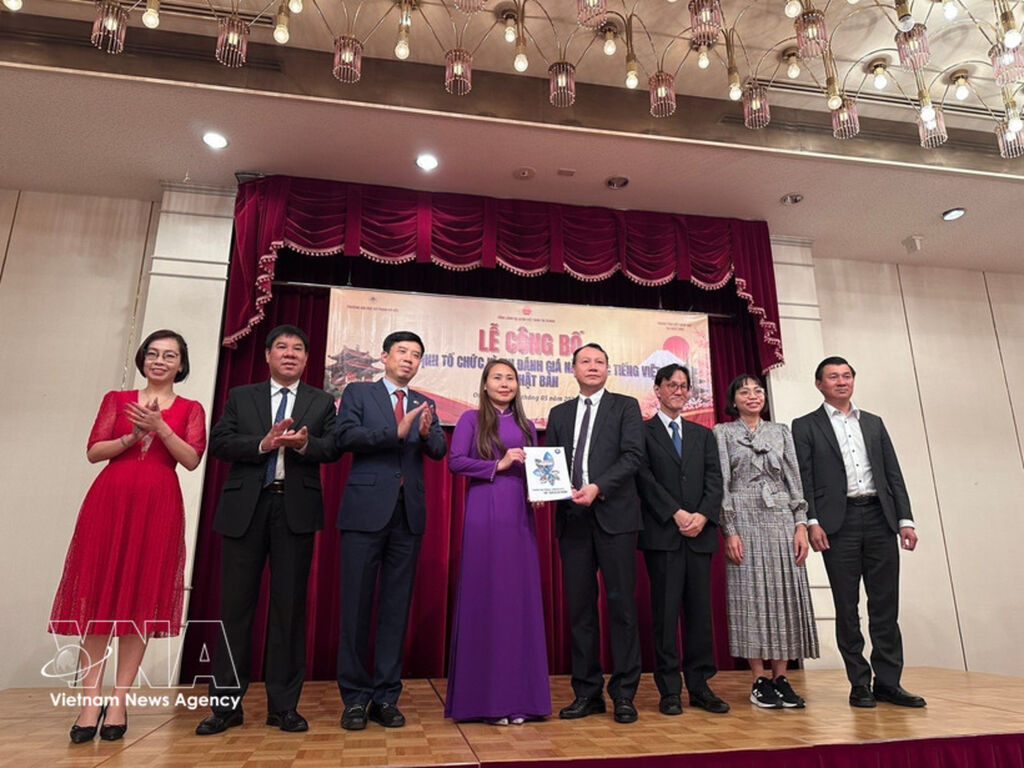
| Assoc. Prof. Dr. Nguyen Duc Son presents the decision establishing the Vietnamese Language Proficiency Test Council in Japan to a representative of the Vietnam Studies Centre in Japan. (Photo: VNA) |
Tokyo (VNA) – Japan has become the first overseas venue to host a Vietnamese language proficiency test based on unified standards issued by Vietnam’s Ministry of Education and Training (MoET), marking a new step in the internationalisation of the language.
The launch ceremony and the establishment of the Vietnamese Language Proficiency Test Council in Japan took place at the Vietnamese Consulate General in Osaka, reflecting efforts to standardise Vietnamese language teaching, assessment and promotion abroad.
Speaking at the event, Vietnamese Consul General in Osaka Nguyen Truong Son said Vietnamese plays a vital role in connecting overseas Vietnamese (OV) communities with their roots while preserving national culture, history and identity. He noted that policies on OV affairs have consistently highlighted the importance of maintaining and promoting the language, particularly among younger generations born abroad.
As bilateral ties between Vietnam and Japan continue to expand, demand for Vietnamese language learning in Japan has also grown rapidly among OVs, educational institutions, businesses and Japanese people interested in Vietnam. Against this backdrop, the introduction of a standardised proficiency test is expected to provide an official and widely recognised benchmark for Vietnamese language skills.
According to Professor Dr. Huynh Van Chuong, Director of MoET’s Quality Management Department, Vietnam has established a legal framework to support the global promotion of Vietnamese through teaching programmes, cultural exchange activities and standardised testing systems.
The test is designed for a broad range of candidates, including children of overseas Vietnamese families, foreign learners of Vietnamese and professionals requiring Vietnamese certification for study or work related to Vietnam, he said.
Osaka was chosen as the first international testing location and is expected to serve as a model for expansion to other regions, including the US, Europe and ASEAN countries, where interest in learning Vietnamese is increasing.
Hanoi National University of Education has been authorised by MoET to organise the assessments and issue certificates. Rector Nguyen Duc Son said the certificates are part of Vietnam’s national qualifications framework. Foreign students holding a B1-level certificate and a high school diploma are eligible to apply to several Vietnamese universities, including Hanoi National University of Education.
Professor Shimizu Masaaki, representative of the Vietnam Studies Centre in Japan, described the initiative as an important milestone for Vietnamese studies and Vietnamese language education overseas. He said the test will help create an objective and internationally recognised benchmark for Vietnamese proficiency at a time when the number of learners in Japan is steadily rising alongside stronger bilateral exchanges.
He added that the initiative also reflects the growing international role of Vietnamese as a language for academia, professional engagement and global exchange, helping raise its profile while creating more opportunities for learners to pursue education, employment and research linked to Vietnam.
The launch of the standardised Vietnamese language proficiency test in Japan is considered a meaningful step in Vietnam’s strategy to preserve the language among OV communities while promoting Vietnamese language and culture globally.
The same day, the Vietnamese Consulate General in Osaka also hosted an incense-offering ceremony marking the 136th birth anniversary of President Ho Chi Minh./.