 |
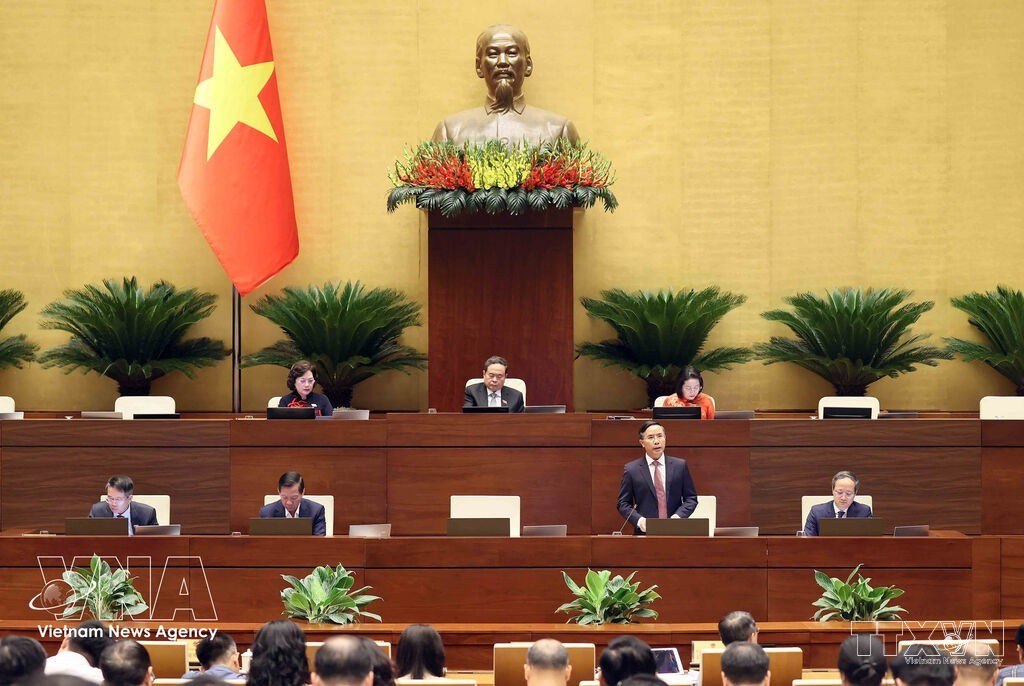
| Lawmakers on August 9 discuss a draft law amending and supplementing a number of articles of the Law on the State Bank of Vietnam, the Law on Anti-Money Laundering and the Law on Credit Institutions. (Photo: VNA) |
Hanoi (VNA) – Lawmakers on August 9 discussed a draft law amending and supplementing a number of articles of the Law on the State Bank of Vietnam, the Law on Anti-Money Laundering and the Law on Credit Institutions, focusing on strengthening safeguards for the banking system and establishing a sound legal framework for emerging financial activities.
The discussion took place during the first extraordinary session of the 16th NA, chaired by NA Chairman Tran Thanh Man.
The draft law sets out provisions to control conflicts of interest when commercial banks act as agents managing collateral for corporate bonds. In this regard, Deputy Le Van The of Ninh Binh province said he supported the move, noting that it could provide a more professional approach to collateral management and help strengthen investor confidence if properly regulated.
He warned of potential conflicts of interest if a bank provides credit to a company while also managing collateral for the company's bonds and providing other services related to the bond issuance.
When the company faces financial difficulties, the bank's interest in recovering its loans may not fully match those of bondholders, he said.
The law should therefore require banks to perform such activities independently and transparently, he stressed.
The Government should issue detailed rules on the conditions, scope and principles for collateral management services, as well as mechanisms to identify, disclose and control conflicts of interest.
The deputy also called for safeguards against the practice of tying banking services to the purchase of other products. Banks, for example, should not link credit approval, loan disbursement, extension or restructuring to requirements that customers purchase or commit to purchasing corporate bonds or other investment products.
He proposed two principles for the draft law: expanded banking powers must come with clear legal limits, data requirements and accountability; and expanded banking activities must be accompanied by stronger conflict-of-interest controls and investor protection.
Legal framework for crypto assets
Deputy Nguyen Minh Duc of Ho Chi Minh City noted that the 2025 Law on Digital Technology Industry officially recognises digital assets and crypto assets and provides a foundation for a pilot market. Including crypto-asset service providers among reporting entities under the draft law is therefore necessary and consistent with property rights under the Civil Code, he said.
He proposed that the draft law should refer to definitions already provided in relevant legislation rather than create new technical definitions. It should also clearly set out specific obligations for crypto-asset service providers and require them to comply with strict technical standards.
These should include customer identification and verification, the application of the Travel Rule to crypto-asset transfers to ensure transparency of sender and recipient information, blockchain-based transaction record-keeping, and timely reporting of large or suspicious transactions.
The deputy also called for clear division of responsibilities among the State Bank of Vietnam, the Ministry of Finance, the Ministry of Public Security, and the Ministry of Science and Technology.
Several lawmakers also discussed a proposal allowing certain alternative prudential ratios to support major national projects and socioeconomic development.
They said such flexibility could help credit institutions meet the large capital needs associated with ambitious growth targets, but stressed that any special mechanism must remain under close supervision and that participating institutions should have a roadmap to return to normal regulatory requirements.
Explaining the proposal, State Bank Governor Pham Duc An said allowing alternative ratios would not mean higher risks or weaker supervision.
The central bank would consider each case carefully and apply the mechanism only to eligible credit institutions and where it directly serves national development goals and priority projects, he said./.