 |
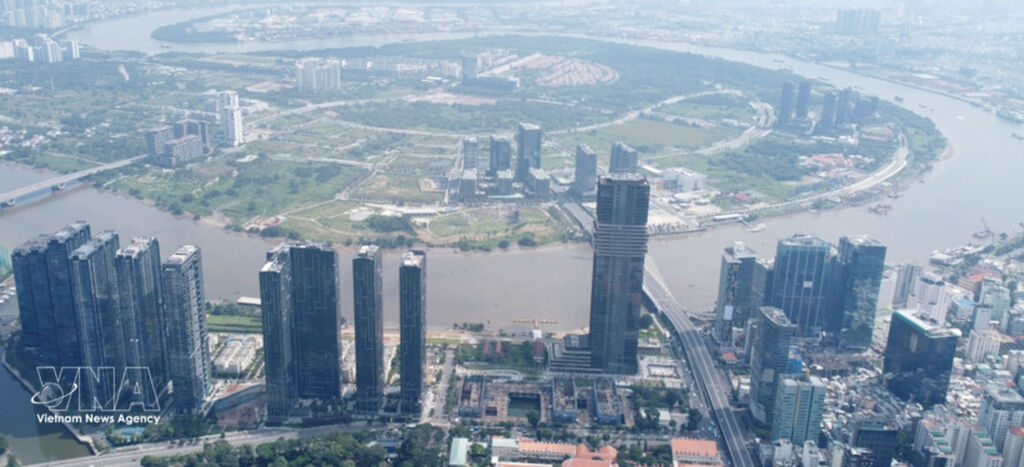
| Thu Thiem Peninsula in Ho Chi Minh City is designated as the core zone of Vietnam’s International Financial Centre. (Photo: VNA) |
Ho Chi Minh City (VNA) – Many international investors have yet to fully grasp the objectives of Vietnam’s International Financial Centre (VIFC). Rather than competing with long-established global financial hubs, the VIFC is expected to serve as a capital channel to support investment demand and drive Vietnam’s economic growth in the next phase of development.
A capital conduit for a new growth phase
More than 18 months after first being proposed, the VIFC has moved from an ambitious concept to becoming a reality, following its official launch in early 2026. The completion of the legal framework in June has further strengthened the foundations for the centre’s gradual rollout and operation in the period ahead.
According to Michael Kokalari, Chief Economist of VinaCapital – one of the seven founding members of the VIFC, while enthusiasm is high in Vietnam, few international financial professionals seem to fully understand what the VIFC actually is and meant to achieve or appreciate how big of a leap forward it is for the country. This has led to some skepticism among foreigners, who mistakenly believe Vietnam aims to compete with Dubai and other more established IFCs.
The goal of the VIFC is to make it easier for foreigners to invest in and profit from Vietnam’s economic development. Its establishment was motivated by Vietnam’s estimated 1.5 trillion USD funding gap – money Vietnam needs in the coming years to industrialise the country.
In sharp contrast, Dubai’s IFC is a centre for wealthy people to park and manage money; its establishment was motivated by the desire to attract high-value economic spill overs associated with the finance industry to Dubai such as highly paid fund management professionals, corporate law firms, and luxury real estate development.
Kokalari said IFCs serve one (or more) of three functions, namely facilitating investment abroad for a country’s savers, facilitating inbound capital flows to a country’s companies, and acting as an offshore hub for private wealth management.
Vietnam’s IFC is economically closer to New York’s during America’s industrialisation since it primarily aims to channel foreign capital into infrastructure and other projects. Legally, it is closer to Dubai’s, since it exists within an approximately 900 hectares ring-fenced area in Ho Chi Minh City and approximately 300 hectares in Da Nang.
The expert went on to note that initial priorities are to establish commercial banks in the VIFC, followed by asset management firms. Beyond these initial priorities, activities within the VIFC are expected to expand to include commodities trading of rice and coffee, industrial real estate investment trusts (REITs), digital assets, and trade finance products.
“The primary benefit of the IFC for Vietnam will be a lower cost of capital, while the primary benefit to foreign investors will be a much wider range of financial products that enable participation in the growth of the country’s economy,” said Kokalari.
Success hinges on a measured implementation roadmap
According to the expert, Vietnam’s IFC should open gradually, starting with a narrow pool of reputable firms while strengthening its executive and supervisory bodies, AML enforcement, and beneficial-ownership transparency. At the same time, Vietnam should pass reforms that increase the ease of doing business outside the IFC since it ultimately interacts with the economy beyond its ring-fenced boundaries.
He observed that India’s GIFT-IFSC – the International Financial Services Centre at Gujarat International Finance Tec-City, which launched in 2015 – is arguably the closest parallel to the VIFC. Like Vietnam, India is a large, fast-growing emerging Asian economy, and GIFT was built as a ring-fenced IFC with the explicit goal of onshoring financial activity that Indian corporates had previously been conducting offshore, and of channeling inbound foreign capital into the domestic economy.
Drawing on the experience of GIFT, Kokalari argued that the VIFC should place particular emphasis on two priorities: establishing a centralised governance model to avoid fragmented authority across multiple agencies, and developing financial products in phases under a clearly defined implementation roadmap.
Kokalari suggested the VIFC build on its initial foundations with clear product-specific regulations, strong supervisory institutions, credible dispute resolution; a highly skilled financial workforce; and a supply of bankable projects and credible issuers.
Progress on these fronts will not only strengthen the VIFC but also improve Vietnam’s wider financial system and lower the cost of capital for infrastructure, energy, logistics, housing, and SMEs, as well as enabling the introduction of more financial products and services in the country.
Looking ahead, the expert said the new VIFC can serve as a controlled policy sandbox for innovations such as tokenized securities, AI-driven compliance tools, and blockchain-based settlement, which – if successfully tested on a limited basis – could later be rolled out across Vietnam’s broader economy./.