|
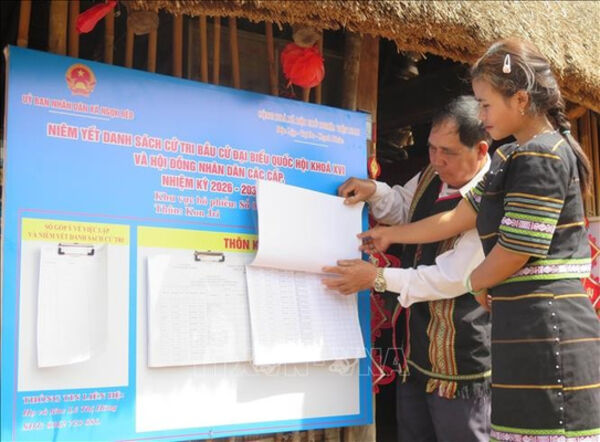
| Residents visit polling stations in their wards to review the list of candidates for deputies to the 16th National Assembly and members of People’s Councils at all levels for the 2026–2031 term. (Photo: VNA) |
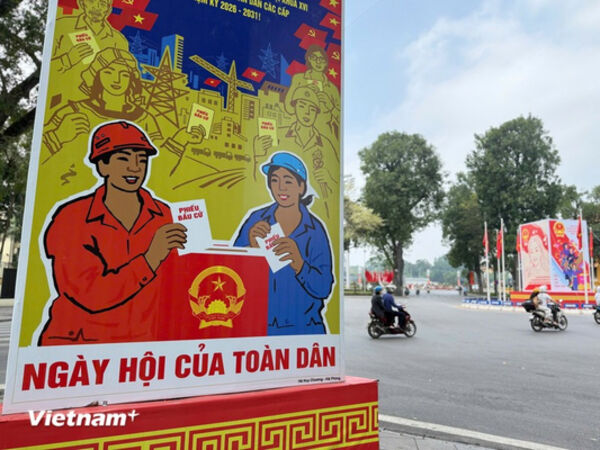
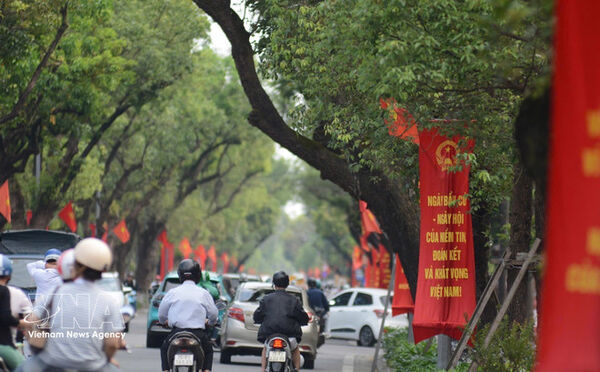
Hanoi (VNA) – Across the Party, the armed forces and the entire political system, preparations are being carried out at pace for the country’s election day. Streets and neighbourhoods are festooned with flags and flowers, while polling stations are being carefully prepared and decorated. Yet, in stark contrast to this atmosphere of anticipation, hostile forces and reactionary elements continue their attempts to distort and undermine the electoral process.
On March 15, 2026, voters across the country will exercise their sacred right and civic duty to elect deputies to the 16th National Assembly and members of People’s Councils at all levels for the 2026 – 2031 term.
This election represents a major political event of national significance. It comes at a time when the country has successfully pursued four decades of Doi moi (renewal), achieving remarkable and comprehensive progress across every field of national life. Vietnam’s achievements have been widely recognised, and the country’s international standing has continued to grow.
Discordant voices
It is hardly unusual that ahead of major political events of national importance, hostile forces and political opportunists seek to distort the truth, sow doubt, and attempt to undermine public trust in the Party, the State and the political system.
The more the country advances, the more fervently these actors attempt to obstruct its progress. They make extensive use of cyberspace, social media and cross-border communication platforms to spread misinformation, misrepresent the nature of Vietnam’s election and deny the leadership role of the Communist Party of Vietnam.
A familiar refrain among them is the claim that elections in Vietnam are merely “symbolic”, and that citizens have no genuine choice.
Nor do their tactics stop there. Hostile elements also attempt to smear and discredit senior leaders and key officials, particularly those expected to stand as candidates. Social media platforms have seen posts and manipulated video clips fabricated to sensationalise private lives, exaggerate shortcomings, or even invent entirely false allegations in an effort to undermine public trust in the Party and the State.
Another tactic involves exploiting the right of self-nomination to disrupt personnel arrangements. Certain groups establish groups masquerading as “democratic” or “civil society” organisations, using the guise of “exercising citizens’ rights” to allow opportunistic individuals to self-nominate.
However, it must be emphasised that while the right to stand for election is protected by law, it is accompanied by strict standards relating to political integrity, ethics, competence and public credibility. The consultation procedures – collecting opinions from voters in both residential communities and workplaces – serve as an effective filter to exclude those whose motives are questionable.
Directive No. 46-CT/TW clearly states that individuals demonstrating political opportunism, personal ambition for power, factionalism, localism, or those under investigation for misconduct, lacking honesty, or presiding over organisations where serious corruption or internal division has occurred, should not be included in the list of candidates.
For that reason, such discordant voices cannot cross this protective barrier.
 |
| Officials check and verify voter cards at Polling Station No. 3 in Hai Ba Trung ward, Hanoi. (Photo: VNA) |
The strength of public consensus
Vietnam’s elections are conducted on the basis of a unified, transparent and carefully regulated legal framework. Under the 2013 Constitution, the right to vote and to stand for election is one of the fundamental political rights of citizens, guaranteed on the principle of absolute equality regardless of gender, ethnicity, religion or social background.
Building upon this foundation, the Law on Election of Deputies to the National Assembly and People’s Councils fully embodies the universally recognised democratic principles of universal suffrage, equality, direct voting and secret ballots. Beyond these general principles, the entire electoral process in Vietnam has been codified in a detailed, scientific and transparent manner.
From consultations to nominate candidates, the compilation and publication of voter lists and election campaigning to voting, vote counting and the announcement of results, each stage is conducted with care and placed under the close supervision of competent authorities, the Vietnam Fatherland Front, and above all the direct oversight of the public. In recent days, notice boards displaying voter information have been busy with citizens checking details and discussing election matters. Their engagement reflects a genuine sense of responsibility toward their vote.
The list of candidates at each polling station emerges from a multi-layered democratic process. These procedures are organised by the Vietnam Fatherland Front at various levels, involving representatives of political and social organisations, relevant agencies and, crucially, the direct opinions of voters in both residential areas and workplaces. Only individuals who meet all legal standards and who receive genuine public confidence are included in the final candidate list.
Under the election law, candidate nominations must pass through strict rounds of consultation organised by the Vietnam Fatherland Front. Prospective candidates must not only satisfy rigorous requirements regarding qualifications and political integrity but also secure high levels of trust from colleagues and local voters through grassroots voter conferences.
These consultations provide a forum for citizens to speak frankly and reject candidates lacking credibility or competence, an illustration of the substantive democratic practices within the country.
The principle of the secret ballot ensures that each vote reflects the independent and honest will of the electorate, free from pressure or influence. Vote counting is conducted openly and transparently in the presence of voter representatives, the Fatherland Front and other organisations, while election results are publicised for citizens to observe and monitor.
Such realities offer clear and persuasive evidence against claims that elections in Vietnam are somehow “pre-arranged”.
A nationwide festival
To counter misinformation surrounding the election, authorities at all levels have deployed coordinated measures to prevent, detect and defeat efforts by hostile forces and reactionary groups, both domestic and overseas, to sabotage the process.
Public communication about the election is taking place widely across society and online. False information and hostile narratives on digital platforms are being promptly identified and removed.
Social media users themselves have been quick to report harmful content, encouraging platforms to take it down. Voters are also increasingly verifying information through official channels such as Party newspapers and national and local broadcasters.
At the same time, artists, public figures, influential personalities and overseas Vietnamese communities have been turning their attention to the upcoming election day.
 |
| A parade promoting the upcoming elections passes through Chanh Hung ward in Ho Chi Minh City. (Photo: VNA) |
Some contribute their voices through commentary, while others produce songs and artistic works celebrating the event. Notably, prominent composers such as Nguyen Van Chung, Hua Kim Tuyen, and Hoang Hong Ngoc have written music pieces inspired by the election, an expression of civic responsibility from artists toward an important national occasion.
The patriotic atmosphere witnessed during recent national commemorations still lingers. Vietnam’s model of socialist democracy is not a replica of any other system. It has grown out of the country’s struggle for independence, its cultural and social characteristics, and its experience in building and developing the nation. In that sense, patriotism, national consciousness and civic responsibility appear almost woven into the very fabric of Vietnamese identity.
At a time when much of the world continues to experience instability and political conflict, the Vietnamese people value ever more deeply the independence, freedom and democratic system that generations sacrificed to secure and preserve. Their confidence in that system is not easily shaken.
When March 15 arrives, one will see elderly voters approaching a hundred years old making their way to the polls, young voters casting their ballots with enthusiasm, and multi-generational families going together to fulfil their civic duty. Together, these moments will create a vibrant atmosphere, resembling a national celebration./.