 |
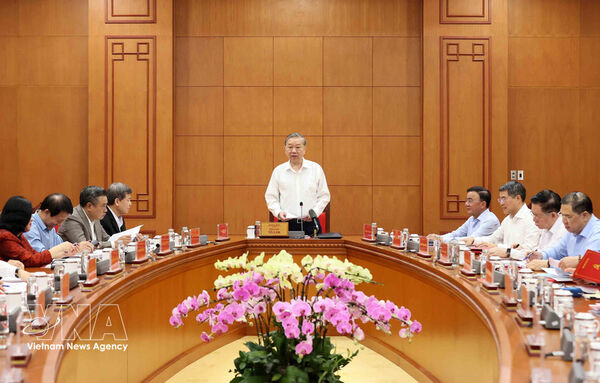
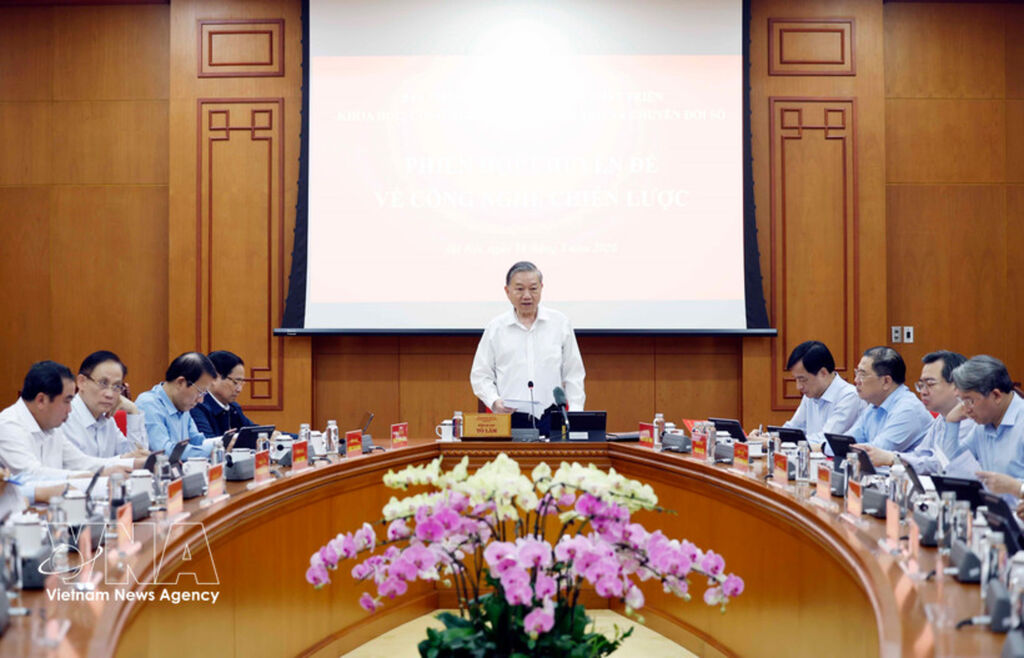
| Party General Secretary To Lam speaks at the meeting (Photo: VNA) |
Hanoi (VNA) - Vietnam can't keep dragging its feet on developing strategic technologies; it's time for tougher, faster, and more hard-hitting moves, Party General Secretary To Lam told a meeting of the Central Steering Committee for Science and Technology Development, Innovation and Digital Transformation in Hanoi on March 18.
Following the Resolution No. 57-NQ/TW, the Politburo issued a list of 11 groups of strategic technologies and 35 groups of strategic tech products under a decision issued on June 12, 2025, while picking six priority strategic technology products for immediate rollout with detailed roadmaps. However, the progress remains uneven. To date, none of the designated priority products has advanced to a stage where it generates substantial, measurable economic contributions.
General Secretary Lam stressed that strategic technologies must directly serve the goals of raising productivity and economic competitiveness, forming new industries, and securing technological autonomy in key sectors. Picking the right ones, he said, boils down to three fundamental factors: real development and competitiveness needs, potential of domestic industries, and the ability to build value chains and markets.
On nailing down the strategic tech list, he wanted it to split into two groups: proven technologies in established markets where the payoff is big, fast, and direct; and technologies that create new growth drivers, foundational tech for the future, and technologies for self-reliance in national defence-security.
Businesses, especially private players, need to be the beating heart of the whole tech ecosystem. Policies have to supercharge them to pour money into R&D and innovation, while the State sticks to high-level guidance, building a friendly regulatory playground, bankrolling key studies, and helping turn lab breakthroughs into market winners.
Resources must zero in on just a handful of truly vital areas, going all-in with depth, strength, smart tactics, efficiency, and unbreakable follow-through till the job's done, he said.
For every strategic tech and product, there must be a clear assignment of the lead ministry or agency, coordinating bodies, and resources. Heads of lead agencies must personally direct the work and bear full responsibility before the Party and State for outcomes within their domains.
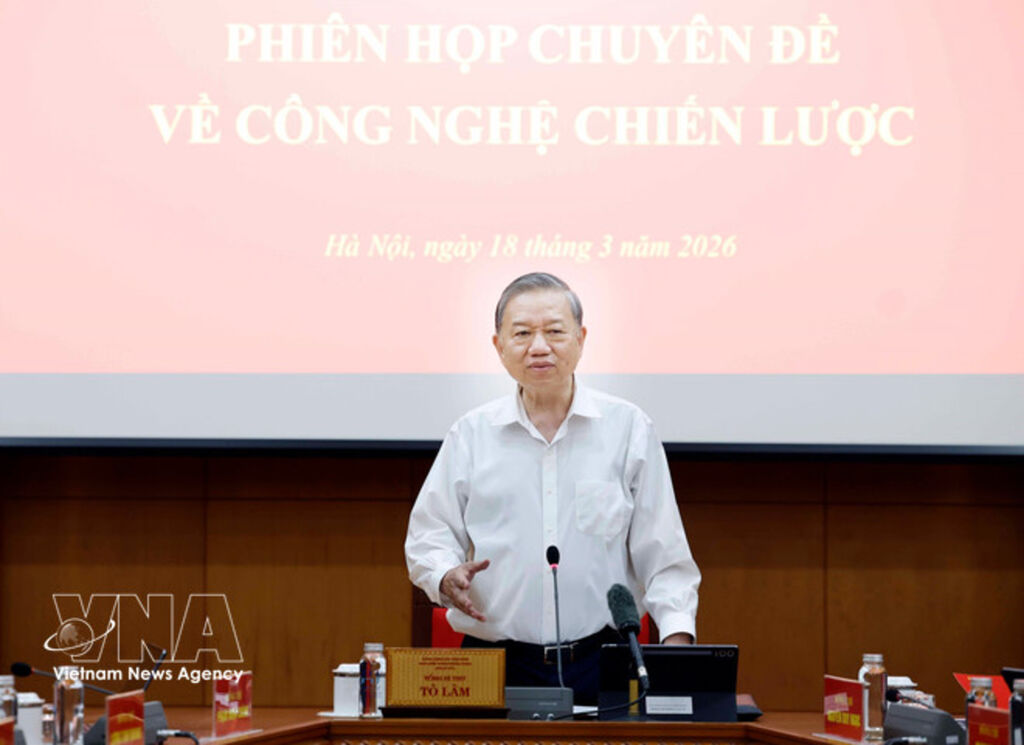 |
| Party General Secretary To Lam, who also serves as head of the Central Steering Committee for Science and Technology Development, Innovation and Digital Transformation, speaks at the event. (Photo: VNA) |
At the central level, a robust, authoritative inter-agency coordination body is required to clear major bottlenecks. Mechanisms must ensure smooth and seamless cooperation, avoiding a situation in which each body acts differently, shifts responsibility, or waits for others to move first.
In his view, training and attracting talent must maintain a forward lead. It is also necessary to empower the broader innovation ecosystem, including start-ups, sci-tech enterprises, and spin-off companies originating from research institutes and universities, while building innovation hub that are strong, open and flexible enough to connect studies with the market.
Among pressing next steps, the leader called for a review and refinement of the list of strategic tech and products toward greater focus on what truly matters for the nation's short- and long-term future. He also pushed for a unified direction and coordination mechanism at the Government level to launch strategic tech schemes; an inter-agency task force for coordination, with monthly progress reports straight to the Steering Committee and its head; and the fast-track rollout of clear standards for strategic tech, core tech, and priority products.
He also ordered overhaul of funding and finance rules for these efforts, especially special output-tied mechanisms that allow controlled risk-taking, tax breaks, cheap credit, public-private funding models, and state budget mechanisms for targeted procurement.
The Party chief also demanded training pipelines geared toward strategic tech needs, with priority given to engineers, master’s and doctoral graduates, elite experts and strong research teams, while forging tight links among schools, companies, research institutes and major projects. At the same time, urgent efforts are needed to clear bottlenecks facing ministries, agencies, businesses, research institutes and universities./.