 |
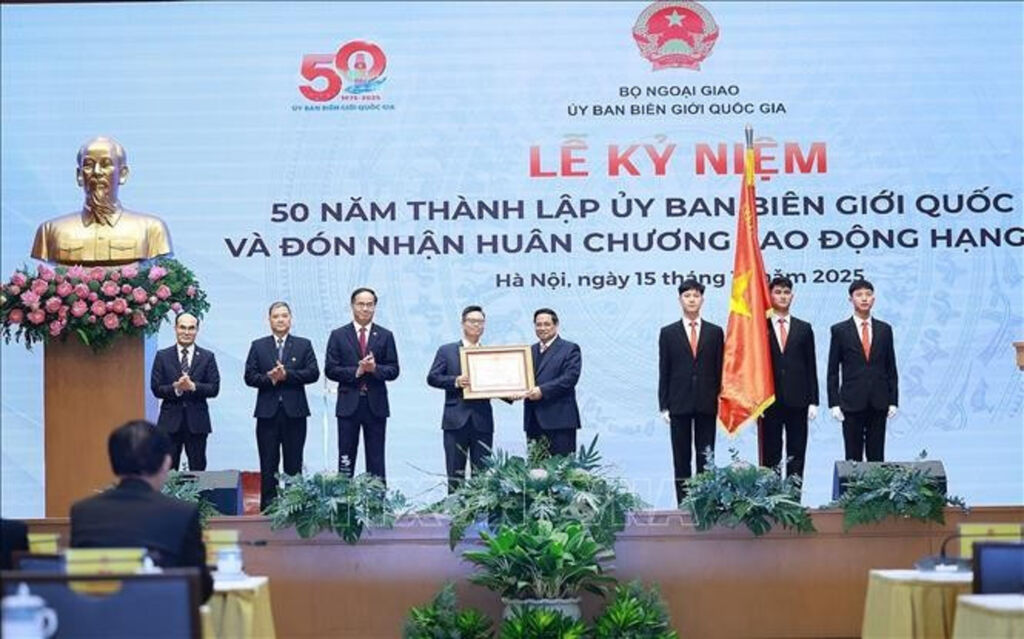
| Prime Minister Pham Minh Chinh presents the first-class Labour Order to the National Boundary Commission at the ceremony on December 15. (Photo: VNA) |
Hanoi (VNA) – Prime Minister Pham Minh Chinh highlighted major principles in safeguarding national independence, sovereignty, unity, and territorial integrity while attending a ceremony marking the 50th founding anniversary of the National Boundary Commission in Hanoi on December 15.
He underlined the need for resolute yet flexible action to protect independence, sovereignty, unity, and territorial integrity; consistent application of legal and technical instruments, bilateral agreements and international law, particularly the 1982 United Nations Convention on the Law of the Sea (UNCLOS), as the foremost instruments for protecting national interests; and steadfast pursuit of cooperation and dialogue to settle differences and seek fundamental and long-term solutions to maintain peace and stability for national development.
PM Chinh praised generations of commission officials and workers for their dedication over the past 50 years, stressing that national borders are a sacred symbol defining the nation’s living space. He described the commission as an “unsung soldier” on the diplomatic, legal and practical frontlines, playing a critical role in safeguarding national sovereignty while strengthening friendly relations with neighbouring countries.
Since its establishment in 1975, the commission has fulfilled its assigned tasks with dedication and resilience. Its work has made significant contributions to the demarcation and management of land and maritime boundaries, thereby helping to firmly safeguard independence, national sovereignty, unity, and territorial integrity, and build borders of peace, stability, and development between Vietnam and its neighbours.
On land, Vietnam has completed the delineation of its borders with China, Laos and Cambodia; finished border demarcation and marker planting with China and Laos; and completed around 84% of this work with Cambodia. The signing of legal documents on border delimitation and management has helped consolidate the shared borders of peace, stability, friendship, cooperation and development, reinforcing Vietnam’s image as a peace-loving nation with intensive integration and high prestige in the world.
At sea, the commission has coordinated with relevant agencies to establish and safeguard Vietnam’s rights and legitimate interests in line with international law, particularly the 1982 UNCLOS. It has advised on and successfully negotiated several maritime delimitation and cooperation agreements with neighbouring countries, including Cambodia, Thailand, Malaysia, Indonesia and China, while actively engaging in addressing complex issues in the East Sea.
PM Chinh reiterated the Party and State's high evaluation of the commission. He emphasised the need for the body to firmly adhere to the Party's directions, remain principled yet flexible in approach, and uphold the rule of law in handling border and territorial issues.
He highlighted the importance of investing in border areas, noting that each citizen there should be considered a “living milestone” in the nation’s frontiers.
On behalf of the Party and State, PM Chinh presented the first-class Labour Order to the commission.
Responding to the PM's instruction, Minister of Foreign Affairs Le Hoai Trung affirmed that the commission will continue to uphold its proud traditions, work with utmost dedication to safeguard Vietnam’s sovereignty, territory, rights and legitimate interests, and maintain a peaceful and stable environment, thereby contributing to the country’s development in the new era./.