 |
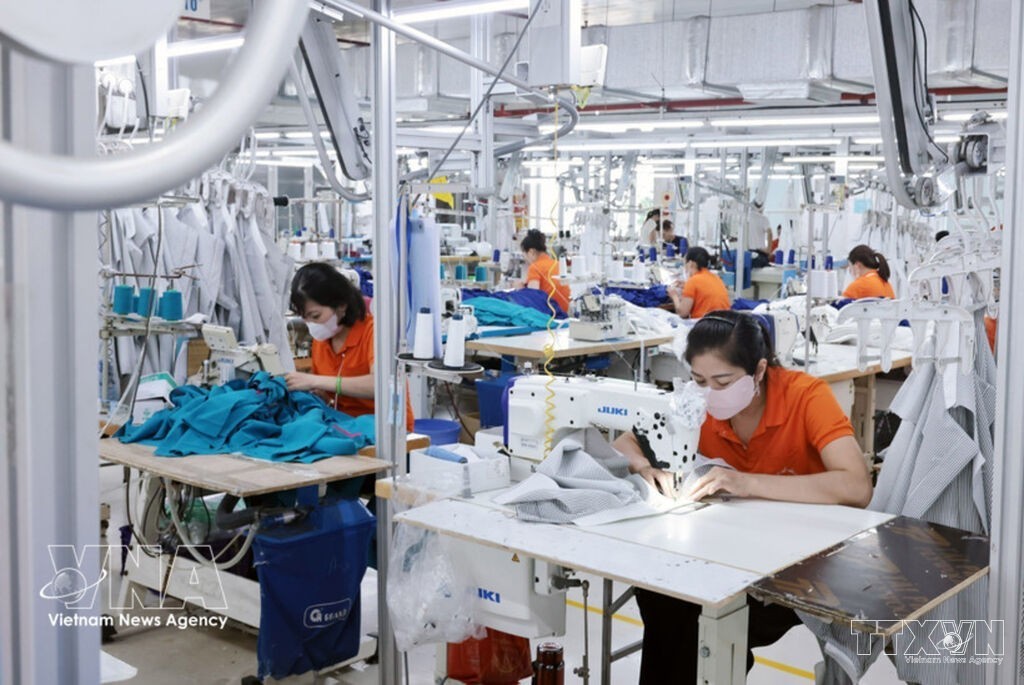
| An export-oriented apparel factory of the Hung Viet Garment Joint Stock Company (Photo: VNA) |
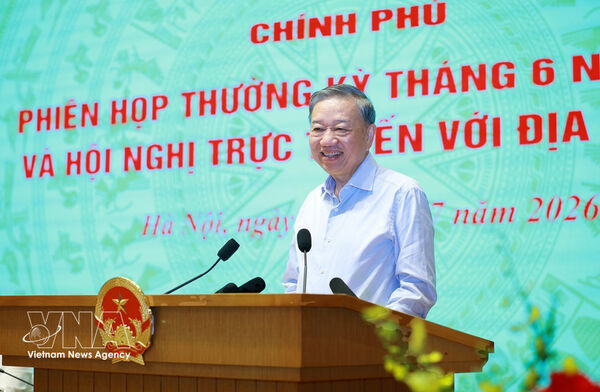
Hanoi (VNA) – The Government Office has issued the Prime Minister's conclusions at a conference between permanent Cabinet members and the business community to clear bottlenecks and unlock resources for growth.
Firms contribute over 60% of GDP
As of late June, Vietnam had more than one million active enterprises with assets worth over 30 quadrillion VND (1.14 trillion USD), contributing more than 60% of gross domestic product (GDP) and 55% of total state budget revenue. They employ 17.6 million workers, underpin social welfare and sharpen national competitiveness.
However, State-owned enterprises (SOEs) have yet to fully deliver, with modest efficiency, sluggish investment and limited cooperation with private and foreign-invested peers.
Private firms are overwhelmingly small and medium-sized, constrained by capital, weak governance, outdated technology and shallow integration into domestic and global value chains. Foreign-invested companies still exhibit fragile linkages with local firms, while technology transfer and localisation remain scant.
The business climate is marred by overlapping, inconsistent legal rules and ineffective enforcement by some ministries, agencies and localities. Capital, labour and science-technology have not kept pace with business needs.
Some enterprises have been passive in policy consultations and institutional reforms, while compliance with laws, corporate governance standards and social responsibility remains inadequate.
Policies must foster transparent and stable business climate
The PM reaffirmed that enterprise development and support for production and trade carry strategic national importance. All policies, he stressed, must aim to create an open, stable and transparent business climate, ensure equal access to resources, safeguard business freedom and encourage innovation, digital transformation, green transition and corporate competitiveness.
The Government, ministries and local authorities must continue refining the institutional framework as the bedrock of national development while accelerating substantive administrative reforms.
Relevant agencies were directed to finalise key draft laws for submission to the National Assembly during its 2026 sessions, including amendments to the Penal Code, the Law on amendments and supplements to several articles of the Law on Investment, the Law on amendments and supplements to several articles of the Customs Law, the Law on amendments and supplements to several articles of the Law on the State Bank of Vietnam (SBV), the Law on Anti-Money Laundering, the Law on Credit Organisations, the revised Law on Real Estate Business, the revised Land Law, and the amended Housing Law, among others.
Administrative reform must cut unnecessary procedures and business conditions, shift more from pre-licensing to post-inspection where appropriate, and accelerate digitalisation and data integration.
Heads of ministries, sectors and localities will be held personally accountable for overdue administrative dossiers or procedures introduced beyond legal requirements.
Unlocking capital, land and investment resources
The PM asked the Ministry of Finance (MoF), ministries, agencies and relevant authorities to keep pushing the healthy, stable and sustainable development of capital and corporate bond markets.
A sweeping financial market reform plan must be submitted to the PM this month. Authorities were also directed to accelerate the development of the Vietnam International Financial Centre in Ho Chi Minh City and Da Nang to facilitate capital mobilisation through diversified financial products and instruments.
Delayed investment projects must be resolved in accordance with the law to halt the waste of land and public resources, with authorities required to deliver concrete and final outcomes.
The SBV must pursue proactive, flexible and effective monetary policy, maintain macroeconomic stability and inflation control, and manage credit growth quotas flexibly. It is also expected to submit a proposal on modernising the banking sector, restructuring weak credit organisations and improving corporate access to finance, particularly for small and medium-sized enterprises (SMEs), within this month.
Lowering business costs and expanding markets
Ministries, agencies and localities must continue cutting logistics costs, specialised inspection fees and unnecessary compliance costs while adopting risk-based management to eliminate overlapping inspections and facilitate production and trade.
The Ministry of Industry and Trade (MoIT) was told to overhaul trade promotion, with effectiveness measured by the number of contracts signed, export orders secured and market share gained by Vietnamese enterprises.
Authorities were also instructed to maximise the benefits of free trade agreements, help enterprises diversify export markets and deepen participation in global supply chains. The MoIT was tasked with effectively following the 2026–2030 international market expansion scheme and urgently proposing a new “Vietnamese people prioritise Vietnamese goods” drive for submission this month.
Other specific tasks were assigned to relevant ministries to fuel innovation, digital transformation, workforce upskilling and business development.
Improving performance and administrative discipline
Ministers, heads of ministry-level agencies and chairpersons of the municipal and provincial People's Committees were ordered to give the top priority to effective performance and administrative discipline.
They must directly take personal responsibility for outcomes and refrain from shifting responsibility or delaying action on issues already clearly regulated by law.
All agencies and local authorities must adopt a people-and business-centred approach while ensuring decentralisation is accompanied by effective supervision and accountability.
Businesses urged to innovate and improve competitiveness
The PM called on the business community, associations and the Vietnam Chamber of Commerce and Industry (VCCI) to strengthen self-reliance, innovation and competitiveness by improving governance, adopting advanced technologies, enhancing product quality and using capital more efficiently.
They must fully comply with legal regulations, strengthen corporate social responsibility, protect the environment, foster a healthy business culture, actively join domestic and international production and supply chains, and prioritise the use of locally produced materials, components, services and technologies.
SOEs, particularly major economic groups and corporations, were instructed to accelerate large national projects while creating opportunities for private firms to join major investment projects and supply chains. The MoF will study mechanisms to boost cooperation between SOEs and domestic enterprises, with completion targeted for the third quarter.
Private enterprises were encouraged to modernise technology, improve governance, strengthen financial capacity and meet international standards. Large private corporations were urged to lead digital transformation and innovation, support SMEs, disseminate technology and digital ecosystems, and actively contribute solutions to major national development challenges.
FDI enterprises were called upon to fulfill commitments on localisation, technology transfer, workforce development and supplier development, while expanding investment in research and development centres, design and innovation facilities, and technical and management training hubs in Vietnam./.