 |
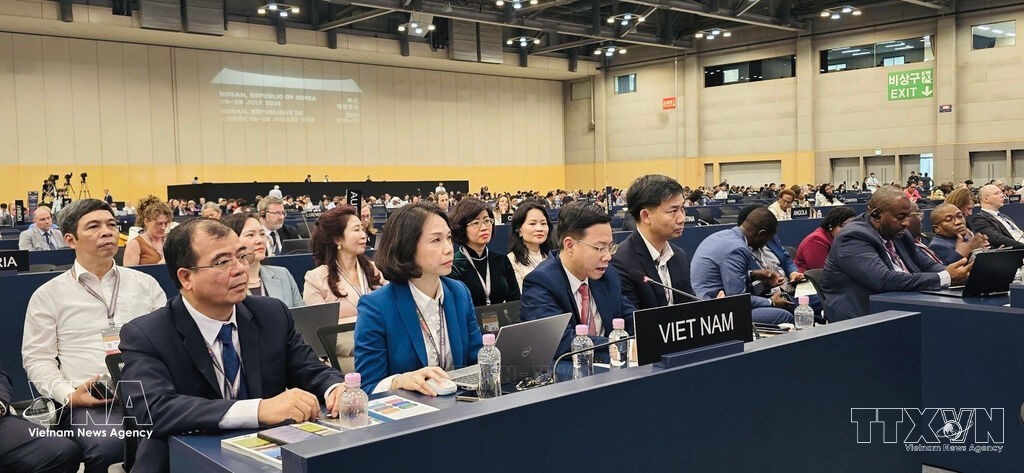
| Deputy Minister of Foreign Affairs Ngo Le Van, Chairman of the Vietnam National Commission for UNESCO, speaks at plenary session of the 48th session of the UNESCO World Heritage Committee in Busan on July 20, 2026. (Photo: VNA) |
Busan (VNA) – Deputy Minister of Foreign Affairs Ngo Le Van, Chairman of the Vietnam National Commission for UNESCO, is leading the Vietnamese delegation to the 48th session of the UNESCO World Heritage Committee, taking place in Busan from July 19 to 29.
Addressing the plenary session on July 20, Van underscored the need to strengthen international cooperation to ensure the effective protection of humanity's shared heritage. He also welcomed the spirit of the Busan Declaration, which promotes enhanced cooperation within the world heritage system.
On behalf of Vietnam, the deputy minister proposed three priorities of strengthening international cooperation and capacity-building for member states, particularly developing countries; promoting science-based conservation that strikes a balance between preservation and development while placing local communities at the centre; and enhancing coordination among relevant conventions and programmes, alongside the responsible application of digital technologies and artificial intelligence in heritage conservation.
Affirming that culture and heritage constitute the spiritual foundation of society, as well as an endogenous resource and key driver of sustainable development, he announced that Vietnam will host the Asia-Pacific Dialogue on Heritage and Authenticity in Hanoi from September 27 to 30.
The deputy foreign minister also reaffirmed Vietnam's commitment to close cooperation with the UNESCO World Heritage Centre, the International Council on Monuments and Sites (ICOMOS), the International Union for Conservation of Nature (IUCN), and the International Centre for the Study of the Preservation and Restoration of Cultural Property (ICCROM).
He cited the conservation and restoration project at Hanoi’s Thang Long Imperial Citadel, which preserves more than 1,300 years of history and distinctive cultural strata, as a notable example of such effective international cooperation, ensuring authenticity, integrity and a science-based conservation approach.
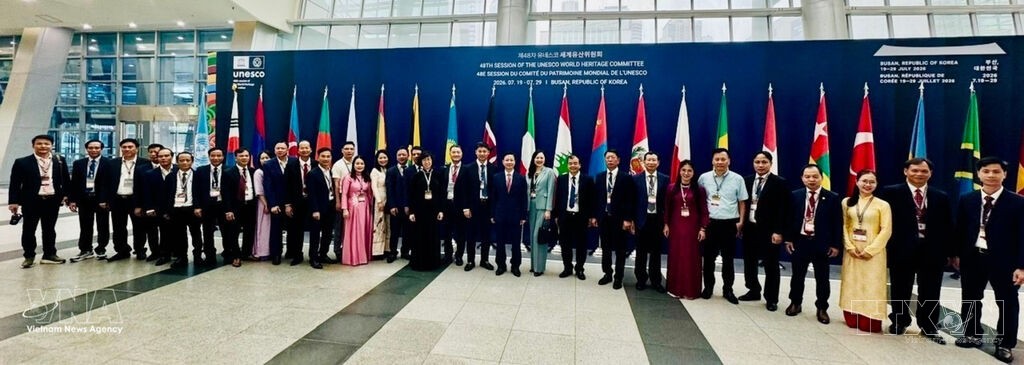 |
| The Vietnamese delegation attends the plenary session of the 48th session of the UNESCO World Heritage Committee, on July 20, 2026. (Photo: VNA) |
On the sidelines of the session, the Vietnamese delegation attended a roadshow in Busan showcasing the culture, tourism, cuisine and traditional craft villages of the central city of Hue, organised by the municipal People's Committee.
Speaking at the event, Van said the programme not only highlights the unique heritage of the former imperial capital but also demonstrated the role of culture and heritage as a bridge connecting peoples, thereby contributing to the further development of the Vietnam–Republic of Korea comprehensive strategic partnership. He expressed confidence that the event would foster new opportunities for cooperation in heritage conservation and promotion, tourism development, cultural industries and people-to-people exchanges.
At the roadshow, Hue authorities introduced the city as home to eight UNESCO-recognised heritage titles and outlined its ambition to position itself as a destination for green tourism, high-quality resort services and the circular economy. The city also showed its desire to strengthen cooperation with Korean airlines, travel companies and investors, while reaffirming its commitment to providing a transparent and favourable investment environment for Korean partners.
The event featured exhibitions of traditional craft villages, presentations of Hue cuisine, performances of Nha nhac (court music), and business networking activities linking Hue with Korean partners in tourism, aviation, cultural industries and investment.
The UNESCO World Heritage Committee is one of the organisation's principal governing bodies. Comprising 21 member states, it is responsible for decisions on the inscription of cultural and natural world heritage sites, reviewing the conservation status of world heritages worldwide, and determining the policies, budget and strategic direction for implementing the World Heritage Convention. At its current session, the committee is expected to consider 33 new world heritage nominations and review the conservation status of nearly 180 inscribed sites./.