Proposals on establishment of Quang Ninh, Bac Ninh cities to be submitted to legislature
Presenting the Government’s proposals, Minister of Home Affairs Nguyen Tien Hai said the establishment of the two cities and Bac Ninh’s 12 wards has met all political and legal requirements. The proposals are also consistent with the national master plan, plans on the urban and rural system and the Red River Delta region, provincial plans, and general urban planning schemes.
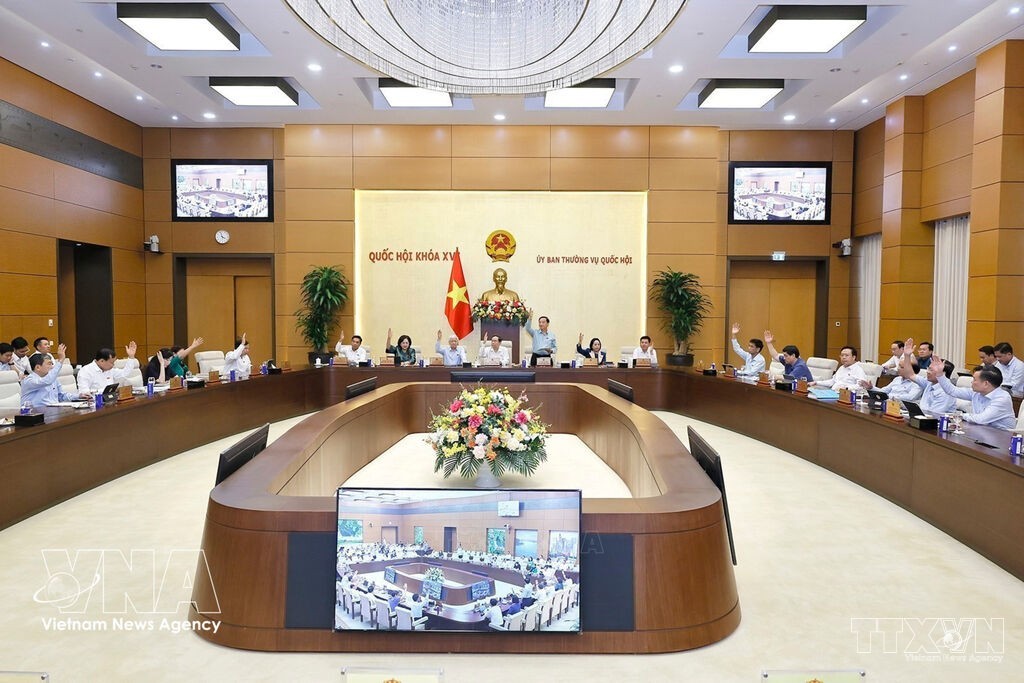
The National Assembly Standing Committee votes and approves the submission of the proposals on the establishment of Quang Ninh and Bac Ninh cities to the 16th-tenure legislature. (Photo: VNA)

Hanoi (VNA) – The National Assembly Standing Committee looked into the proposals for upgrading Quang Ninh and Bac Ninh provinces to centrally-run cities and establishing 12 new wards in Bac Ninh, at a session on August 4.

Presenting the Government’s proposals, Minister of Home Affairs Nguyen Tien Hai said the establishment of the two cities and Bac Ninh’s 12 wards has met all political and legal requirements. The proposals are also consistent with the national master plan, plans on the urban and rural system and the Red River Delta region, provincial plans, and general urban planning schemes.

He noted that Quang Ninh and Bac Ninh have continued to play important roles in the development of the Red River Delta. Both provinces have effectively tapped their potential and advantages to become major economic centres and among the country’s leading localities.

The proposal for Quang Ninh is based on its existing natural area, population and the number of commune-level administrative units. The new city will cover 6,231.27 sq.km, have a population of over 1.52 million, and comprise 54 commune-level administrative units, including 30 wards, 22 communes and two special zones.

Meanwhile, Bac Ninh city will be established based on the existing natural area, population and commune-level administrative units of Bac Ninh province after the establishment of 12 wards. The city will cover 4,713.75 sq.km, with a population of nearly 3.99 million, and 99 commune-level administrative units, including 54 communes and 45 wards. The proposed 12 wards comprise Yen Phong, Tien Du, Chi Lang, Phu Lang, Luong Tai, Gia Binh, Nhan Thang, Hiep Hoa, Bo Ha, Lang Giang, Kep and Luc Nam.

Hai affirmed that the proposals met all five conditions stipulated in the Law on Organisation of Local Administration and all seven criteria for establishing centrally-run cities, as well as all five criteria for establishing wards under relevant regulations.

Chairman of the NA Committee for Legal and Judicial Affairs Phan Chi Hieu said the committee supported the establishment of the cities and wards, which has received in-principle approval from the Party Central Committee and its Politburo.

The committee also endorsed the proposals by the Supreme People’s Court and Supreme People’s Procuracy to establish the People’s Courts and People’s Procuracies in Quang Ninh and Bac Ninh cities.

Following discussions, the NA Standing Committee approved submitting the proposals to the 16th-tenure legislature for consideration and approval at its ongoing first extraordinary session.

With 100% of members present voting in favour, the committee also adopted a resolution establishing the wards in Bac Ninh province and approved in principle draft resolutions on people’s courts and procuracies in Quang Ninh and Bac Ninh./.
Related News

Pathways to double-digit growth to be tabled at 16th NA’s first session

In the morning sitting on April 20, deputies are expected to hear proposals and verification reports on a range of draft resolutions. The documents cover breakthrough mechanisms and policies for the development of Vietnamese culture; the establishment of Dong Nai as a centrally run city; a pilot framework for public lawyer institution; and special mechanisms to address land law violations committed prior to the 2024 Land Law taking effect, alongside measures to resolve long-delayed and stalled projects.

Top legislator urges legal reforms to support fast, sustainable development

National Assembly Chairman Tran Thanh Man reaffirmed on August 3 that the institutional framework must not become a bottleneck to Vietnam’s rapid and sustainable development, underscoring the country’s continued efforts to reform its legal and institutional systems through a renewed legislative mindset and the accelerated application of technology and digital transformation.

See Also

Top legislator urges legal reforms to support fast, sustainable development

National Assembly Chairman Tran Thanh Man reaffirmed on August 3 that the institutional framework must not become a bottleneck to Vietnam’s rapid and sustainable development, underscoring the country’s continued efforts to reform its legal and institutional systems through a renewed legislative mindset and the accelerated application of technology and digital transformation.

Deeper reforms needed to achieve target of 2 million firms

If Vietnam can create the institutions, funding channels and support systems that allow businesses to develop at different stages, the target of 2 million active enterprises by 2030 could mark not just a numerical milestone, but the emergence of a more resilient engine of growth.

October 15 designated as Vietnam’s annual digital citizen day

The Government has issued Resolution No. 66.22/2026/NQ-CP, dated July 9, 2026, on the development of digital citizens. The resolution will take effect from August 15, 2026, to February 28, 2027. It sets out principles for developing digital citizens, their rights and responsibilities in the digital environment, policies encouraging the use of digital services, and the responsibilities of relevant agencies, organisations and businesses. Notably, the resolution designates October 15 each year as Vietnam's Digital Citizen Day.

Powering growth: Ensuring reliable energy supply to keep investment flowing

Across Ha Tinh and Nghe An, maintenance teams conduct inspections day and night, using thermal cameras and drones to detect potential faults without interrupting electricity supply. Their work helps ensure stable power supply for businesses as the region accelerates development in line with the Government's economic growth targets.

Top leader attends opening of 33rd Diplomatic Conference

Since its inception in 1957, the Diplomatic Conference has served as the foreign affairs sector’s most important forum for reviewing international developments, assessing diplomatic performance, disseminating the Party’s foreign policy and guidelines, and defining priorities for the coming period.