 |
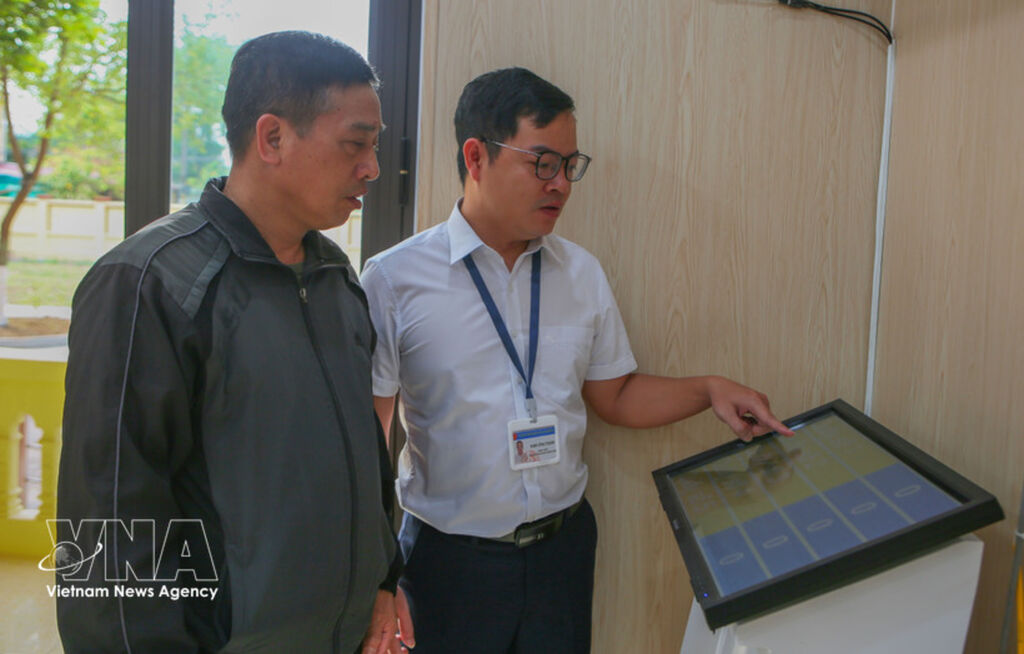
| A civil servant at the Van Thang commune Public Administrative Service Centre in Ninh Binh province guides a resident on how to obtain a queue number using the machine. (Photo: VNA) |
Hanoi (VNA) – Resolution No. 57-NQ/TW, issued by the Politburo on December 22, 2024, on breakthroughs in science and technology, innovation, and digital transformation, is being widely implemented across sectors and localities, helping improve governance efficiency and streamline administrative procedures.
The resolution is emerging as a powerful driver for building a modern administration, enhancing public service delivery, and offering increasingly convenient experiences for citizens.
From policy to practice
At the Public Administrative Service Centre of Khanh Hoi commune in Ninh Binh province, online public services are being actively deployed. The centre uses automated queue numbering systems, digital signatures, and electronic records. QR codes listing administrative procedures are also introduced, allowing residents to look up information, prepare documents in advance, and reduce waiting time.
Digital transformation goes beyond moving procedures online; it represents a comprehensive shift in governance toward transparency and data-driven management. The provincial Department of Science and Technology has organised training sessions to help agencies, especially at the grassroots level, effectively use administrative information systems, while providing timely support to address implementation challenges.
All communes and wards in Ninh Binh have now fulfilled all 16 criteria for Phase 1 digital transformation under Resolution 57, achieving a “green” (excellent completion) status on the national monitoring system. The province has also improved its ranking in the Provincial Innovation Index, placing 14th out of 34 localities nationwide.
In tourism-driven areas in Tuyen Quang province such as Thanh Thuy and Na Hang communes, particularly in the Dong Van Karst Plateau, digital transformation is reshaping community-based tourism. Local residents are shifting from traditional methods to proactively accessing markets through digital platforms.
Many households now use smartphones, social media, and QR codes to promote services and showcase local culture. Homestay owners and food service providers create photos and videos to attract visitors online, while QR codes are used for menus and local products such as brocade, corn wine, and agricultural goods. Participation in online booking platforms is also expanding market access and boosting business autonomy.
To further support implementation, Tuyen Quang province’s culture, sports and tourism sector is digitising databases on cultural heritage and tourist destinations, integrating them into the provincial tourism information portal for easier public access.
Building modern innovation ecosystem
 |
| Civil servants at the Phan Rang ward Public Administrative Service Centre in Khanh Hoa province apply digital technology to handle administrative procedures for citizens. (Photo: VNA) |
According to the Ministry of Science and Technology, Vietnam’s startup ecosystem has grown significantly, with around 4,000 startups, including unicorns valued at over 1 billion USD such as MoMo and Sky Mavis. The support infrastructure includes 208 investment funds, 84 incubators, 40 accelerators, and over 20 startup support centres at local and national levels.
The Government’s Resolution No. 86/NQ-CP on the national startup strategy marks a major step forward, reaffirming its commitment to fostering a favourable environment to unlock the creative potential of the entire population.
The strategy aims to spread innovation-driven entrepreneurship based on science, technology, and digital transformation, making it a key driver of socio-economic growth, improving living standards, accelerating industrialisation and modernisation, and strengthening national self-reliance. Vietnam also targets becoming a leading innovation hub in the region.
Efforts to inspire innovation among young people are also gaining momentum. In 2026, three Vingroup-affiliated entities —the Green Future Fund, VinUniversity, and VinTechTalent— launched the “Asian Hackathon for Green Future,” the first regional competition of its kind hosted in Vietnam.
The contest encourages interdisciplinary solutions combining technology, environment, economics, and social sciences. Proposed ideas focus on three major challenges: renewable energy and low-emission transport; urban air quality and climate resilience; and water resources and climate-adaptive agriculture.
Amid a shift in growth models and deeper global integration, innovation and entrepreneurship are increasingly recognised as vital engines of development. Many localities are working to build comprehensive startup ecosystems by leveraging their strengths.
Under its 2026–2030 innovation ecosystem development plan, Khanh Hoa province is investing in infrastructure such as innovation centres, startup hubs, innovation parks, and venture capital funds. It is also rolling out incubation and acceleration programmes to support startups in refining products, business models, and market access, while promoting technology adoption to enhance productivity and competitiveness.
Vice Chairman of the provincial People’s Committee Nguyen Thanh Ha said the province is creating favourable conditions for high-growth innovative startups based on intellectual property, advanced technologies, and new business models.
Innovation under Resolution 57 is expected to enhance enterprise competitiveness, accelerate the commercialisation of research outcomes, and maximise the value of intellectual assets. In turn, it will create jobs, attract high-quality human resources, and foster a vibrant culture of innovation and entrepreneurship, contributing to Vietnam’s sustainable development in the digital era./.