 |
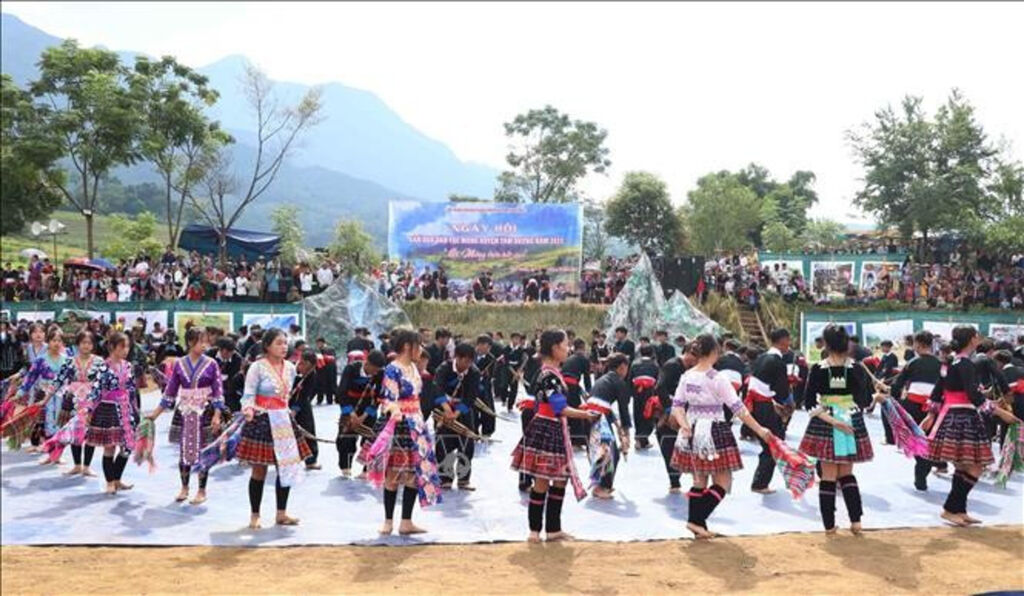
| A Mong flute performance (Photo: VNA) |
Hanoi (VNA) – The Politburo's Resolution No. 80-NQ/TW on the development of Vietnamese culture identifies culture as the spiritual foundation of society and an internal resource for sustainable development, serving as a link connecting communities and strengthening social consensus.
Practical experience from local communities and insights from researchers show that when culture is properly positioned in social life, the spirit of the resolution can be realised in a natural and lasting manner.
Folk arts in community life
Dr. Nguyen Thi Tam of the Institute of Anthropology and Religious Studies under the Vietnam Academy of Social Sciences (VASS) said the vitality of folk arts is shaped not by a single factor, but by the combined effects of performance spaces, benefit-sharing mechanisms and intergenerational transmission within communities.
Performance spaces play a foundational role – when folk arts retain their “living space” in community activities, cultural values can be practiced, observed, learned and naturally passed on. Meanwhile, benefit-sharing mechanisms, especially those linked with community-based tourism, create additional momentum for people to sustain cultural practices while intergenerational transmission ensures the continuity of knowledge and skills.
Resolution 80 highlights the need for culture to permeate daily life. Tam noted culture truly spreads only when communities themselves practice it and choose ways to preserve and promote it in everyday living.
In Lo Lo Chai, a village of Mong and Lo Lo ethnic people in northTuyen Quang province, folk arts are practiced in communal spaces, rituals and visitor reception, helping maintain “living heritage” while adding economic value for local residents.
For the Mong community in Then Pa, also part of Tuyen Quang, where performance spaces are limited and young people often work away from home, solutions tied to communal activities, traditional rituals or on-site tourism are seen as key channels to keep folk arts present in daily life. In parallel, documentation, preservation and sharing on digital platforms – gradually forming “digital cultural resources” and “digital cultural spaces” – can support cultural preservation and promotion amid social changes.
Culture as internal resource
Associate Professor Dr Pham Van Duong of the VASS’s Institute of Cultural Studies said the core spirit of Resolution 80 is to make culture both the spiritual foundation of society and an internal driver of sustainable development. This requires a shift in approach, viewing culture not only as something to be preserved but as an active force embedded in social life to spur development.
Preservation detached from daily life – limited to collection, archiving or symbolic performance – struggles to create lasting impact. By contrast, when culture is practiced in connection with livelihoods, education, tourism and social activities, its values are naturally renewed and disseminated.
From this perspective, Duong stressed the role of social sciences and humanities research in concretising Resolution 80. Cultural studies should go beyond description to clarify how culture operates within communities and how it can become a genuine development driver.
Amid accelerating urbanisation, labour migration and market forces that are reshaping social structures, treating culture as an internal resource is increasingly vital. When placed in its proper role, culture can serve as the “glue” that binds communities, reinforces identity, strengthens social consensus and provides a solid spiritual foundation for sustainable development./.