 |
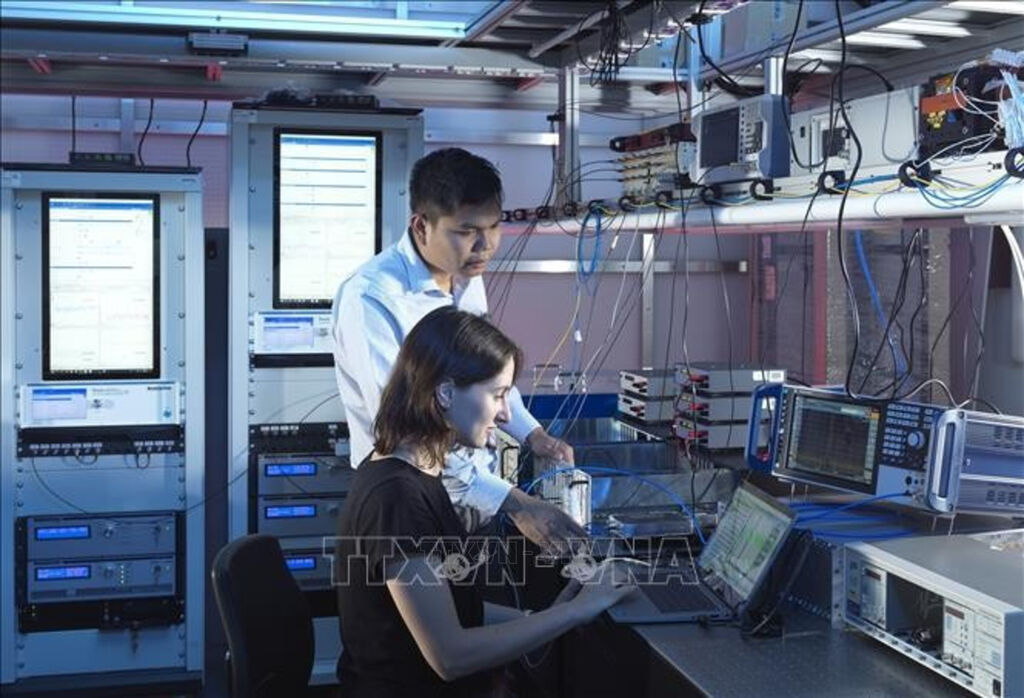
| Dr. Tran Dang Bao An with a colleague at the UK’s National Physical Laboratory. (Photo: VNA) |
Hanoi (VNA) – The inclusion of quantum technology in the Politburo’s Resolution No. 57-NQ/TW on breakthroughs in the development of science, technology, innovation and national digital transformation demonstrates Vietnam’s proactive vision in anticipating global trends, at a time when major economies such as the US, the European Union, the UK and China are investing heavily in this field, according to a UK-based Vietnamese expert in quantum technology.
In an interview with the Vietnam News Agency’s correspondent in the UK, Dr. Tran Dang Bao An, a senior researcher at the UK’s National Physical Laboratory (NPL), expressed confidence in the feasibility of Resolution 57 which carries profound significance and a high strategic vision, reflecting the Party and State’s strong political will and forward-looking mindset, creating new momentum for Vietnam’s socio-economic development in the period ahead.
According to him, quantum technology development is currently focused on three main pillars: quantum computing, quantum communication, and quantum sensing and metrology. Many countries are shifting from basic research toward practical applications and commercialisation, marked by increased public investment and the mobilisation of private capital. The researcher cited the US, the EU and the UK as examples, noting that they have all launched large-scale national quantum programmes and strategies with long-term horizons. Over the past five years alone, the EU has invested approximately 11 billion EUR (around 12.8 billion USD) in quantum research, while the UK aims to become a global quantum hub through its 10-year National Quantum Strategy.
For Vietnam, he assessed that participation in the global quantum race offers an opportunity not only to catch up with advanced countries, but also to create new value and establish a solid foundation for applying quantum technologies in areas such as cybersecurity, high-performance computing, advanced materials, biomedicine and sensing.
Beyond being a scientific breakthrough, quantum technology is expected to underpin national security and economic innovation in the coming decade. Therefore, he stressed that Vietnam should proactively pursue research and gradually deploy quantum technology in science, technology and daily life, particularly in cybersecurity and the digital economy.
Alongside these opportunities, An acknowledged that Vietnam faces significant challenges, as quantum technology requires substantial investment, involves high risks and is subject to intense global competition. Moreover, the country’s infrastructure and human resources in this field remain nascent, with a considerable gap compared to developed countries. He therefore recommended that Vietnam promptly formulate a national quantum technology programme with a clear vision and strategic roadmap.
Drawing on his research and professional experience in the UK, the expert proposed a comprehensive set of policy recommendations tailored to Vietnam’s development level and national resources. These include prioritising investment in key quantum laboratories toward establishing a National Quantum Research Centre; developing long-term human resources training programmes; building a supportive innovation ecosystem through regulatory sandboxes and targeted investment funds; and strengthening international cooperation with leading global research institutions.
He also emphasised the importance of focusing on selected strategic areas, such as quantum communication networks and quantum sensing, to enable early practical applications in secure communications, high-security banking and health care./.