 |
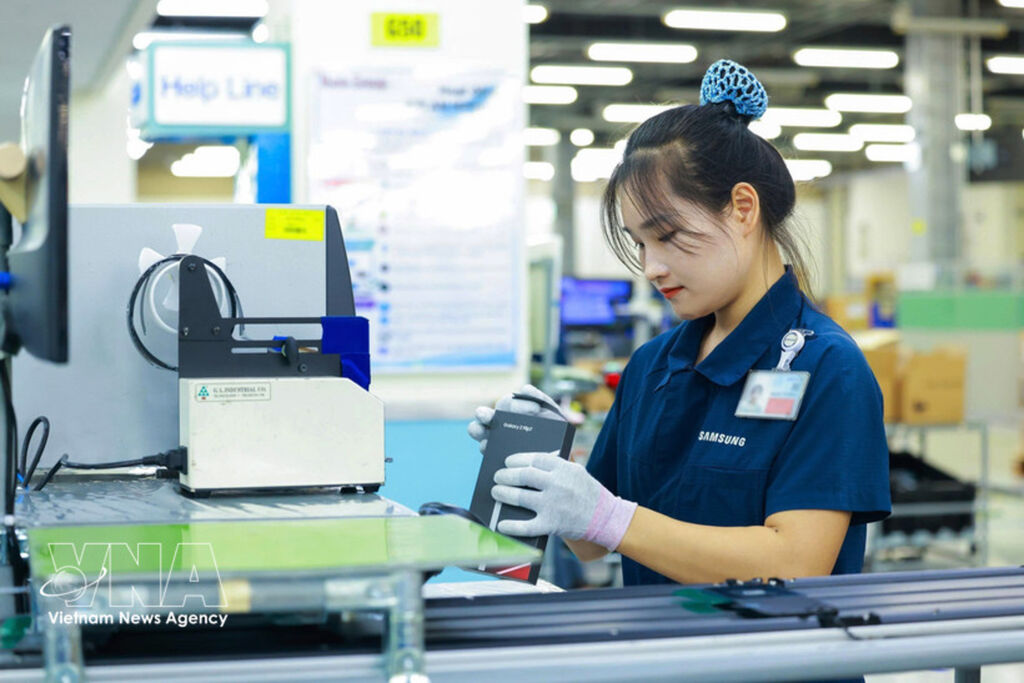
| A worker in the smartphone assembly line of Samsung Electronics Vietnam Thai Nguyen in the Yen Binh Industrial Park, Thai Nguyen province (Photo: VNA) |
Seoul (VNA) – Samsung is stepping up efforts to nurture high-quality technology talent in Vietnam as part of its long-term strategy to build a global workforce for artificial intelligence (AI) and semiconductor industries.
The strategy recently drew attention after Hoang Huong Giang, one of Vietnam's top performers in the 2026 national high school graduation examination, chose to pursue a degree in computer science at the Korea Advanced Institute of Science and Technology (KAIST) on a four-year Samsung scholarship.
Giang, a student at the High School for the Gifted under the Hanoi National University of Education, achieved a perfect SAT score of 1,600, an IELTS score of 8.0, and was among the country's top scorers in the A01 examination group, which combines Mathematics, Physics and English.
Experts say her case reflects Samsung's long-term strategy of identifying and developing promising young talent in key technology fields, such as AI, semiconductors, big data and the Internet of Things (IoT).
At the core of this strategy is the Samsung Innovation Campus (SIC) programme, launched in 2019 and now operating in about 40 countries. The initiative provides young people with training in AI, IoT, coding, big data and other digital technologies.
Vietnam has been identified as one of Samsung's key markets for developing high-tech human resources. In April, Samsung Vietnam launched the 2026 Samsung Innovation Campus programme in Bac Ninh in cooperation with the National Innovation Centre (NIC) and High Tech Vietnam.
For the first time, the programme includes semiconductor technology alongside courses on AI, IoT and big data.
Samsung plans to partner with about 20 universities and colleges to train more than 2,200 students this year, supporting Vietnam's goal of producing 50,000 semiconductor engineers by 2030. The company said it will offer training from basic to advanced levels while also preparing instructors to expand the programme's reach.
Samsung has also established technology training centres in Vietnam equipped with STEM laboratories, XR/VR practice rooms and semiconductor design simulation facilities.
In June, the company signed a cooperation agreement for 2026–2028 with the University of Engineering and Technology under the Vietnam National University, Hanoi, the Posts and Telecommunications Institute of Technology, and the Hanoi University of Science and Technology. The partnership covers training, research, scholarships, internships and recruitment.
Under the agreement, Samsung will provide scholarships worth about 17 billion VND (over 646,500 USD) for outstanding undergraduate and postgraduate students in information technology, AI, electronics, telecommunications, multimedia and cybersecurity. Since 2012, the company has invested around 180 billion VND in university partnership programmes in Vietnam.
Samsung is also expanding AI training programmes in other countries, while its Solve for Tomorrow initiative has attracted more than three million students in 68 countries./.