 |
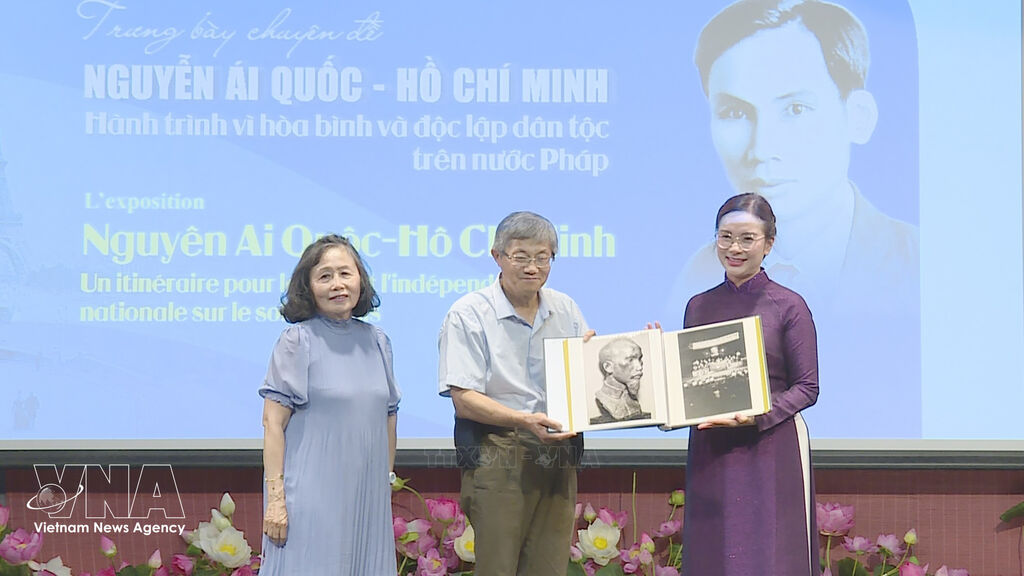
| Representatives of overseas Vietnamese families in France present the Ho Chi Minh Relic Site at the Presidential Palace with valuable archival documents and photographs of President Ho Chi Minh preserved in France. (Photo: VNA) |
Paris (VNA) – A series of cultural and academic events honouring President Ho Chi Minh took place in Paris on June 27 to mark the 115th anniversary of young patriot Nguyen Tat Thanh’s departure in search of a path to national salvation (June 5, 1911 – 2026) and the 80th anniversary of President Ho Chi Minh’s visit to France as a guest of honour of the French Government (1946–2026).
Co-organised by the President Ho Chi Minh Relic Site at Vietnam’s Presidential Palace, as well as the Embassy of Vietnam and the Vietnam cultural centre in France, the programme included the opening of a thematic exhibition, the launch of the bilingual Vietnamese–French photo book on Nguyen Ai Quoc – Ho Chi Minh and France, a ceremony to receive archival photographs donated by overseas Vietnamese families who welcomed the late Vietnamese leader during his 1946 visit to the European country, and an artistic performance dedicated to his life and legacy.
Speaking at the opening ceremony, Le Thi Phuong, Director of the President Ho Chi Minh Relic Site, stressed that France holds many significant milestones in his revolutionary journey. It was there that he identified the path towards national liberation and laid the foundations for Vietnam’s struggle for independence.
She said organising the programme in France not only helps introduce the great man’s life, career and thought more deeply to international audiences, but also strengthens national pride and reinforces ties between overseas Vietnamese communities and their homeland.
According to Phuong, the centrepiece of the programme was a thematic exhibition retracing, through images, the activities of Nguyen Ai Quoc – Ho Chi Minh in France, from his aspiration to find a way to liberate the nation, his advocacy for the rights of colonised peoples, efforts to pursue dialogue for peace in 1946, the Paris Peace Accords of 1973, and the enduring legacy of Ho Chi Minh in contemporary Vietnam–France relations.
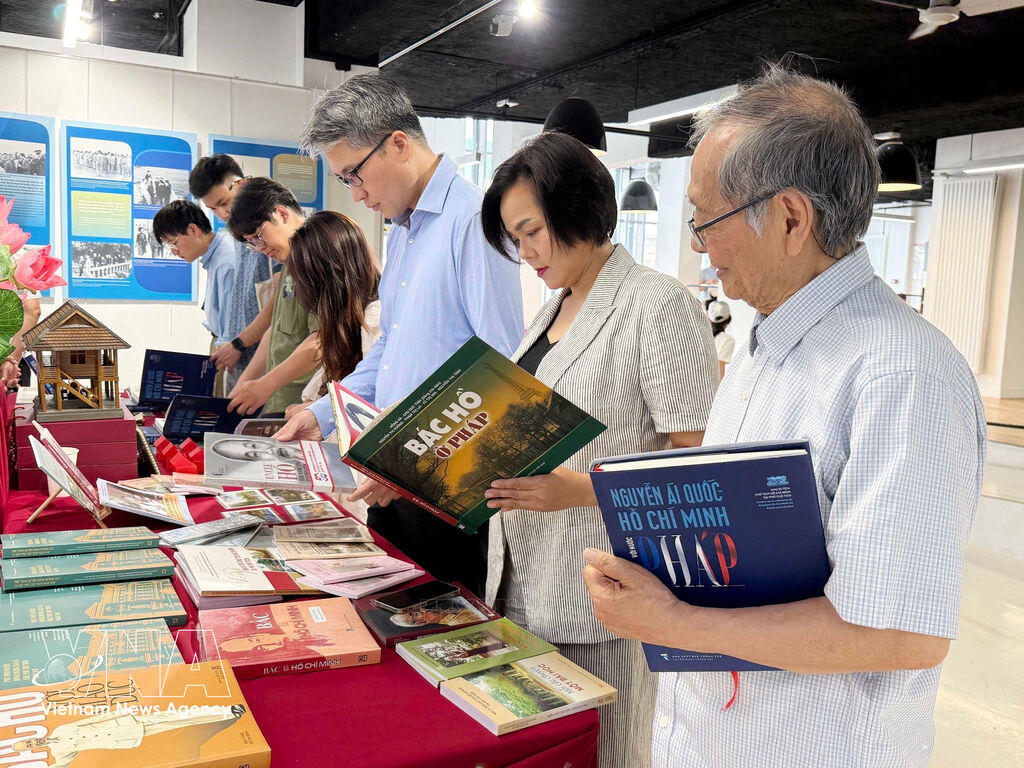 |
| Delegates visit the exhibition space showcasing books, archival materials and artefacts relating to President Ho Chi Minh as part of the programme. (Photo: VNA) |
Vietnamese Ambassador to France Trinh Duc Hai emphasised that President Ho Chi Minh’s life and career continue to symbolise patriotism, humanitarian values and aspirations for peace – principles that remain deeply relevant to Vietnam’s development today.
The diplomat also highlighted sites and memorials associated with him that continue to be preserved in France, including Montreau park in Montreuil, the Ho Chi Minh space at the Living History Museum, the commemorative plaque dedicated to him in Sainte-Adresse, and the memorial marker in the port city of Marseille.
According to Hai, these locations stand as vivid symbols of Vietnam–France friendship and reflect the respect held by French authorities and people for President Ho Chi Minh and the historical ties between the two nations.
Presented during the programme, the bilingual photo book published jointly by Vietnam News Agency Publishing House and the President Ho Chi Minh Relic Site brings together nearly 300 archival documents and photographs collected from archives, museums and libraries in Vietnam and France, alongside contributions from historical witnesses within the Vietnamese community in France.
The publication traces the activities of Nguyen Ai Quoc – Ho Chi Minh in chronological order while highlighting his role in laying the foundations for solidarity and friendship between the two countries.
As part of the programme, the Vietnamese relic site also received numerous archival photographs donated by the family of Dr Le Van Cuu and the family of photographer Le Tan Xuan.
The collection includes photographs of President Ho Chi Minh, images taken at the residence of Raymond Aubrac and his family, editions of L’Humanité featuring President Ho Chi Minh, and other materials relating to his 1946 visit to France and subsequent diplomatic exchanges between Vietnam and France.
Representatives of the vestige said the donated materials will be preserved, studied and further promoted through exhibitions, publications and educational activities./.