 |
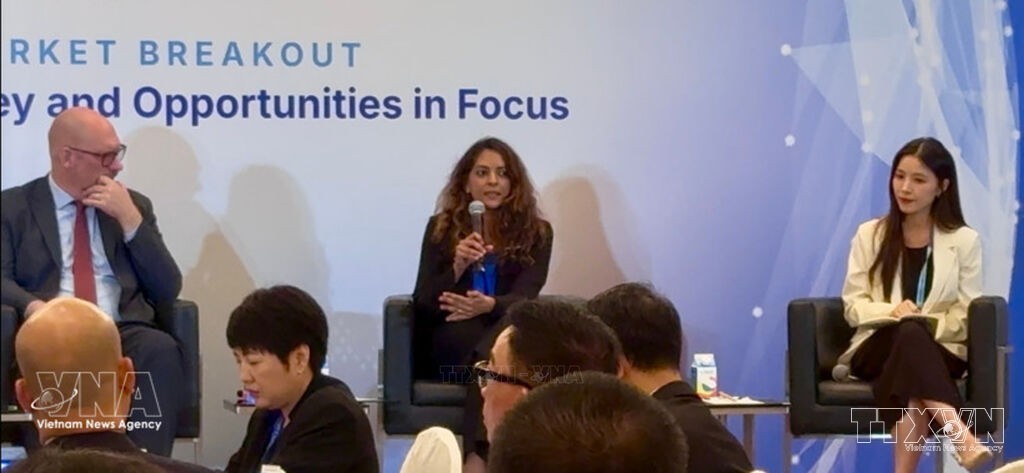
| Shanti Alexander (centre), Meta’s Director of Policy Programmes and Campaigns for Asia-Pacific and Thao Dao, Country Strategy & Operations Lead at Google at a seminar in Singapore (Photo: VNA) |
Hanoi (VNA) – Singapore’s experience in governance, institution-building and engagement with the global technology ecosystem offers valuable lessons for Vietnam as its digital economy and AI adoption expand rapidly, while opening new opportunities for bilateral cooperation in science, technology and AI.
In an interview with Vietnam News Agency correspondents in Singapore, Prof. Vu Minh Khuong of the National University of Singapore said a notable feature of Singapore’s approach was its ability to quickly adjust legislation and government structure to keep pace with technological development.
The renaming of the Ministry of Communications and Information to the Ministry of Digital Development and Information reflects the growing role of digital transformation in the country’s development strategy, he noted.
Singapore has also strengthened resources for agencies implementing digital transformation policies and launched initiatives to help tens of thousands of businesses integrate AI into their operations, while promoting AI training among civil servants.
At the same time, the country considers both the benefits and risks of new technologies, including AI misuse, misinformation, personal data breaches and technology-enabled scams. These challenges are addressed through legal frameworks combined with greater public awareness.
Khuong said Singapore places particular emphasis on digital literacy, helping citizens identify and respond to risks in the digital environment. It also seeks to ensure vulnerable groups, particularly older people with limited access to technology, are not left behind. Such an approach enables society to benefit more from technological advances while strengthening public trust in digital transformation, he said.
Singapore simultaneously focuses on policy, legislation, infrastructure and human resources to prepare for emerging technologies, with particular attention to developing AI engineers and specialists.
The country also actively links national initiatives with multinational technology ecosystems. Khuong said Singapore identifies major challenges requiring solutions and then involves capable businesses in developing them.
In areas such as AI, data centres and digital infrastructure, the Singaporean Government works with businesses to address investment needs and obstacles related to regulations, finance, land and energy, helping facilitate large-scale projects.
This enables Singapore to tap the technology, capital and long-term vision of leading global corporations to address strategic challenges, while creating jobs and enhancing national competitiveness. Khuong said another strength of the model was its focus on developing the broader innovation ecosystem, with new policies and regulations subject to extensive consultation with affected stakeholders.
Vietnam’s digital potential
Vietnam has favourable conditions for accelerating the adoption of new technologies. Thao Dao, Country Strategy & Operations Lead at Google, said studies over the past decade have shown that Vietnam continously ranks among the fastest-growing digital markets in Southeast Asia.
Vietnam’s digital economy currently has a gross merchandise value of about 39 billion USD, including 25 billion USD from e-commerce. Video commerce grows about 60% annually, while around 650,000 sellers and shops increasingly use digital platforms as their main channels to reach customers and markets.
Vietnamese people’s interest in and use of AI is also among the highest in the region, she said, showing that AI is becoming a widely used tool in business, education and daily life.
Shanti Alexander, Meta’s Director of Policy Programmes and Campaigns for Asia-Pacific, also highlighted Vietnam’s potential in digital technology and AI. Vietnamese businesses are among regional leaders in conversational commerce and the use of business messaging platforms to reach domestic and international customers.
According to a Meta study, about nine in 10 people and businesses surveyed in Vietnam believe AI can improve productivity, communication and business operations. Alexander also praised Vietnamese businesses for their entrepreneurial spirit and willingness to experiment with new technologies.
Experts said Singapore’s experience and Vietnam’s rapidly growing digital market create opportunities for greater bilateral cooperation in AI, the digital economy, human-resource training and innovation ecosystems.
Singapore’s experience in linking policies with business needs, mobilising technology corporations to address national challenges and ensuring vulnerable groups are not left behind could provide valuable lessons for Vietnam, they added./.