 |
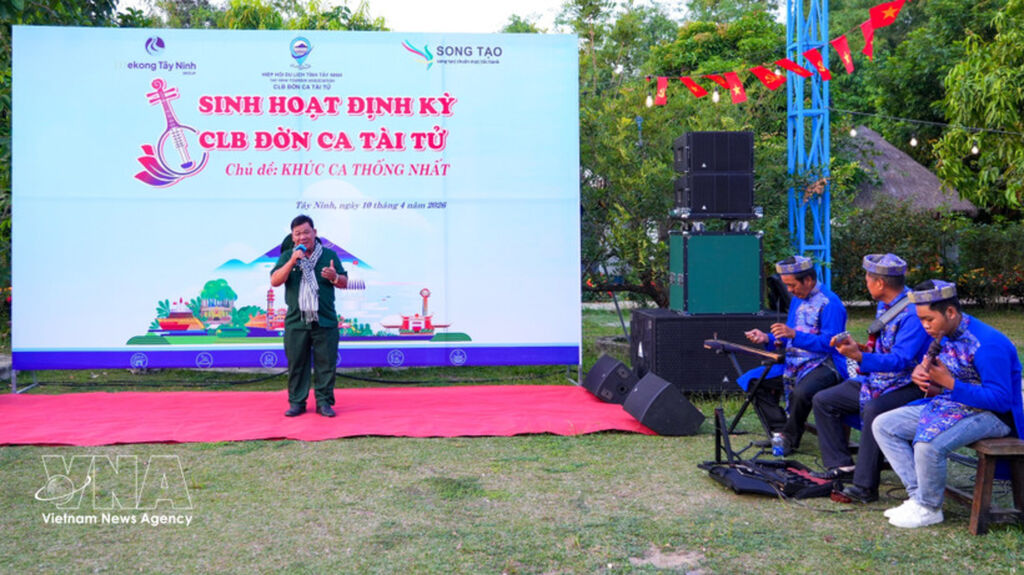
| Members of the Don ca tai tu Club under the Tay Ninh Tourism Association perform at a regular event of the club in Binh Minh ward, Tay Ninh province. (Photo: VNA) |
Tay Ninh (VNA) – Inscribed by UNESCO on the Representative List of the Intangible Cultural Heritage of Humanity, “Don ca tai tu” in southern Vietnam is not only a traditional art form but also a reflection of the region's cultural identity and spiritual life.
In Tay Ninh, efforts to preserve and promote this heritage are being reframed within a tourism-driven strategy, gradually positioning it as a hallmark of the southeastern region.
Linking heritage with tourism
Director of the provincial Department of Culture, Sports and Tourism Tran Anh Minh said Don Ca Tai Tu embodies generations of cultural transmission, blending the sounds of traditional instruments and vocal performance into a distinctive “symphony of rural life”.
Historically, Tay Ninh has played a role in the formation and development of the art since the late 19th century. Today, local clubs serve as key hubs for preservation, serving as “nuclei” in upholding this musical art.
Nguyen Thi Hoang Oanh, head of the Don ca tai tu Club under the Tay Ninh Tourism Association, shared that although established only in May 2025 with 16 members, the club has maintained monthly activities, providing a platform for exchange and sustaining passion among enthusiasts.
However, several challenges remain. Funding is limited, the pool of successors is thin, and formal training programmes are lacking.
Scriptwriter Do Thanh Phuong, a member of the Tay Ninh Literature and Arts Association with over 40 years of experience in this music, stressed the need for systematic investment, including the establishment of training centres, regular competitions, and platforms to discover and nurture young talent.
In reality, attracting younger generations is a major hurdle. Amid the rapid rise of modern music, Don ca tai tu risks being overshadowed.
Le Cong Thuan, a club member, noted that the art form requires a high level of technical mastery – from rhythm and breathing techniques to vocal training, making it less accessible to younger audiences without proper guidance and support.
Expanding value through tourism
As Tay Ninh identifies tourism as a crucial economic pillar, integrating Don ca tai tu into tourism offerings is seen as a strategic move.
Tourists from Ho Chi Minh City and localities in the Mekong Delta enjoy Don ca tai tu in Binh Minh ward, Tay Ninh province. (Photo: VNA)
For visitors, experiencing the art in its cultural setting enriches travel experiences beyond sightseeing. This aligns with the growing demand for experiential tourism, where visitors seek deeper cultural engagement.
However, for Don ca tai tu to become a signature tourism product, activities need to be more professionally organised and better linked with key destinations.
Duong Van Thua, Vice Chairman of the Tay Ninh Tourism Association, stated that cultural tourism will be central to the province’s development strategy, with Don ca tai tu at its core. Efforts are underway to incorporate the art into gala events and experiential tours.
Businesses are also stepping up engagement. They are working with local associations and clubs to promote the art through tourism products and media platforms, helping to both preserve the heritage and enhance visitor experiences.
Vice Chairman of the People's Committee of Binh Minh ward Nguyen Thanh Nghi highlighted the importance of cultural preservation to strengthening community cohesion and identity, adding Don ca tai tu plays a special role in connecting communities, creating spaces for interaction, and maintaining the local cultural beauty.
Aside from assets such as the Ba Den Mountain national tourist area, Tay Ninh aims to elevate this folk music genre into a distinctive cultural tourism offering.
Thanks to coordinated efforts by authorities, businesses, and communities, Tay Ninh is laying the groundwork to unlock the full potential of Don ca tai tu. Properly invested and promoted, the art is expected to not only endure within community life but also emerge as a defining tourism product, contributing to sustainable socio-economic development and reinforcing the province’s cultural identity./.