Top leader heads to China for state visit
This is the first state visit to China by General Secretary and President Lam in his capacity as the Party and State’s top leader.
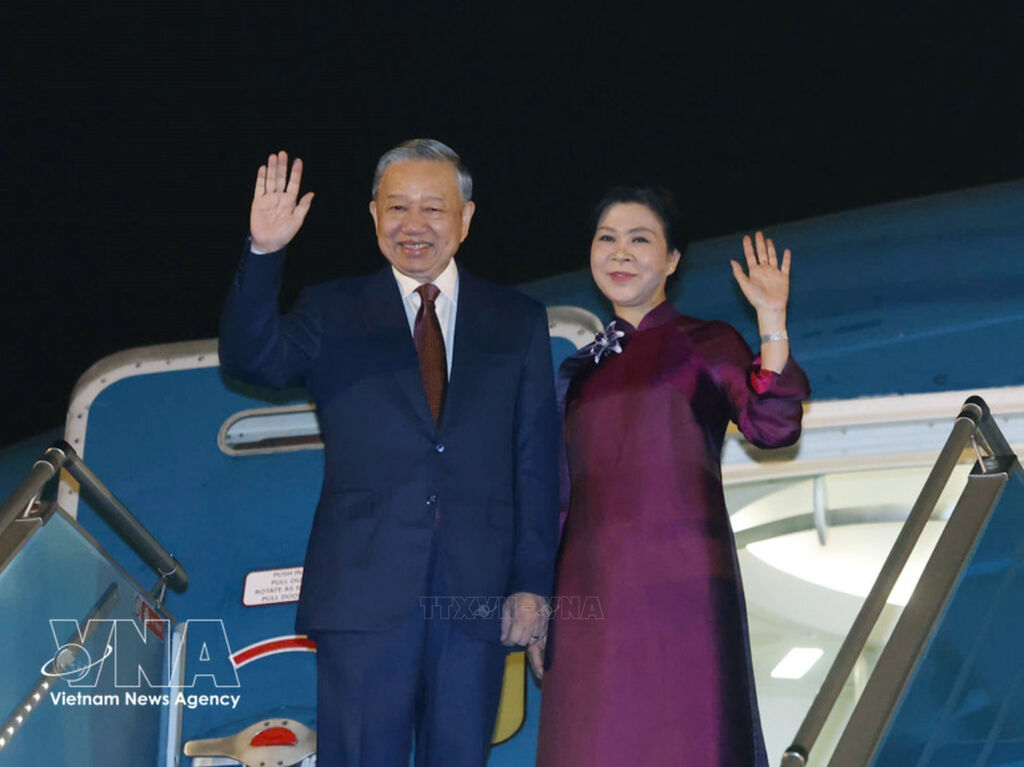
General Secretary of the Communist Party of Vietnam (CPV) Central Committee and State President To Lam and his spouse Ngo Phuong Ly leave Hanoi for a state visit to China (Photo: VNA)

Hanoi (VNA) – General Secretary of the Communist Party of Vietnam (CPV) Central Committee and State President To Lam, accompanied by his spouse Ngo Phuong Ly and a high-ranking Vietnamese delegation, departed Hanoi on April 14 for a four-day state visit to China.

The visit is made at the invitation of General Secretary of the Communist Party of China Central Committee and President of China Xi Jinping and his spouse.

The delegation comprises Politburo members: Tran Cam Tu, Permanent member of the CPV Central Committee’s Secretariat; Bui Thi Minh Hoai, Secretary of the CPV Central Committee and President of the Vietnam Fatherland Front Central Committee; Nguyen Duy Ngoc, Secretary of the CPV Central Committee and head of its Organisation Commission; Gen. Phan Van Giang, Deputy Prime Minister and Minister of National Defence; Gen. Luong Tam Quang, Minister of Public Security; Nguyen Thanh Nghi, Secretary of the CPV Central Committee, head of its Commission for Policies and Strategies; Le Hoai Trung, Minister of Foreign Affairs; Doan Minh Huan, President of the Ho Chi Minh National Academy of Politics; and Tran Duc Thang, Secretary of the Hanoi Party Committee; along with other ministers and senior officials.

This is the first state visit to China by General Secretary and President Lam in his capacity as the Party and State’s top leader. It comes one year after General Secretary and President Xi’s state visit to Vietnam in April 2025 and represents the third bilateral visit between the two countries’ top leaders in less than two years./.
See Also

Party conference spotlights key reforms in inspection, disciplinary work

Resolution 05 introduces a number of breakthrough viewpoints, positioning inspection and supervision as one of the Party’s most critical leadership functions. It is defined as a mechanism for self-correction and self-improvement, a key tool to control power and uphold Party discipline and order, ensuring that the Party’s guidelines are implemented rigorously and effectively in practice.

New regulation on political, ideological work in Party highlighted at national conference

The regulation, adopted at the second plenum of the 14th Party Central Committee and issued as Regulation No. 19-QD/TW on April 8, 2026, marks the first comprehensive and systematic framework governing political and ideological work in the Party. It reflects a new step in theoretical mindset and strong political resolve to enhance Party building as well as the Party's leadership and combat capacity.

Institutional bottlenecks must be fully resolved in 2026: PM

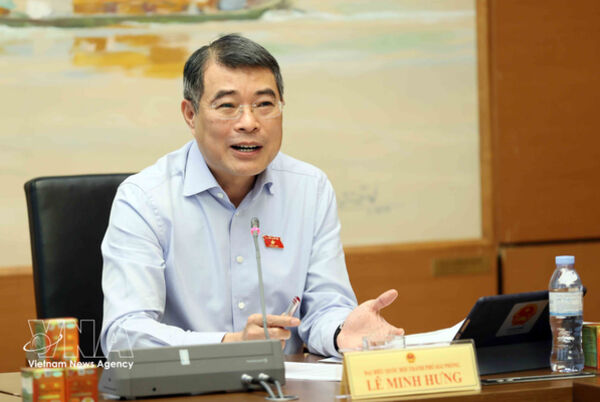
Prime Minister Le Minh Hung outlined three strategic breakthroughs, with institutional reform identified as the top priority. He likened institutions to “roads” for the economy, stressing that synchronised and improved regulations will accelerate development.

Vietnam eyes silver economy to fuel growth amid rapid aging

In the global development landscape, the “silver economy” is no longer an unfamiliar concept but an inevitable trend. For Vietnam, building an economic ecosystem that adapts to rapid population ageing is not only a social welfare solution but also a gateway to a new, sustainable and humane growth model.

Aviation sector ensures fuel supply for April 30–May 1 peak

Aviation fuel suppliers are actively negotiating and diversifying supply sources both domestically and internationally, while strengthening coordination, storage and distribution capacity to meet immediate demand. These efforts aim to support airlines in optimising operations and maintaining stable flight schedules.

State President’s amnesty decision in 2026 announced

In 2025 alone, more than 22,000 inmates were granted early release, while political security and social order remained firmly maintained. Most beneficiaries have successfully reintegrated into society, earning public support and international recognition.